





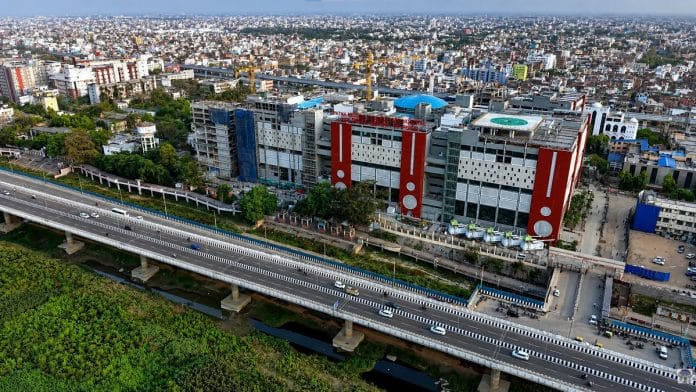


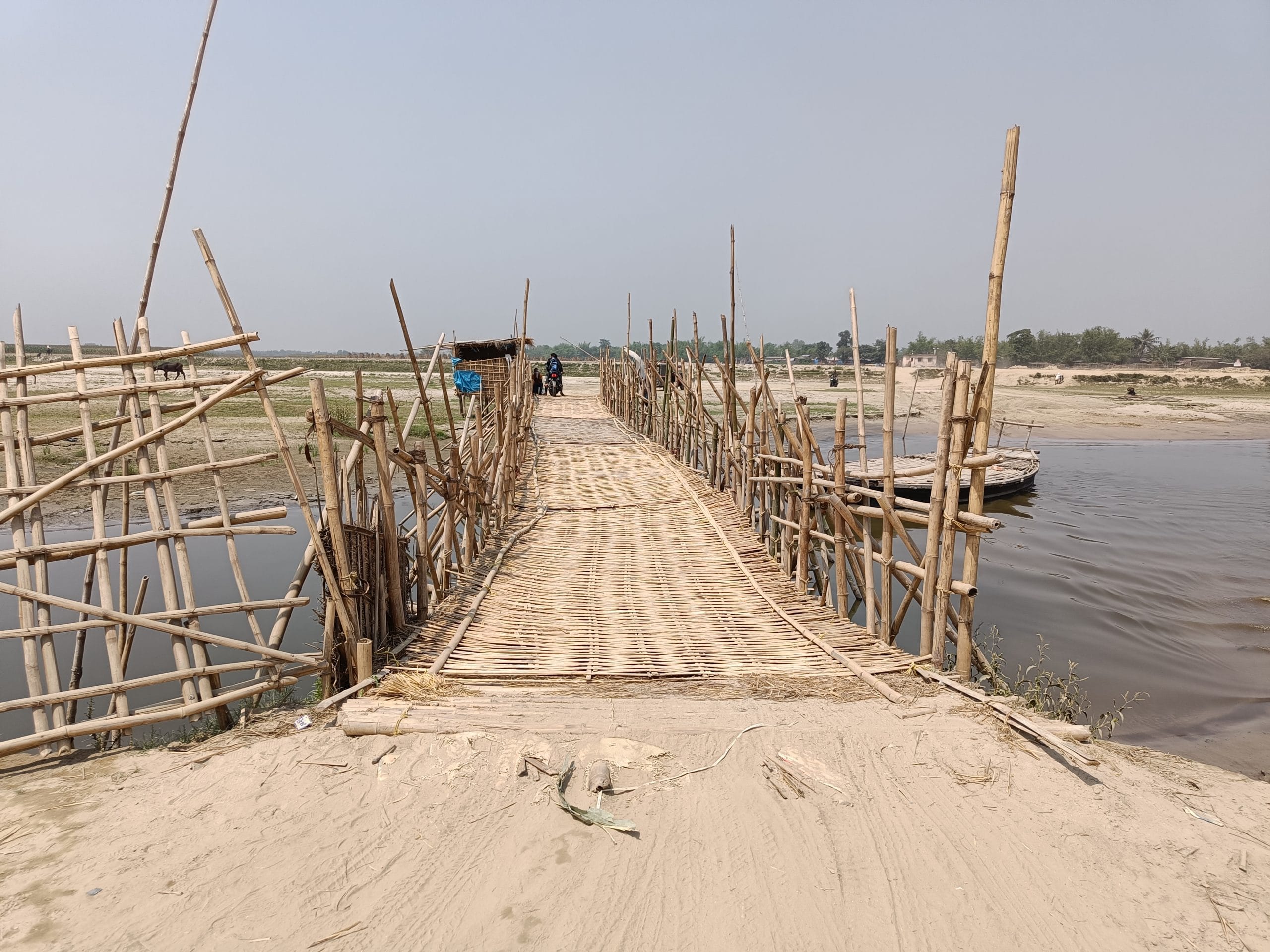
Darbhanga: For decades, Bihar has practiced a sole script for progress: migrate, study, earn, and settle in a comfortable metro life. So, when a land dispute forced 45-year-old Dhirendra Kumar to return to his hometown in Darbhanga, he could do without the cushion of his urban life. He converted his mud house into a concrete structure with a balcony, modern interiors and other amenities associated with urban living. And he is not alone. Bihar is importing “urbansisation” house by house—without creating new cities of growth.
“Living in the old setup was not possible for me after spending 20 years in the city. For me, transformation is more about importing a city lifestyle,” said Kumar.
Across Bihar, thousands of families like Kumar’s view urbanisation through the prism of construction. Despite the construction boom fuelled largely by remittances, only 11 per cent of the state’s population lives in urban areas, far below the national average of 31 per cent. Since Independence, the state has struggled to build economically vibrant cities. Its economy and social structure have remained deeply rooted in agriculture, while migration became an economic safety valve. Unlike states such as Maharashtra, Gujarat and Tamil Nadu, Bihar never developed a strong industrial base. The creation of Jharkhand in 2000 further weakened its industrial profile, as most of its mineral resources, mines and heavy industries went to the new state. Now, the urgency to create new growth centres is finally catching up with the political establishment.
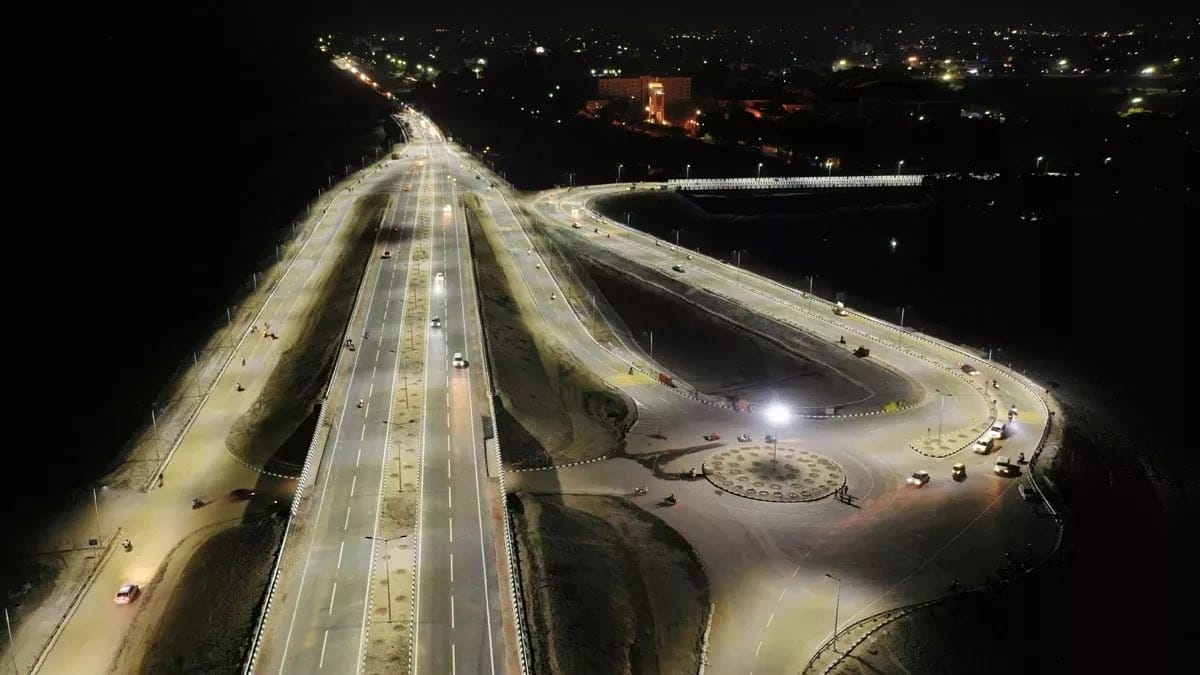
Weeks after Nitish Kumar stepped down as the chief minister, his successor Samrat Choudhary unveiled plans for 11 satellite townships across the state. The proposal marks a significant policy shift, an acknowledgement that Bihar cannot rely indefinitely on villages, migration and remittances to drive growth. The ambitious project is by a $500 million World Bank loan approved by the state cabinet.
Poor infrastructure and law and order problem kept the private capital away from Bihar. As a result, cities such as Patna, Darbhanga, Muzaffarpur and Gaya expanded far more slowly than urban centres elsewhere in India. The weak urban growth has also come on the back of the government’s rural focussed policy that prioritised – sadak, Bijli, paani.
“In terms of infrastructure, imagining Bihar prior to 2005 is a frightening prospect. Afterwards, efforts have focused on delivering basic necessities and policies have centered around it. Nitish Kumar’s policies have been rural-driven, in a sense on Gandhian lines. So much time was consumed in fulfilling basic needs that urbanisation was left behind,” said Anjani Kumar Singh, who served as the chief secretary of Bihar when Nitish Kumar was the chief minister.
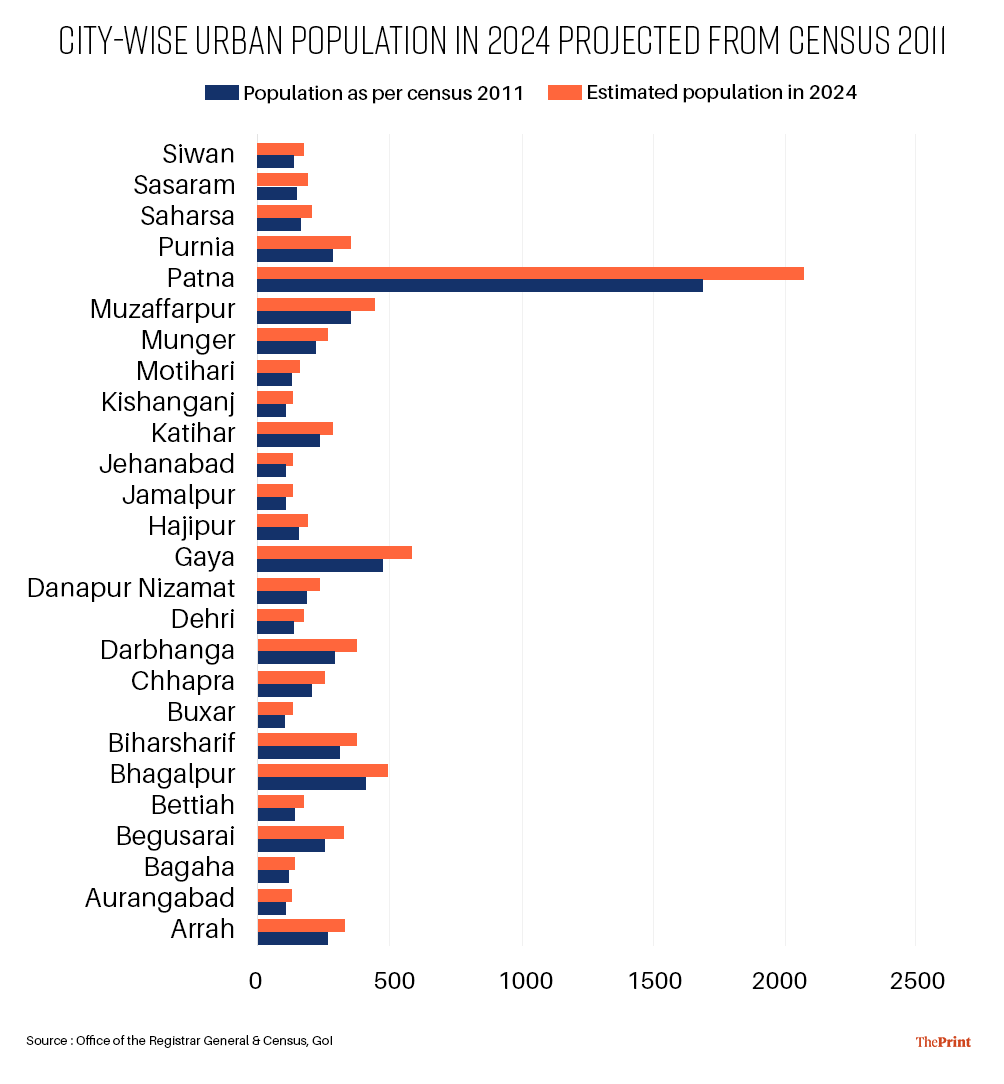
Data accessed by ThePrint from the state’s Urban Development and Housing Department shows Patna remains the state’s dominant urban centre with a population of 20.61 lakh, while Gaya (4.74 lakh), Bhagalpur (4.12 lakh) and Muzaffarpur (3.54 lakh) trail far behind. Yet none of these cities have emerged as the kind of economic engines that transformed states such as Gujarat, Maharashtra or Tamil Nadu.
Also read: Lal Dora villages are a parallel city in Delhi. No one wants to fix this dirty secret
The new satellite towns
Inside Bihar’s Urban Development Department in Patna, the satellite township project has become a central focus, two weeks after the announcement was made. Soon after taking charge in May, Urban Development Minister Nitish Mishra emphasised the need for a systematic and long-term approach to urban growth.
“Cities reflect the governance and development of a state,” said Mishra who represents Jhanjharpur constituency in Madhubani.
The government is currently in the process of appointing consultants to prepare detailed town-planning schemes for the proposed townships. A senior official from the urban development department, part of the meetings on satellite townships, said discussions within the department increasingly revolve around how these satellite cities can reshape Bihar’s urban future. The state government has a separate plan for all these townships such as airports, industrial parks, film cities, said the official.
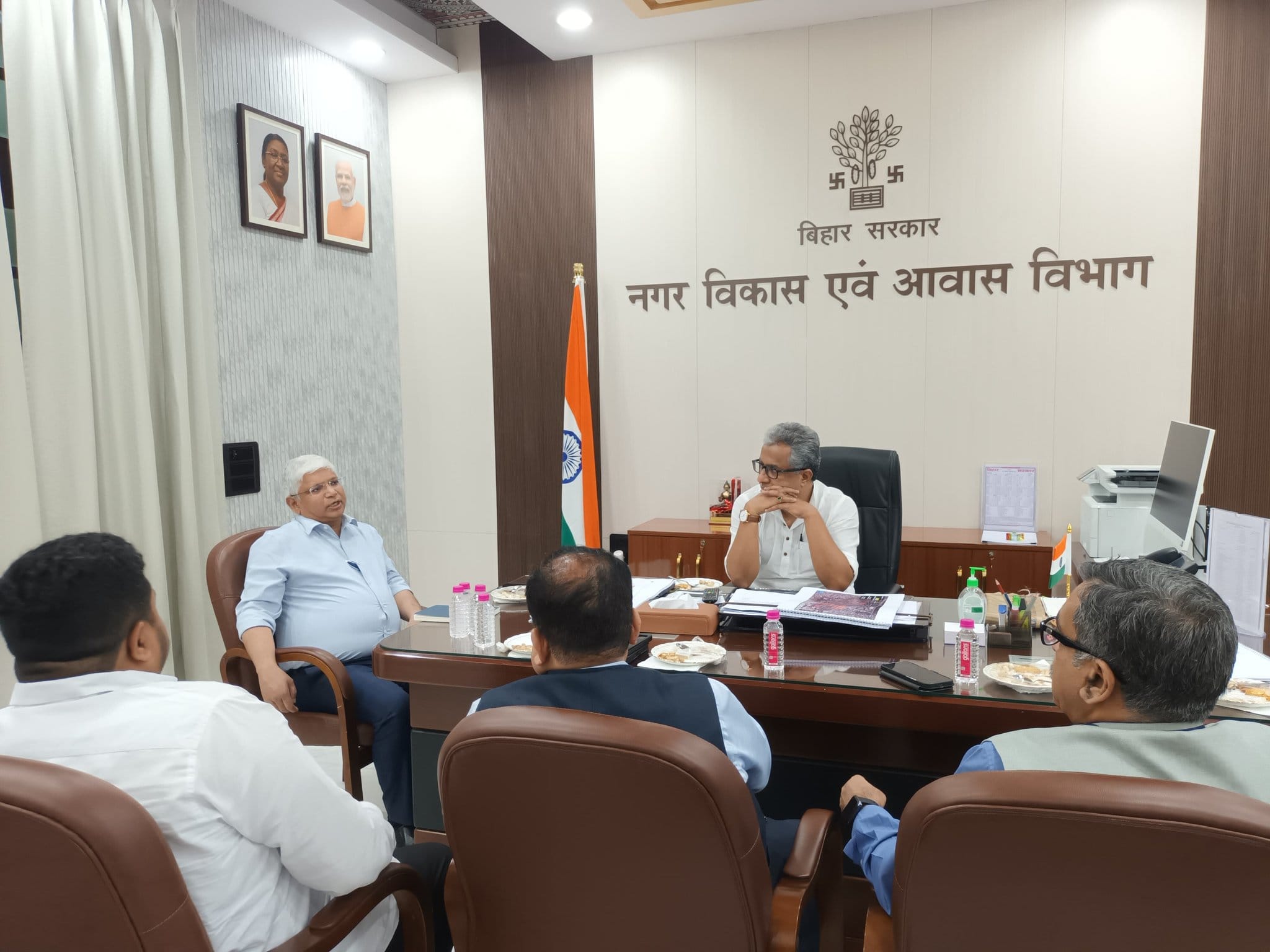
After a round of meetings, principal secretary of Urban Development department held a press conference in May.
“Around these townships, airports, industrial parks, film cities have envisioned that will anchor the growth of that area. The development will be planned and systematically, so that townships will be economically viable and employment will be generated and the local economy is boosted,” said Vinay Kumar.
The names chosen for the townships evoke Bihar’s ancient past. Mithila will rise in Darbhanga, Magadh in Gaya, Patliputra in Patna, Vikramshila in Bhagalpur, Koshi in Saharsa, Sitapuram in Sitamarhi and Anga in Munger.
In Darbhanga, property dealer Rajan Jha has been closely following the developments. For the past six years, he has worked in the city’s real estate sector and has witnessed the growth of several private townships.
“The idea behind the government project is to create urban infrastructure. In Darbhanga, private players have been doing this for nearly a decade. The government should do more than housing projects and focus on industrial development that will create jobs and revenue,” said Jha.
His observation reflects a larger skepticism surrounding the township project. While better roads, housing and civic amenities are welcome, urbanisation without employment generation will not fundamentally transform Bihar’s economy.
The Modi government told Rajya Sabha in 2023 that 7.06 lakh workers migrated from Bihar for work and employment in 2020-21.
According to a 2019 paper titled Multi-dimensional Poverty and Migration – A case Study of Darbhanga, the District is one of the highest migrating districts in Bihar with around 6 per cent male out-migration.
Around 17,400 acres have been identified as a special area and another 1,600 acres as a core area for development, according to the proposed plan.
In Darbhanga, 102 villages spread across the blocks such as Bahadurpur and Keotiranway have been brought under the proposed township area. The nucleus of the planned city is expected to emerge around the Darbhanga Airport and the upcoming AIIMS Darbhanga.
Also read: Flip-flop economy: The costs of policy U-turns in Indian states, from Maharashtra to Delhi to Andhra
‘Who will live in these townships’
For villagers living in these areas, the transformation promises both opportunity and disruption.
57-year-old Ashutosh Mishra, resident of Darbhanga tried to sell his ancestral land for his daughter’s marriage last month. He did not know about that the government freeze the land for sale.
“I have no issues that government is planning to build township on our land. But this can’t suffer people on the ground. I need money for my daughter’s marriage, but at the last moment got to know that I can’t sale it for next one years,” said Mishra.
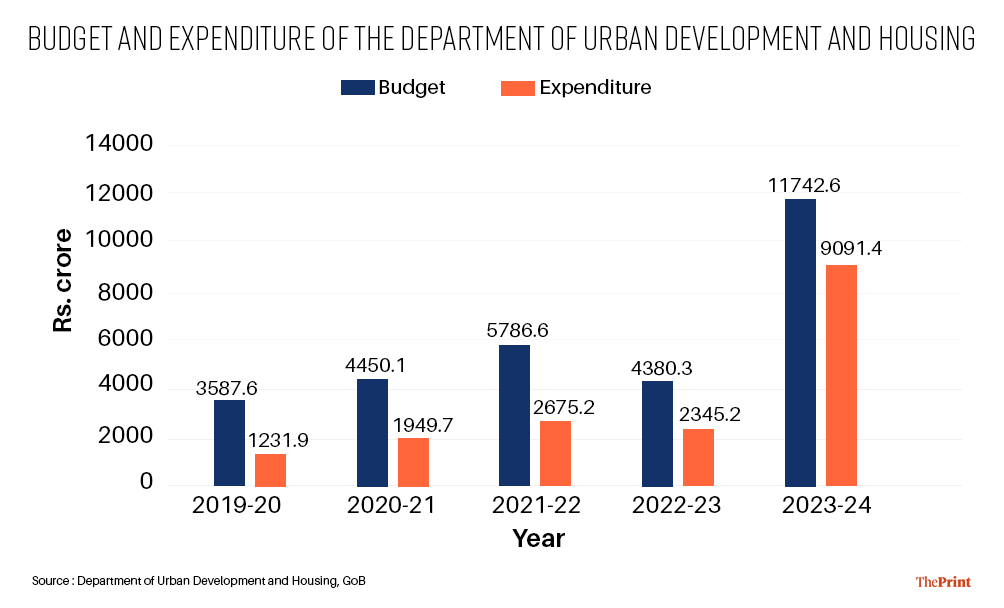
According to the state economic survey, Bihar government has increased its urban development ministry budget by 227 per cent, rising from Rs 3,587.6 crore in 2019-20 to Rs 11,742.6 crore in 2023-24. However, much of the budget went unspent even as the percentage of expenditure has shown improvement, increasing from 34.3 per cent in 2019-20 to 77.4 per cent in 2023-24.
Some urban planners and economists, however, are not enthusiastic about the township project.
“The biggest question is who will live in these townships. Will they be economically viable to stop the people from migrating? There has to be a driving force to push people to these townships,” said Sheema Fatima, urban planner and architect at School of Architecture at NMIMS, Mumbai who studied urban growth in Patna. She said that urban governance has never been a priority for the state government.
Fatima said India has a long history of building townships such as Raurkela, Bhilai and Jamshedpur and the cities expanded due to big industries. Who will live in the city in Saharsa and Munger, one of the least economical activities area, she asked.
In the last few years, agro-based and food processing industries have come up in Darbhanga, particularly makhana processing. Still, they are far and few.
“It (the project) will end up making money through increasing the price of land,” alleged Fatima, adding that construction is the biggest industry in the state.
For scholars and urban planners, for decades, Bihar’s urbanisation has been the field of their studies.
“Urban planning in Bihar is at an infant stage. It is ironical that at present only the capital city of Patna has a master plan for the city and that too is unsound, could not stop the unplanned growth of city,” reads a paper by urban consultant Manoj Kumar Pandey titled Bihar, in a state of messy urbanisation – way forward.
Also read: India’s housing boom, bust and buyer revolt gave birth to RERA. Where is it after 10 years?
Failed attempts
Long before Bihar began drawing up plans for new satellite townships, it had already started expanding its urban map – one government notification at a time. No new cities, factories or economic hubs. Just a change in law.
In 2020, the Nitish Kumar government amended the Bihar Municipal Act, easing the criteria used to classify settlements as urban areas. The revised law lowered the threshold for non-agricultural workers required for an area to qualify as urban, triggering one of the largest expansions of urban local bodies in the state’s history.
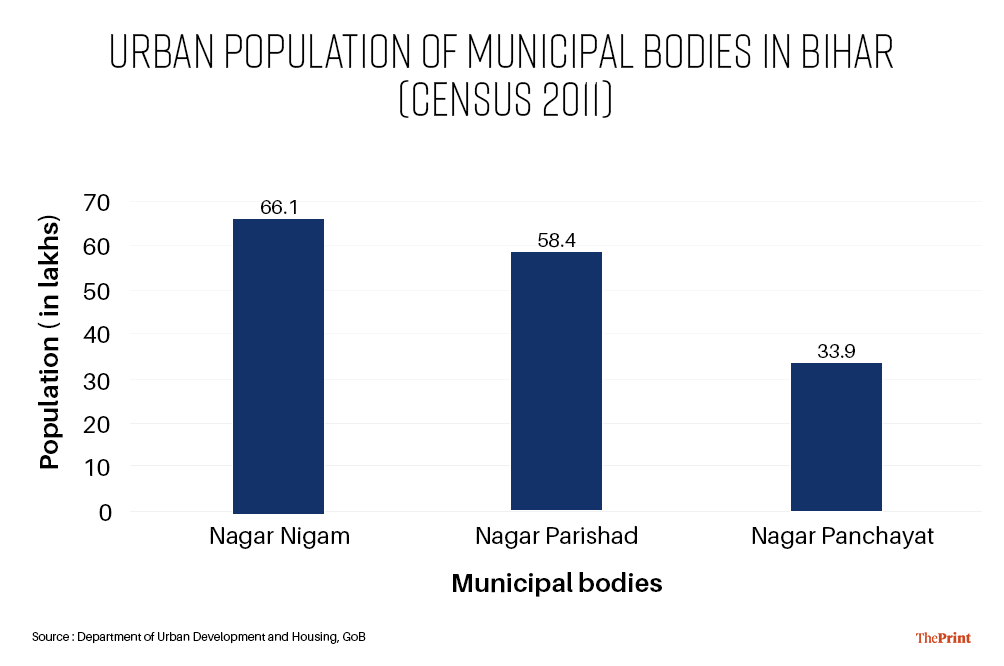
Overnight, Bihar’s urban administration expanded from 142 Urban Local Bodies (ULBs) to 261, bringing dozens of villages and semi-rural settlements under the categories of Municipal Corporations, Nagar Parishads and Nagar Panchayats.
On paper, Bihar became significantly more urban. On the ground, however, the transformation has been far less dramatic. Many of the newly notified urban local bodies still lack basic ingredients associated with city life – a master plan, an independent revenue base, industrial activity or meaningful employment opportunities.
The gap between designation and reality is visible in Bangaon, one of the largest villages in Saharsa district with a population of nearly 30,000. In 2023, it was officially notified as a Nagar Panchayat.
At the entrance of Bangaon stands a green welcome board proclaiming, “Nagar Panchayat Bangaon mein aapka hardik swagat hai.” Flanking the message are images of Mahatma Gandhi and illustrations of modern urban life.
Yet beyond the signboard, much remains unchanged.
Kamal Mishra, a resident of Bangaon, said the most visible difference since the area became a Nagar Panchayat is the arrival of a garbage collector at his doorstep every morning.
“No other major change has happened. Bangaon is not producing any revenue and there are no job opportunities here,” said Mishra.
His assessment captures a larger challenge confronting Bihar’s urbanisation drive.
“Administrative reclassification may create urban bodies, but it does not automatically create urban economies. Providing a means of livelihood is crucial. Merely providing electricity and roads will not turn villages into cities,” said DM Diwakar, former director of AN Sinha Institute of Social Sciences in Patna and ex-member of Planning Commission.
More than a decade ago, Bihar briefly appeared ready to have a serious conversation about urbanisation. Around 2010, the Urban Development Department and the A.N. Sinha Institute of Social Studies began working on a project to chart the state’s urban future. The project was halted.
“There has never been any political will regarding urbanisation, which is why the face of Bihar has not changed,” said Diwakar.
Instead, Bihar’s development story took a different route.
In 2015, Chief Minister Nitish Kumar launched the ambitious Saat Nischay Yojana, a programme designed to address the state’s most basic deficits. The focus was not on building new cities but on bringing essential amenities to villages and small towns – roads, electricity, piped drinking water, drainage networks and other civic infrastructure that much of the state had long lacked.
“With more than half of the workforce still dependent on agriculture, the state’s challenge is not merely to build new towns but to create the economic opportunities that allow workers to move beyond the farm. The government has to push its workforce into the non-farm sector, then urbanisation will happen,” said Aviral Pandey, professor at the Department of Economics, Patna University.
Also read: 15 years of UPSC CSAT — protests, U-turns & now a new parliamentary panel
Lost decades
The story of how Bihar missed the urban century stretches back decades. In the decades after Independence, undivided Bihar occupied an important place in India’s economy. Rich mineral deposits, industrial centres and fertile agricultural land gave it considerable economic weight.
A 2024 working paper by the Prime Minister’s Economic Advisory Council (PM-EAC) shows that in the early 1960s, undivided Bihar accounted for 7.8 per cent of India’s GDP—the fifth-highest share among Indian states, ahead of Gujarat and Karnataka.
“Bihar’s relative position has stabilized in the last two decades, it remains significantly behind other states and requires much faster growth to catch up,” reads the paper.
From the 1960s onwards, a combination of policy failures, weak industrialisation, political unwillingness and poor urban planning gradually slowed Bihar’s transformation. As Maharashtra, Gujarat, Tamil Nadu and Karnataka expanded their industrial base and built thriving cities, Bihar remained tied to an agrarian economy.
Many economists trace the roots of this trajectory much further back.
“Largely due to colonial-era policies, Bihar emerged as an agrarian-driven state, one where the Zamindari system was deeply entrenched,” said Aviral Pandey, professor at the Department of Economics, Patna University.
Others point to post-Independence economic policies that weakened Bihar’s natural advantages.
“First, the Freight Equalisation Policy nullified Bihar’s geographical advantage despite its mineral wealth. Second, GST made Bihar more of a consumer state than a producer state,” said economist Diwakar.
This policy subsidised the transport of key industrial resources, so they cost the same anywhere in the country. It led to industrial stagnation in mineral-rich eastern states as industries established their plants near ports and buy the resources from mineral-rich areas on subsidised rates.
“For decades Bihar lived on the royalty of South Bihar. We were working in a planned economy and had limited resources in the 1990s. For the politicians of the state, urbanisation is not in their list of priorities,” said Shankar Prasad, 1973 batch retired IAS officer and former secretary planning, Bihar.
Prasad said the old towns of the state didn’t survive and failed.
“The government should look into their reasons. With the announcement of new townships, the symbolism must be backed by actual performance,” said Prasad.
Also read: The cult of Khan Sir and Patna’s coaching war
Economic imbalance
The biggest blow came in 2000. With the creation of Jharkhand, Bihar lost most of its mineral wealth, mining belts and heavy industries. The division redrew not just political boundaries but also the economic map of eastern India.
“When the state was bifurcated, its mineral-rich regions were transferred to the sparsely populated state of Jharkhand, leaving the densely populated remaining territory with virtually no resources,” said Pandey.
The contrast is stark. Many of undivided Bihar’s major industrial cities – Jamshedpur, Bokaro and Dhanbad became part of Jharkhand. While those cities continued to generate substantial industrial revenue, Bihar was left with a handful of declining industrial centres struggling to reinvent themselves.
Urban planner Fatima recalls how industrialisation once transformed places such as Barauni.
“When the Barauni refinery started in 1965 with Russian collaboration, it changed the region. Good schools, colleges and jobs came up around it,” she said.
But the benefits remained localised. “The industry had little spillover effect beyond a specific area,” she added.
The result is an urban landscape dominated by a single city. Bihar exhibits a high degree of urban primacy, where Patna overwhelmingly dominates the state’s economic, administrative and institutional life. Government offices, universities, hospitals, businesses and service-sector jobs are concentrated in the capital, while secondary cities struggle to emerge as independent growth centres.
In a paper titled Urban Primacy: The Context of Bihar, India, Lakshya Gupta of the School of Planning and Architecture argues that such concentration creates regional imbalance, strains urban services and fuels migration towards a handful of urban centres.
“Patna is the hub for government services, education, healthcare, and commerce. Major industries and service sectors are concentrated in Patna, while other cities remain underdeveloped,” reads the paper.
The imbalance is reflected in everyday statistics.
Patna’s per capita income has crossed Rs 2.2 lakh annually. In Sheohar, one of Bihar’s most rural districts, it remains around Rs 34,000. The gap is not merely numerical, it reflects two very different worlds. One is connected to institutions, markets and services, the other remains dependent on agriculture, remittances and seasonal migration.
In recent years, Bihar has managed to attract some new industrial investments. Factories and manufacturing units have begun appearing in select pockets. Under Nitish Kumar’s tenure, investor summits and industrial promotion initiatives sought to attract private capital. Yet investors remain hesitant to venture far beyond the Patna region, reinforcing the state’s pattern of concentrated growth.
For scholars and planners, the challenge is no longer simply about increasing the number of urban residents. It is about creating a network of cities capable of generating jobs and economic activity across regions.
“There is a need to adopt a theme-based approach to urbanisation, thereby ensuring that its growth proceeds in a structured and thematic manner,” said Pandey.
He said urbanisation has now become a necessity and a demand of the times.
“Bihar must now decide whether to pursue urbanisation alongside manufacturing or without it,” he said.
Sitting with friends over burgers at the Maurya Lok shopping complex in the heart of Patna, Rajeev Yadav, 22, reflected on the difference between the state capital and other big cities.
“Yet even here, the city largely winds down much earlier than in India’s major metros. There is a missing night-life culture in Bihar. Some changes took place but the pace is very slow. Bihar cities still go to sleep long before the night truly begins,” said Yadav.
(Edited by Anurag Chaubey)
Poor socialist Bihar has no money to build new cities. It can afford only freebies, subsidies, reservations, loan waivers, and corruption.