







While visiting Noida for a news debate on the Real Estate (Regulation and Development) Authority Bill, Rajya Sabha Select Committee chairman Anil Madhav Dave remembered an uncanny experience.
In a Rajya Sabha speech, he recalled: “I saw people inside a folding tent screaming on top of their voices, ‘Buy this plot.’ I asked the mediapersons what these people were selling. Because in my head, the imagery that popped up was that of ‘puri-sabzi’ vendors stationed outside the bus stops of Bhopal or Indore. To my surprise, they were selling flats.” (translated from Hindi).
Such was the frenzy that, in cities like Noida, flats priced between Rs 50 lakh and Rs 1 crore were being sold like vegetables in a “sabzi mandi” (vegetable market).
It was a heady period, one of irrational exuberance around the real estate boom in India.
It soon became unsustainable.
The global financial crisis of 2008 arrived as a harbinger of doom. The bubble bust. People lost jobs as liquidity dried up overnight, credit became scarce, demand fell, projects stalled and unsold inventory piled up.
Many developers, however, continued to focus on ultra-luxury projects, even as affordable housing slipped further out of reach for millions. Soon, slowdown materialised into stagnation. Developers struggled to stay afloat, bankruptcies mounted and lawsuits followed. The result was a dark, unruly era of Indian real estate, characterised by lack of trust, a buyer-less market and scores of half-finished ghost homes.
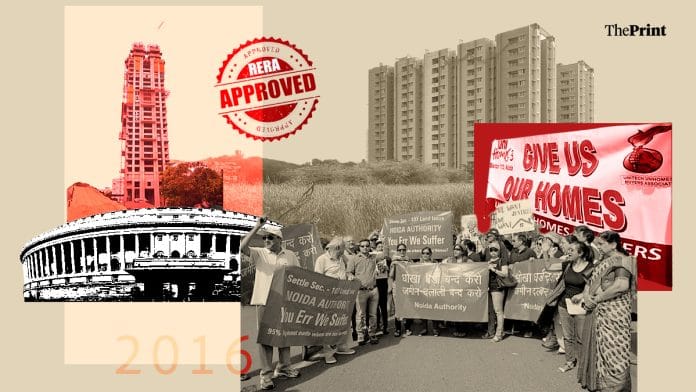
By 2015, public anger had reached a boiling point. Agitated buyers spilled onto the streets nationwide, holding placards and shouting slogans against real-estate giants.
It was out of this crisis that the Real Estate (Regulatory and Development) Authority Act (RERA) emerged. First introduced in 2013 under the UPA government, the bill’s journey to becoming law was far from straightforward. Under Prime Minister Narendra Modi’s government, and after scrutiny by parliamentary committees, the bill received presidential assent on 25 March 2016.
Modi, in his 2016 Independence Day speech that year, described how middle-class buyers were being lured by “beautifully printed booklets” and forced to wait for the possession of their homes despite paying monthly instalments.
When it arrived, the establishment of the Real Estate Regulatory Authority (RERA) was widely seen as a much-awaited reform. It was greeted with celebration, hope and optimism across much of the sector. At its core, RERA sought to create a sector where buyers felt protected and growth was driven by transparency, accountability and predictability.
A decade later, however, the debate has shifted. If the law succeeded in making real estate more transparent, has it been equally successful in enforcing accountability? The answer lies at the heart of RERA’s first ten years.
The enthusiasm, however, was not universal.
Many in the industry felt it was a walk back in time, a return to the strangleholds of the License-Quota Raj.
Ten years on, that debate remains alive: has RERA transformed India’s real estate landscape as intended, or is it yet another tale of broken promises?
The boom before the bust
Prior to this, the 1990s had come as a breath of fresh air for the industry after decades of excessive government oversight. Following the economic reforms of 1991, the real estate sector underwent a sea of transformation.
Economic barriers became porous, the not-so-invisible hand of government regulation eased, and foreign direct investment (FDI) swamped the sector.
By the mid-2000s, the sector had reached its peak. A casual stroll through any major metro would have revealed an unrecognisable landscape. Huge swathes of earth lay dug up, while brick and concrete lined the horizon. It was a construction boom, buoyed by rising middle-class incomes and growing aspirations. Owning a home—perhaps even two—suddenly seemed possible.
The rapid growth of the IT sector, easy access to credit and the rise of an aspirational middle class with greater disposable income all fed this construction frenzy.
In many ways, it was a Wild West era for Indian real estate.
What followed was unbridled construction, soaring prices and the emergence of concrete skeletons across the urban landscape. Mega-townships were built on land to which developers often did not hold clear titles. Eager homebuyers fell prey to dubious schemes, lining up to book dream homes whose existence was often confined to glossy brochures.
“Firstly, the boom was saturated in select pockets like Noida, Gurgaon, Hyderabad, Bangalore and to a certain extent in parts of Lucknow. Secondly, the balance of power categorically tilted towards the supply side,” says Arun Kumar Misra, Former Secretary of the Ministry of Housing and Urban Poverty Alleviation.
Homebuyers were reduced to mere spectators, with little control over what was being promised—or ultimately delivered.
After the final blow of the Global Financial Crisis of 2008, a critical demand-supply disequilibrium across the real estate sector set in.
With that, the house of cards came crashing down.
Also read: For over 6,000 HDIL homebuyers, there is no home a decade since they invested. Hope running out too
When homebuyers fought back
The next phase of the saga was a story of defaulting builders, bankruptcy filings, endless legal battles, and shattered dreams. Newspaper headlines and news channels alike flashed reports of buyers’ discontent.
“As many as 500 homebuyers of DLF New Town Heights, Gurgaon held a demonstration against the developer for delay in handing over possession of the flats,” wrote Hindustan Times. “Noida Extension homebuyers allege harassment again,” said a headline in The Times of India.
These accounts were no longer isolated episodes. Throughout the country, agitated homebuyers were increasingly joining the street protests, while several collective action groups sprang up, with “Fight for RERA,” playing a prominent role. Jantar Mantar, the iconic protest site, was yet again bustling with discontent and mounting frustration.
Scores of aggrieved buyers ran from pillar to post, knocking on every possible door and waiting helplessly in court galleries. Years passed, with no relief in sight.
All they wanted was a house of their own.
After depleting their years of savings, what they got in return was mounting uncertainty, years of litigation, shattered dreams and the crushing double burden of EMIs and rent.
But how did RERA suddenly become a “household name”? Was it just the supply-side vagaries that necessitated its birth, or was a larger storm already brewing in the background?
The buyers’ distress
Large swathes of land were filled with half-completed concrete jungles. With the liquidity crunch tightening its grip, the sector came to a standstill.
Unregulated, unorganised and largely localised, the sector thrived on opacity and fragmentation, operating as a predominantly developer-driven enterprise.
For the buyers, it was a nightmare.
“Majority were first-time homebuyers from the aspiring middle class, who spent years saving for their dream homes, only to be ensnared in a matrix of weak accountability, opacity and repeated frauds,” says Abhay Upadhyay, president of the Forum For People’s Collective Efforts and a member of the Central Advisory Council under RERA (Ministry of Housing and Urban Affairs).
Through glossy brochures, buyers were promised low-density housing and expansive green spaces. But behind their backs, builders would unilaterally approach local authorities and get sanctioned blueprints revised, replacing the promised park with another high-rise tower.
Could an aggrieved buyer seek legal remedy? Not in this case. Such officially sanctioned changes were, technically speaking, legal. This was no trivial matter, and the buyers’ distress was hardly unfathomable
Developers regularly demanded massive upfront payments, often amounting to 80 per cent of the property’s value. They would then divert that money to more lucrative projects or use it to acquire new land.
Legal ambiguities compounded the problem. The original project was left starved of cash and stalled indefinitely.
“Routine delays in project completion went unpunished and one-sided contracts that shifted all the financial onus on to the buyers. Even minor delays in dues or check-bounces attracted exorbitant interest charges. This lopsidedness, for years, persisted unchecked,” said Upadhyay.
With hefty down payments already made, buyers simply could not back out. With every legal recourse exhausted, they were reduced to spectators, watching their savings drain and their dreams crumble.
Accountability was negligible, promises were routinely broken and governance was scant.
The battle for RERA
Thus began the lengthy and cumbersome process of consensus-building.
The stakeholders were many, and so was the cacophony of competing voices. Creating a balance, albeit a delicate one, was paramount.
The government was clear in its objectives.
“It seeks to establish symmetry of information between the promoter and purchaser, transparency of contractual conditions, set minimum standards of accountability and a fast-track dispute resolution mechanism. The proposed Bill will induct professionalism and standardisation in the sector, thus paving the way for accelerated growth and investments in the long run,” read the objects and reasons of the proposed Real Estate (Regulation and Development) Bill, 2013.
Though the mood remained largely the same from coast to coast, the primary points of contention in Parliament were two.
Questions of inclusivity and reaching the ‘last man’ echoed throughout the debate.
The bill proposed mandatory registration of projects above 500 sqm or eight apartments, leaving out projects below this benchmark.
“Why are we limiting ourselves to this square metre area?” asked Kumari Selja, a Congress Member of Parliament. “In a city, in the poorer sections, the plot area is very small. So, are we going to keep them out? Are we going to keep those consumers out?… because this whole Act is in favour of the consumer, the last man,” said Selja.
While Selja spoke in favour of protecting “people coming from the downtrodden sections of the society”, including Dalits and transgender persons who often face discrimination in acquiring housing, Ritabrata Banerjee of the Trinamool Congress raised regional concerns, noting that many Bengalis “cannot live without fish in both meals” and cited several cases of attacks on people cooking non-vegetarian meals.
The second major point of contention revolved around a familiar fault line in Indian politics.
Concerns about the Centre encroaching upon domains traditionally reserved for the states resurfaced. Some of the strongest opposition came from southern states. The debate quickly acquired a federal dimension.
“But how can we accept a Bill which eats into the already limited powers of the States? That is why, All India Anna Dravida Munnetra Kazhagam (AIADMK), our leader, hon. Chief Minister, Puratchi Thalaivi Amma, categorically oppose this Bill in toto,” declared Arokiaswamy William Rabi Bernad, Member of Parliament.
The Union government argued otherwise.
Misra said that, following examination by the Law Department, Entries 6, 7 and 46 of the Concurrent List of the Seventh Schedule gave the Centre the authority to legislate in this regard.
“It was concluded that despite ‘housing’ falling under the State List, the moment a housing stock enters the domain of trade and commerce, the Government of India becomes the competent authority to legislate on the matter,” said Misra.
The disagreement, however, was short-lived. States eventually became enthusiastic partners in the process and began rowing in the same direction.
“We told the States, there is no Central RERA – Centre’s role is largely advisory,” said Misra.
Barring a handful of contentious issues, Parliament stood firmly behind the bill, cutting across party lines.
Recounting an encounter with a retired Army officer in Gurugram who had invested his entire savings in a housing project and who, almost 20 years later, was still awaiting possession, Kishan Chand Tyagi of Kanata Dal (United) remarked, “The soldier who did not lose against China and Pakistan, lost to the real estate sector!”
Selja was equally optimistic. Referring to both buyers and the industry, she said it gave her “a great deal of personal satisfaction” that Parliament would finally “pass this Bill and make it an Act.”
Regulation, not strangulation
The other side of the spectrum was no less vocal.
Developers, too, had their own list of reservations, with regulatory bottlenecks among their biggest concerns.
“Let’s clear up a common misconception: the industry never opposed the idea of regulation. At CREDAI, we had long been advocating for transparency and accountability. Our concern was purely about balance,” says Getamber Anand, former CREDAI president (2016).
The National Real Estate Development Council (NAREDCO), established in 1998 under the patronage of the Ministry of Housing and Urban Poverty Alleviation (MHUPA), had similarly positioned itself as a bridge between policymakers, the industry and the public.
It took persuasion, concessions and many more rounds of discussion.
Yet, the dialogue remained collaborative.
“We weren’t there to push back; we were there to ensure the final law was practical and implementable for everyone. We strongly championed mandatory project registration. Why? Because we wanted to weed out the fly-by-night operators who were building without permissions and tarnishing the reputation of the entire industry,” says Anand.
In a sector already weighed down by cumbersome approvals and regulatory bottlenecks, RERA was viewed as yet another addition to the growing alphabet soup of regulators.
“The biggest concern among developers was the sudden introduction of a regime of disclosures, escrow discipline, and delivery accountability into a sector that had a wide operational flexibility,” says Anshuman Magazine, Chairman & CEO, India, South-East Asia, Middle East & Africa, CBRE.
There were concerns that these rules would “increase the compliance burden and restrict the freedom of execution,” he says.
For the government, however, regulation was seen as a necessary response to the sector’s growing complexities.
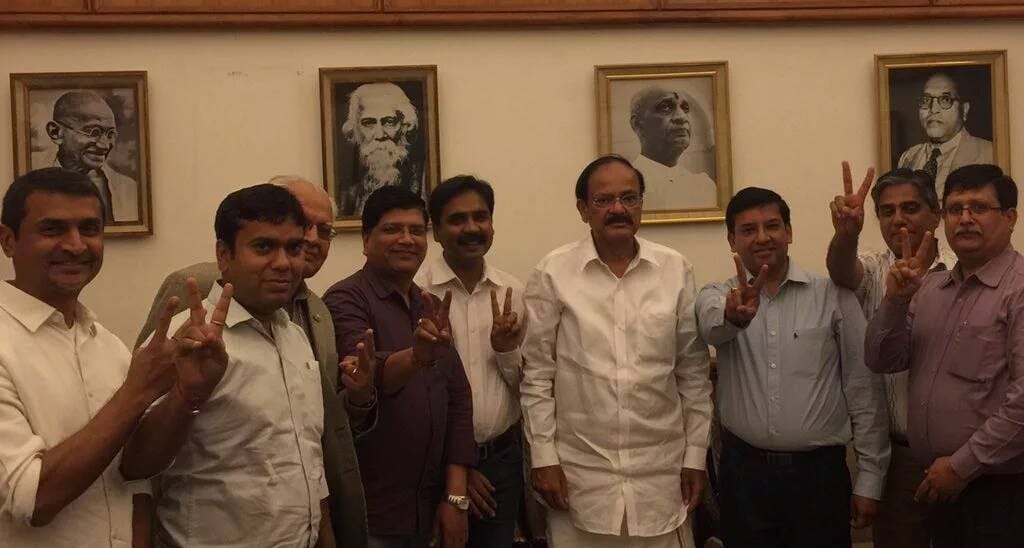
“It is really a regulation; not a strangulation,” said Venkaiah Naidu, then-Union Minister of MHUPA in Rajya Sabha, while discussing the RERA Bill.
Since RERA was a central law to be implemented by the states, concerns about inconsistent enforcement were already beginning to surface.
“There was also a real fear of fractured, inconsistent implementation across different states,” says Anand.
In contrast, the consensus among policymakers was that real estate was fundamentally a local issue. Any kind of centralisation, they argued, would have been counterproductive.
“We were very convinced that decentralisation was the right approach, and indeed the only approach,” said Misra.
Creating RERA was akin to walking a tightrope. A delicate balance had to be struck—protecting buyers and promoting growth without encroaching upon the states’ jurisdiction.
A bitter-sweet victory
Calling the consumer “the king” and the developer “the queen,” Naidu conceived RERA as a mechanism that would help nurture a “happy marriage” between the two.
“There shall be a happy marriage between the king and the queen. It is for both of them to live happily ever after,” said Naidu.
Ten years on, one might wonder: was it a “happy marriage” after all?
Or has it been an awkward marriage of convenience, bound by a law still searching for common ground?
What RERA got right
RERA sought to address the systemic deficiencies and information asymmetry that had long afflicted the sector.
Misra says that, to some extent, the balance has been restored.
Buyers are more empowered. Legal recourse now exists, backed by penal provisions that were once “unthinkable before RERA.”
Perhaps its biggest achievement, he adds, is that “RERA has become a household name,” which is “very heartening.”
Through state-level Real Estate Regulatory Authorities and Appellate Tribunals, it aimed to rectify persistent inefficiencies, infuse greater accountability and strengthen consumer protection.
In effect, says ShrutiKirti Kumar, Partner at Shardul Amarchand Mangaldas & Co, it has introduced much-needed discipline and transparency into the pre-sale and construction phases.
Thus providing much-needed relief to buyers.
Projects could no longer be sold — or even advertised — without registration, and any changes to approved plans required the consent of two-thirds of allottees.
It also created a disclosure-based regime, says Kumar, requiring key project information such as layout plans, carpet area, timelines and the RERA registration number to be publicly available on online portals, with quarterly updates.
It also provided for refunds in cases of delay and imposed stringent penalties, including imprisonment for deliberate fraud and non-compliance.
With all the regulatory compliances that it set to initiate, it has, to a considerable extent, achieved that objective.
Where the law fell short
Yet significant administrative blind spots remain.
“RERA as an act, is a very good act. The blueprint is ingenious, but the execution remains a challenge.”
In practice, some of the old malpractices — fund diversion, pre-launches and unsanctioned plan revisions continue even today.
“What good is a 10% cap, if projects are still delayed and plans continue to be altered arbitrarily?” asks Abhay.
A closer look reveals a far more uneven picture.
The uncomfortable reality is this:
Several states have underperformed on even the most basic mandates of the Act.
As of June 2026, several northeastern states, including Arunachal Pradesh, Manipur, Mizoram and Sikkim as well as the Union Territory of Ladakh, are yet to establish permanent RERAs, despite this being among the Act’s most basic mandates.
These states, along with Nagaland, have fallen short on another cornerstone of the Act: the creation of dedicated RERA websites, which form the backbone of the Act’s transparency agenda.
The portals were meant to enable buyers to make informed choices based on facts rather than promises.
The Centre, which championed RERA with considerable political capital, took almost a decade to finally launch a dedicated Unified RERA Portal—a one-stop platform stitching together RERA data from states and Union Territories.
RERA—the accountability gap
Joining the ranks of these underperformers, Bihar and West Bengal, too, have failed to appoint dedicated adjudicating officers entrusted with awarding compensation and interest to aggrieved buyers
West Bengal had tried to chart its own course barely a year after RERA through the Housing and Industry Regulation Act (HIRA), 2017, though it was later struck down by the Supreme Court.
Yet states are not the only ones falling short.
The legacy of recurring delays and defaults continues to cast a long shadow over the sector.
Upadhyay argues that builders have mastered the art of legal manoeuvring, most visibly in the persistence of project delays.
Developers, he says, have learned to weaponise provisions within the Act itself, using extensions meant for exceptional circumstances to their advantage.
Clauses such as “force majeure”, he argues, are being used to secure additional leeway, leaving projects trapped in bureaucratic limbo while buyers continue to drown in EMIs and rent.
Timelines must mean something.
“A project is to be completed in three years, with an extension of, say, two more. Five years should have been more than sufficient,” says Misra.
Yet, to this day, many projects continue to languish beyond that.
“That defeats the very intent of the law,” he adds.
An even more damning assessment came from Chief Justice of India Surya Kant.
While hearing a case concerning Himachal Pradesh RERA on 12 February 2026, he described state RERAs as a “rehabilitation centre” and questioned the very rationale behind “even constituting this institution.”
Observing that the people for whom it had been constituted were “depressed, disgusted and disappointed,” the CJI remarked that RERA was “facilitating the builders in default.”
“Better abolish this institution, we don’t mind it,” he added.
Within a few years of the Act’s enforcement, reports of growing discontent had begun surfacing once again.
In 2018, The New Indian Express reported, “Hundreds of Karnataka homebuyers protest to demand enactment of stricter RERA rules.”
Similar headlines followed across the country: “Homebuyers seek exit clause in agreement with builders”; and “Disgruntled homebuyers unite to fight for their rights, hold protest at Jantar Mantar.”
For developers, too, the regulatory handcuffs often felt like a flawed triumph.
While it has injected discipline, consumer confidence, and credibility into the sector, the job remains unfinished.
“It is absolutely a transformative success story, but by definition, reform is a continuous process,” says Anand.
Anand adds that if housing supply is hindered as a result of bureaucratic red tape, “prices skyrocket, and the homebuyer is the one who ultimately suffers.”
Shekher G Patel, President of CREDAI, notes that several approval authorities—including urban local bodies, fire departments and environmental regulators—remain outside RERA’s ambit.
“RERA has not by itself eliminated approval delays,” says Kumar.
This is because “many underlying permissions still sit outside the RERA framework.”
As a result, the promise of ease of doing business remains constrained by many of the same approval bottlenecks that existed before RERA.
Lessons from abroad
Looking to mature markets, Neeraj Bansal, Partner and Head, India Global at KPMG, points to Dubai’s more consistent regulatory framework.
He argues that Dubai has moved much faster on digitisation and that wider application of “tools like AI and blockchain can help improve tracking, consistency and overall enforcement.”
Dubai’s REST (Real Estate Self Transaction) platform brings regulators, developers, banks, buyers and courts onto a single digital interface. It enables transactions, approvals and project monitoring in one place.
Malaysia’s One Stop Centre system streamlines approvals through a single portal, while strict timelines reduce bureaucratic delays.
Malaysia’s housing tribunal also provides a low-cost dispute-resolution mechanism that limits the advantage enjoyed by deep-pocketed developers.
The silver lining
RERA has rewritten the rules of the game.
Yet, the vital truth is that real estate is a robust engine of growth and job creation. While rules are essential, impractical rules choke supply. But the journey is far from complete.
So, what lies ahead?
It should be less about new laws and more about sharper, more consistent implementation, time-bound clearances and faster dispute resolution.
Anand says that “efficiency needs to be embedded across the entire value chain, from the sanctioning desk to the final key handover.” Professionalism must be at the front and centre.
“Much like mature markets in the United States,” says Misra, these intermediaries should be “certified, trustworthy and knowledgeable,” forming a cadre of professional, licensed and accountable agents and replacing opacity with credibility.
Recovery mechanisms should have actual teeth, and RERA must embrace digitalisation.
Magazine says “fintech-enabled escrow management, API-based fund tracking and automated milestone disbursals” should be implemented to drive transparency at scale.
Drawing lessons from markets such as Singapore, Japan and South Korea, Magazine says, “real estate works best when regulation is predictable, data is reliable, and the system gives both consumers and investors confidence. That is where India must move now.”
A globally competitive real-estate market requires “treating regulation as a living system rather than just a compliance exercise,” he says.
The next phase of reforms must break free of the clutches of industry giants and marquee markets, shifting the regulatory gaze from metro skylines to smaller towns and cities.
It also means cutting through the tedious web of red tape and mandating time-bound clearances to empower smaller developers, who are often squeezed by the weight of costly and cumbersome bureaucracy.
The “happy marriage” that Naidu envisioned remains a work in progress.
RERA’s first decade laid down the ground rules. The next decade, however, will determine whether those rules can evolve into a relationship built on enduring trust.
(Edited by Prashant Dixit)