





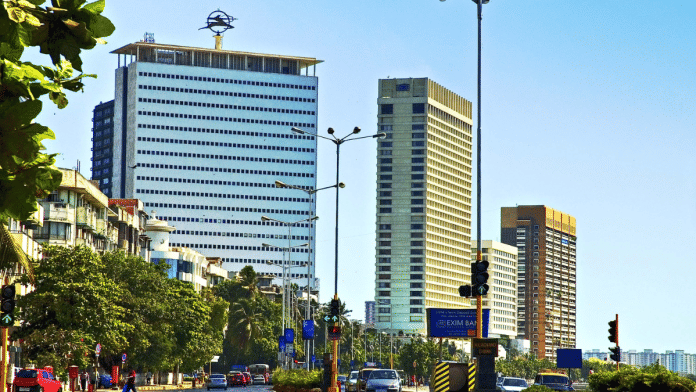


Mumbai: For over five decades, the Air India building in Mumbai has been one of the city’s most recognisable addresses. A sea-facing tower with the airline’s iconic centaur logo crowning it, the building once projected the glamour of India’s national carrier. It also survived the 1993 bomb blasts and is now set to be folded into Maharashtra’s administrative machinery.
On Tuesday afternoon Chief Minister Devendra Fadnavis presided over the deed of surrender between the state government and Air India Assets Holding Limited (AIAHL), taking charge of the 22-storey building. In March 2024, the Centre had approved the sale for Rs 1,601 crore, while the state cabinet cleared the acquisition in November 2025. In April this year, the state’s finance department transferred Rs 1,600 crore to the Public Works Department to finalise the agreement with AIAHL.
The Air India building at Nariman Point, crowning the Queen’s Necklace, was built in 1974 on reclaimed land leased by the Maharashtra government to Air India. It was designed by American architect John Burgee who also designed several of the world’s most iconic postmodern skyscrapers. The Air India building not only served as the headquarters for the airline carrier but also housed several corporate and government offices on rent.
With its central air-conditioning, elevators, and basement parking, it was meant to be more than an office block. It was Air India’s statement of arrival, a headquarters that matched the airline’s international image. Now it is being repurposed for a very different need—office space for the government.
Mantralaya, the administrative headquarters of the government of Maharashtra, is no longer enough to house the state’s growing administrative apparatus. Several departments have been functioning from scattered offices across south Mumbai, including rented premises, making coordination cumbersome and expensive.
🤝CM Devendra Fadnavis presided over the Deed of Surrender between the Government of Maharashtra (Public Works Department) and Air India Asset Holding Limited.
DCM Sunetra Ajit Pawar, Minister ShivendraSinh Raje Bhonsle, Minister Shambhuraj Desai and senior officials were… pic.twitter.com/P6O2ebLems
— CMO Maharashtra (@CMOMaharashtra) June 2, 2026
The 1993 scars and a monetised asset
On 12 March 1993, Mumbai was hit by a series of coordinated bomb blasts that killed 257 people and injured around 1,400. The iconic Air India building was among the targets. The blast at the building took place on a Friday afternoon, after the Bombay Stock Exchange, Narsi Natha Street and areas near Shiv Sena Bhavan were hit.
The blast at the Air India building emanated from an RDX-laden vehicle, killing at least 20 people and injuring 87. The building’s security office was reduced to rubble.
The Air India building, however, was not abandoned. After the explosion, damaged portions of the structure were repaired and the building was back in use. Its restoration followed the broader pattern of the city’s recovery after the 1993 attacks. Once restored, it continued to house offices, including public sector and government tenants.
In 2013, though, the debt-laden airline shifted its headquarters from Mumbai to Delhi NCR as part of a wider restructuring and asset monetisation exercise. Air India vacated large portions of the Nariman Point building and began leasing space to other entities.
In 2018, five years after the shift, Air India decided to sell off the building as part of its asset monetisation plan and invited bids. But the sale was not straightforward. It was not part of the Tata Group’s acquisition of Air India when the airline was privatised.
Instead, it remained with AIAHL, the government-owned special purpose vehicle created in 2019 to hold several of Air India’s non-core assets and liabilities. That separation meant the building had to be dealt with through a government-to-government style transaction rather than as part of the airline sale.
Why the state wants it
The Maharashtra government’s interest in the building goes back several years. Over the years, Devendra Fadnavis, first as chief minister and later as deputy chief minister, repeatedly pushed for the state to get the tower, arguing that Mantralaya and its annexe did not have enough space for government offices.
After the 2012 fire at Mantralaya, several departments had to be shifted out. Even with repairs, new offices and annexe plans, the secretariat complex has struggled to accommodate ministers, bureaucrats, staff and public-facing offices. A new Mantralaya Annexe-2 is also being built next to the main Mantralaya structure, but even that is designed to house only a portion of the requirement, including space for the Chief Minister’s Office, select ministers and some departments.
According to news reports, the PWD floated tenders for Annexe-2 in 2025 at an estimated cost of Rs 100 crore. The new annexe is expected to be ready by September 2026 and will house the offices of the CM and other ministers. But, this too will not be enough.
In 2022, then deputy CM Fadnavis said he had met then union civil aviation minister Jyotiraditya Scindia in New Delhi and requested that the Air India building be given to the Maharashtra government. “At present, even with the Mantralaya and an annexe, the space for government offices is insufficient, hence the demand for this building,” he had said at the time. He also said the Air India building was close to Mantralaya and the Vidhan Bhavan, offering the state a large stretch of the city.
According to reports, the acquisition is expected to provide around 46,470 square metres of office space, helping the government streamline administrative functioning. The state government is also expected to undertake internal renovations before moving departments into the building.
The roadblocks
The acquisition, however, has taken years because of several hurdles.
The first roadblock was valuation. When the state had earlier tried to acquire the iconic Mumbai building, Air India valued it at around Rs 2,000 crore, while the state was looking at a lower figure of Rs 1,400 crore. By late 2022, during the Eknath Shinde-led government, the state was preparing to raise its bid to Rs 1,601 crore, while also waiving Rs 300 crore in dues related to unreleased income and interest on the leased land.
The second was competition. The Jawaharlal Nehru Port Authority (JNPA) and the Life Insurance Company of India (LIC) had also pitched bids for the building. The Reserve Bank of India was also reported to be interested, making it necessary for the state to seek guidance from the Centre. Fadnavis had urged the civil aviation ministry to give the state priority in the sale process.
There was also the question of dues. When the Centre approved the transfer in 2024, the Department of Investment and Public Asset Management said Maharashtra had agreed to waive dues of Rs 298.42 crore that would otherwise have been payable by Air India Assets Holding Ltd to the state government for the transaction.
As the transfer is now complete, the Air India Building will no longer be a monument to the glamour of Indian aviation. It will become an extension of Maharashtra’s state machinery, less symbolic perhaps, but deeply functional.
(Edited by Viny Mishra)
Also read: Air India asks Tata, Singapore Air for funds after $2.4 billion loss