








Lined up along the entrance to the Qissa Khwani bazaar, machine-guns protruding from the turrets of the 50-horsepower Vickers-Crossley M25 armoured cars behind them, the soldiers of the Royal Garhwal Rifles stood under the searing April sun, weathering an unending shower of abuse and human excrement from the balconies of the merchants’ homes on either side of the street. That St. George’s Day, 23 April 1930, local police arrived in the bazaar to arrest the Pashtun nationalist leader Khan Abdul Ghaffar Khan. Khan’s red-shirted Khudai Khidmatgar volunteers had blocked the police’s path and slashed the tyres of their trucks. Finally, the official history records, “the sub-inspector in charge had to accept the prisoners’ suggestion that they should get down from the lorry and proceed to the jail escorted by the crowd.”
The protesters remained in control of the bazaar, though, and the armoured cars were called in. Then, a blow from an axe killed Private Harold Bryant and one of the armoured cars exploded in flames. Lacking clear orders, Captain SJ King ordered his machine gunners to open fire. “The crowd, which had been estimated to be 1500 in the main street alone,” an officer of the King’s Own Yorkshire Light Infantry wrote, “disappeared like magic, leaving numerous corpses on the ground.”
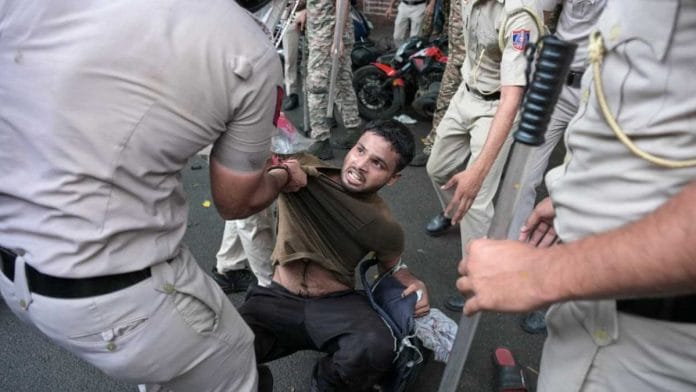
Last week, after the Central Reserve Police Force used pump-action shotguns loaded with birdshot and electric cattle prods against students in Delhi, a long-overdue debate has begun on when it is legitimate for law enforcement to use force against protesters, and what weapons ought to be permitted.
The record of Indian policing is grim. Kashmir saw 117 protesters shot dead by police in 2010, another 85 in 2016, and 59 in 2018, according to classified police data obtained by ThePrint. Less-lethal shotguns firing birdshot, designed for use in sports like skeet shooting, were introduced from 2016 in an effort to mitigate the awful toll of life in Kashmir, but ended up claiming the eyesight of several hundred young people.
Former Intelligence Bureau officer Yashovardhan Azad has joined two individuals injured in Delhi to demand a ban on the use of birdshot—a demand that has long been made by medical professionals. The Supreme Court had, in 2017, declined to ban the use of shotguns in Kashmir, after then-attorney general Mukul Rohatgi claimed other technologies had been ineffective. The court was told the government was working on “a secret weapon to disperse crowds.”
The problem goes far deeper than technology, though: The shotgun is a symptom, not the malaise. For the most part, police forces across India continue to use a crowd control vocabulary that would have been familiar to the soldiers in the Qissa Khwani bazaar, almost a hundred years ago.
Also read: Kangana Ranaut raps CJP protesters over language, calls Gen Z the gutter generation
The Raj and the riot
Led by young men armed with lathis perched on their shoulders like rifles, Hindus and Muslims had spilled out of the grounds around the Badshahi Mosque in Lahore, cheerfully proclaiming that the Emperor, King George V, was dead. The Danda Fauj, as the group called itself, marched on Lahore’s Fort, where they “spat at the British soldiers on guard and called them ‘white pigs.’” The Danda Fauj then made its way to the railway station, and urged the workers there to go on strike. Large numbers of posters were pasted on the walls of Lahore by 12 April 1919—just before the tragic climax of the uprising at Jallianwala Bagh—calling the people of Punjab, in the name of Gandhi, to enlist in this new army, and kill the English.
Finally, the Danda Fauj was confronted in the sex workers’ district, Hira Mandi, by the District Magistrate and a detachment of police. This time, a well-known weapon was used: The pump-action shotgun, firing buckshot.
“The fact that the police, armed with buckshot, were made to take the brunt of the collision with the crowd instead of the troops with service ammunition, the small number of shots fired by the police, and the warnings given to the crowd, showed, in the opinion of the Committee, that the greatest care was taken and the least possible degree of force was used,” the official investigation into the violence recorded.
For colonial administrators, terror was the central tool for the maintenance of order. Egypt’s cities saw canes, clubs and bludgeons against urban protesters. Lewis machine-guns were frequently used in the countryside against Bedouin, sometimes together with airstrikes.
Tactics were similar in India. Air power was routinely used against civilians in India, too. In 1923, the bombing of villages in North Waziristan claimed 50 lives, and numbers of livestock. Following Jallianwala Bagh, the town of Gujranwala was strafed by the Royal Air Force. “Five regiments of cavalry, twenty-one British infantry battalions, fifteen active and thirty-two training Indian infantry battalions, eight sections of armoured cars, and numerous artillery, engineer, and pioneer units, all assigned to internal security duties,” held the British Raj together in 1920, historian Simeon Shoul reminds us.
The limits of coercion
The problem colonial administrators refused to learn was evident in Qissa Khwani: Terror just didn’t work. The armoured vehicles brought into the bazaar, crowds surrounded them, refusing to move. Bryant, who jumped out of the first armoured car to clear the path, was killed when he waved his gun at a protestor. The armoured car braked sharply after this, leading the second one to plough into it. Fuel leaking from the accident caught fire. Even though the machine-gun fire directed at the crowd killed large numbers of people—twenty, according to official accounts; over 125, according to an Indian National Congress investigation—the Khudai Khidmatgars ruled Peshawar for the next several days. The Raj remained at war through North-West Frontier Province until its eventual end.
Lessons were not learned in post-Independence India, either. The political scientist David Bayley, writing in 1971, noted that the practice of policing remained “overwhelmingly colonial,” showing little willingness to engage with communities and demonstrate accountability to the public. For the most part, policing remained a coercive enterprise, concerned only with the use of force to enforce public order. Through the first decades of the new millennium, the use of firearms against protesters became increasingly common.
The scholar Sonal Marwah has demonstrated that the use of lethal force against civilians became increasingly common in the new millennium. Large-scale caste violence that tore across Rajasthan in 2007 led to the loss of at least 37 lives, mostly of protesters, adding to 26 the previous year. Thirty-two people were killed in 2017, after police opened fire on supporters of the cult leader Gurmeet Ram Rahim Singh, who rioted after he was convicted for rape.
Learnings from Delhi
Even though successive governments have promised to address the use of excessive force by police, there has been a disturbing lack of seriousness. Figures released by the National Crime Records Bureau are, sadly, simply not credible. The NCRB’s data for 2024, published earlier this summer, asserts that not a single person was killed, and just two injured in lathicharges and police firing—this in a year when murderous ethnic violence erupted across Manipur, communal violence trended sharply upwards, and farmer protests swept across the country. There is little data on the circumstances which led to the use of lethal force, and even less on how deaths and injuries might have been avoided.
Lethal force ought to be used only when there is an imminent danger to human life: there is no other circumstance in which it ought to be countenanced. London’s police force allowed mobs to burn and loot properties in 2011, knowing the perpetrators could later be arrested and prosecuted.
From the many learnings the Government ought to learn from the student protests, this one is key: Treating Indians as subjects, instead of citizens, is unsustainable. The right to protest needs to exist not just as a constitutional abstraction, but as part of the lived experience of societies.
Praveen Swami is Contributing Editor at ThePrint. His X handle is @praveenswami. Views are personal.
(Edited by Theres Sudeep)
Under which doctrine were protestors able to injure so many police personnel ?
Since British rule. Could not agree more. Decolonisation. That does not come from cosmetic changes in apparel or translating the criminal codes from English to heavily Sanskritised Hindi. A police baton – embedded with rusted nailers is a new one – is where the state meets the citizen. That is where change and improvement need to be seen and felt.
The Indian police should be disbanded, and policing should be outsourced to world-class police services.