






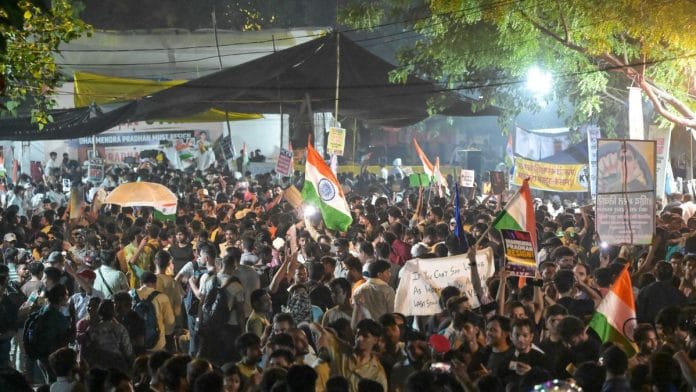

The Cockroach Janta Party protests have generated considerable attention in China. Commentators have interpreted them as a sign of mounting political pressure on Indian Prime Minister Narendra Modi. Across Chinese media and academic discussions, the protests have been framed as a challenge to the political narrative that has sustained the Modi government’s popularity. On Weibo, the hashtag “large-scale protests erupt in Indian capital” attracted millions of views, with one widely shared post stating: “India is in turmoil again.”
“The Indian government has conceded! The victory of the ‘cockroach’ youth has shattered a long-held illusion of Modi,” wrote Chen Zhuo, a columnist for Guancha. Another commentator argued that while Chief Justice Surya Kant’s comparison of unemployed youth to cockroaches may have begun as a controversy, the anger behind it is real. The movement, the commentator suggested, echoes the collective frustration of a large number of disadvantaged young Indians.
Similar sentiments appeared across Chinese online platforms. A Zhihu post noted widespread anger in India, while a Weibo user wrote that “growing discontent with the Modi government has sparked anti-Modi protests by Gen Z in India.” Another argued that “the discontent of Gen Z youth has transcended the leak of exam questions itself, sparking widespread dissatisfaction with the Modi government across Indian society.” This became a common framing of the CJP protests in Chinese online discussions.
Also read: Fear ruled India after the CAA-NRC protests. The youth got over it by laughing at it
Is Modi facing a serious challenge?
Chen Zhuo, a doctoral student at Fudan University’s School of International and Public Affairs and a member of the South Asia Studies Group, described the protests as one of the most serious political challenges Modi has faced during his 12 years in power. In Chen’s view, the demonstrations are evidence of growing dissatisfaction among a generation that has known no national government other than the Bharatiya Janata Party (BJP).
For those who grew up during the era of “New India” and “Developed India” (Viksit Bharat), Chen argued, the BJP is no longer the party promising change but the party in power, increasingly judged by its record rather than its promises. She further noted that Modi’s political rise was partly driven by anti-incumbency sentiment against the Congress Party. That advantage, she suggested, may now be weakening as public frustration increasingly turns toward the BJP itself.
For Chinese observers, the CJP protests represent deeper tensions beneath India’s rapid economic rise. Modi’s challenge, they argue, is no longer only managing political opponents but addressing a generation that grew up with the promise of a rising India and is increasingly questioning whether that promise applies to them, particularly in terms of jobs, opportunities, and social mobility.
One Chinese commentator identified three key weaknesses in Modi’s governance. First, he argued that economic growth has failed to generate sufficient employment, leaving many young Indians frustrated by limited opportunities. Second, he highlighted the gap between ambitious policymaking and grassroots implementation, with agricultural laws, CAA, and labour reforms exposing the limits of centralised decision-making. Third, he pointed to declining trust in institutions, particularly competitive examinations, arguing that repeated irregularities have weakened faith in one of the few pathways to upward mobility. In his view, this erosion of trust transformed the CJP from an online joke into a symbol of wider youth frustration.
Also read: CJP protest isn’t a Gen Z victory alone. Millennials laid the groundwork
The future of the protests
A commentary published by Guancha portrayed the government’s response as a sign of political anxiety rather than confidence. As the protests gained momentum, the article argued that New Delhi appeared unsettled, pointing to restrictions on the CJP’s social media accounts in India.
A Chinese commentary published through a WeChat account argued that Modi’s real concern was not the unregistered online political party itself, but the anger of the millions of young people behind it. With nearly half of India’s 1.4 billion population under 25 and Gen Z exceeding 350 million, the commentator warned that if youth grievances cannot find a political outlet, the CJP may only be the beginning. The commentator opined that, with the 2029 election approaching, this poses a challenge for the BJP, whose support has long relied on young voters. Modi has repeatedly presented himself as the leader guiding India’s youth toward the future. But the commentator asks who will bear responsibility when young people face exam leaks, dismissive officials, and limited economic opportunities. The answer, it argues, will ultimately be the ruling party.
For Chinese observers, the CJP protests are about a generation beginning to question India’s development narrative. Yet they also highlight the movement’s biggest weakness: its lack of organisation. Unlike traditional political parties, the CJP has no established structure, hierarchy, or machinery to sustain mobilisation. Many supporters have joined through shared frustration rather than a common political programme, creating a powerful emotional force but an uncertain strategy.
Protests are a normal feature of democracy, and movements such as the CJP protests exemplify the political awareness and anti-incumbency sentiments among India’s young population. While the protests, their motivations, and their future have been widely dissected on the Chinese internet, one important question remains largely absent: how does China’s own Gen Z view political expression and social grievances? Much of the Chinese discussion has focused on India’s youth, but it also raises a broader question: where are China’s Gen Z voices in this conversation?
Sana Hashmi, PhD, is a fellow at the Taiwan-Asia Exchange Foundation. She tweets @sanahashmi1. Views are personal.
(Edited by Theres Sudeep)
Thankfully we don’t have Tiananmen Massacre happening in India.
Laughed my guts out. A young man, speaking Marathi with the intonation of the interior, saying, Hello, Xi Jinping, I hear you are funding the protests. Three of us are having a cup of tea. Would you clear the check, please. Ching. Chang. Chung.