





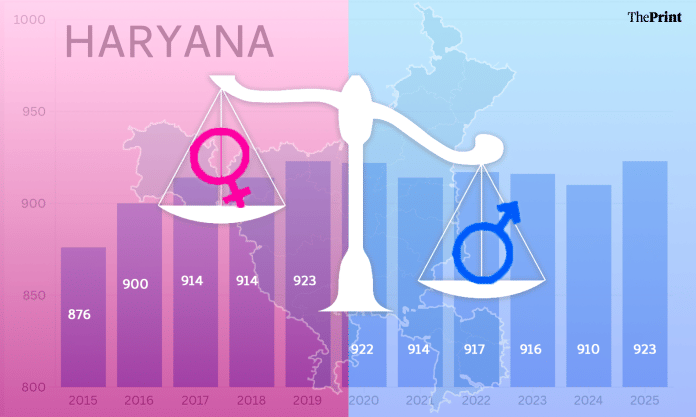

Gurugram: In Haryana, for the first six months of 2026, there were only 900 girls for every 1,000 boys. A year earlier, the number stood at 923. Officials, unable to explain the slide, hope that a new digital portal will help them keep a closer watch on every pregnancy in the state and, indirectly, on the missing girls.
Chief Minister Nayab Singh Saini on Sunday announced that the state government is rolling out a portal called ‘SAMRIDDHI’ to register every pregnant woman in Haryana and track her health from conception through delivery and the weeks after.
Every woman will get a unique ‘SAMRIDDHI ID’, linking her records across government hospitals, private hospitals and medical colleges, wherever she seeks treatment.
The portal will be tied to a six-seat State-Level Command Centre, working in two shifts under the National Health Mission, and to a ‘102 Maternal and Child Health Call Centre’ staffed by trained nurses.
Women with normal pregnancies will be contacted once every three months. Those flagged as high-risk will be monitored, with the frequency rising as the delivery date nears.
Saini said the aim was simple: catch high-risk pregnancies early, get women to the right hospital in time, and cut down maternal and neonatal deaths. “The government’s objective is not merely to collect data, but to ensure that every pregnant woman receives the right healthcare service at the right time,” he said. The portal will be built to Ayushman Bharat Digital Mission standards and linked to birth registration, so a child’s health record picks up where the mother’s pregnancy record leaves off.
But behind the official language of “safe motherhood” lies a number that has quietly worsened.
A senior Haryana government officer associated with the Beti Bachao Beti Padhao programme said the mandatory registration under SAMRIDDHI would also help keep an eye on female foeticide, an admission that the portal has a second, unstated purpose.
The numbers explain why. Haryana’s sex ratio at birth had been climbing steadily for a decade — from a low of 876 in 2015 to 900 in 2016, 914 in 2017 and 2018, and 923 in 2019, its best showing in years.
The gains dipped slightly through the Covid years before the ratio recovered to 923 by the end of 2025. In the six months since, it has dropped back to 900.
The scale of the problem becomes clearer against the backdrop of Haryana’s history. When the 2011 Census was conducted, the state’s child sex ratio for the 0-6 age group stood at 834 girls per 1,000 boys, the worst among India’s major states.
A senior officer in the state health department, speaking on condition of anonymity, said the portal’s real test would be compliance, not design.
Antenatal care registration is already mandatory in Haryana, he said, but compliance hovers at only 50 to 60 per cent.
“Haryana has on an average 5.25 lakh births every year — 5,25,129 in 2025. Against this, the state has over 50,000 health workers, including ANMs, ASHAs and Anganwadi workers.
Leaving out urban pregnancies, each worker has to track hardly three pregnancies where they are normally posted. Still, hardly 50 per cent of pregnancies are registered,” he said. He expressed hope that registration would improve once the new portal was in place.
Whether SAMRIDDHI can do what a decade of campaigns and mandatory registration have not, close the gap between Haryana’s boys and girls at birth, will depend on what the Command Centre’s data throws up in the months ahead.
(Edited by Nivedita Patil)