



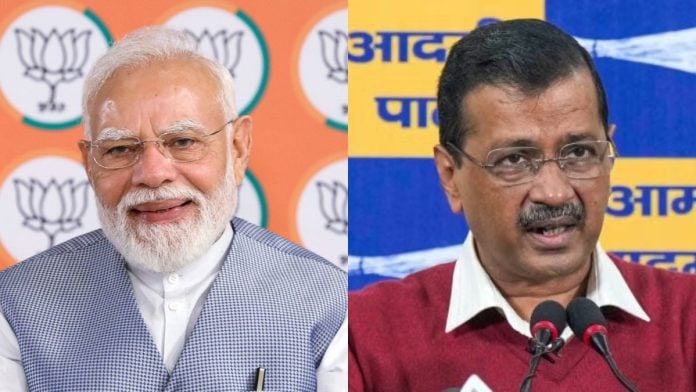
New Delhi: Dismissing an appeal by Aam Aadmi Party chief Arvind Kejriwal, the Gujarat High Court has upheld an earlier ruling by a single-judge bench denying disclosure of Prime Minister Narendra Modi’s educational records under the Right To Information (RTI) Act.
In a judgement delivered Tuesday, the Gujarat High Court held that degree certificates and academic records constitute personal information protected by privacy and confidentiality safeguards, emphasising that there should be a balance between a citizen’s right to seek information and an individual’s right to privacy.
A division bench of Chief Justice Sunita Agarwal and Justice D.N. Ray Tuesday dismissed the appeal, ruling that the mere fact that the information pertains to a constitutional functionary does not automatically bring it within the ambit of public interest or larger public interest. It also refused to remove the Rs 25,000 cost imposed on Kejriwal by the single judge in March 2023 for misusing the RTI machinery for political gain.
The judgement was authored by Chief Justice Sunita Agarwal, who has also recently been recommended by the Collegium for elevation to the Supreme Court.
Background
The controversy began in April 2016 when the Central Information Commissioner (CIC), acting on a communication submitted by Kejriwal during separate proceedings, treated it as a RTI request seeking details of Prime Minister Modi’s educational qualifications and directed the concerned authorities, including universities, to provide the information sought.
In March 2023, a single judge quashed the CIC’s order. Significantly, Kejriwal did not challenge the correctness of the single judge’s decision quashing the CIC’s order directing disclosure of degree-related information. His appeal was confined to the findings made against his conduct and the imposed cost on him.
Despite this limited challenge, the division bench undertook an extensive examination of the legal issues surrounding the CIC’s jurisdiction, the scope of the RTI Act, privacy rights, fiduciary obligations of universities and the larger public interest doctrine. The result was a comprehensive reaffirmation of the single judge’s reasoning.
Also Read: After backlash from Oppn & allies, Vijay govt revokes RTI exemption for law & order department
Public interest vs personal information
The division bench agreed with the 2023 single judge’s finding that educational records, including degree certificates and marksheets, constitute personal information and are protected from disclosure under Section 8 (1)(j) the RTI Act.
The court further held that such records are held by universities and examining bodies in a fiduciary capacity on behalf of students, attracting the exemption under Section 8(1)(e). A fiduciary relationship exists where information is entrusted to an institution with the expectation that it will be preserved and used only for legitimate and authorised purposes.
The bench observed that merely because the information related to the prime minister did not automatically bring it within the ambit of “public interest” or “larger public interest”. It emphasised that information does not lose its private character solely because the individual concerned occupies a constitutional office.
The judgement relied on the Supreme Court’s decisions in Subhash C. Agarwal (2020) and K.S. Puttaswamy (2017) which recognised professional and educational records as personal information entitled to protection against unwarranted invasion of privacy.
The court noted that the RTI Act itself balances the right to information with privacy and confidentiality by exempting personal information, confidential information and information held in a fiduciary relationship, unless a larger public interest justifies disclosure.
The bench further observed that the test of public interest requires a balancing exercise. Authorities must weigh the interest in disclosure against the possible harm, invasion of privacy and breach of confidentiality that disclosure may cause to the individual concerned.
It held that no larger public interest had been demonstrated in seeking the prime minister’s educational records.
Election disclosure vs RTI disclosure
The court also dealt with the argument that voters are entitled to know the educational qualifications of candidates contesting elections, as election laws require candidates to disclose such information in their nomination papers.
While acknowledging this requirement, the court described the RTI Act as a “code in itself”. It observed that the present dispute concerned a request made under the RTI Act and any request made under the Act must be examined within the statutory framework of the RTI Act, including the exemptions and procedural safeguards.
The court held that “the RTI Act, 2005 cannot be used as a tool to ventilate personal grudges or political vendetta against an individual even if he or she is holding a public office, and information sought may be refused by the RTI authorities”.
In essence, the bench distinguished between a citizen’s right to receive information that election law requires a candidate to place in the public domain and a separate demand for educational records maintained by universities under the RTI Act.
Why court said CIC went beyond scope of RTI Act
The bench began by examining the legality of CIC’s action itself. According to the court, the RTI Act prescribes a clear statutory sequence.
A person seeking information must first make an application to the concerned public authority and only thereafter remedies for complaints come into operation and in the present case, the court found that no independent RTI application had been submitted by Kejriwal seeking information about the prime minister’s educational records. Rather, a communication made by him during separate proceedings before the CIC was treated by the commission, on its own motion, as an RTI request.
The court held that the CIC had no authority to convert a communication received into a fresh RTI application and then proceed to direct disclosure of information. Such an exercise, the court observed, was completely outside the statutory framework of the RTI Act.
(Edited by Nardeep Singh Dahiya)
Also Read: Kuno director summoned after RTIs on Project Cheetah denied citing ‘threat to India’