





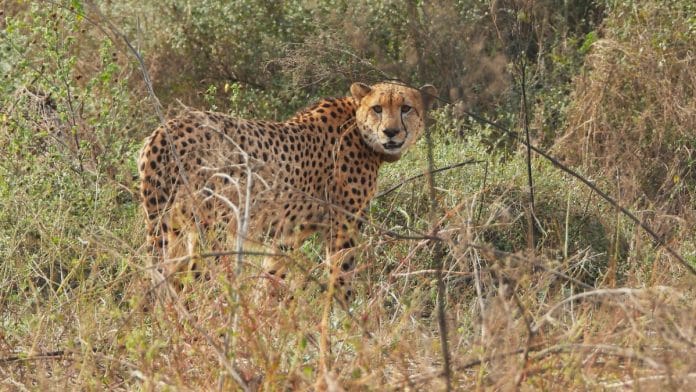

New Delhi: After petitions related to Project Cheetah, the Madhya Pradesh Information Commission on 31 July summoned Uttam Kumar Sharma, Field Director of Kuno National Park, to appear before it. The commission was hearing four cases related to refusal or delay of Right to Information requests about Project Cheetah, filed by activist Ajay Dubey.
In his complaint to the MP State Information Commission (SIC) filed in February 2025, Dubey said that the MP Forest Department had denied, delayed or provided partial answers to four of his RTI requests regarding details of Project Cheetah in Kuno National Park. Some of his requests were denied under the exemption clauses that said the information would be a threat to India’s security concerns, while in other cases, he was asked for extra fees to access the information.
Dubey’s complaint alleged that Sharma, who is the field director of Kuno where India’s Project Cheetah is housed, acted as both the Public Information Officer (PIO) and the appellate authority for RTI requests. This is in violation of the Right to Information (RTI) Act, said Dubey.
In response, Rajesh Bhatt, the Information Commissioner of MP SIC, summoned Sharma and other officials of the MP Forest Department for a hearing to justify why the requested information was withheld.
Dubey, who has been tracking Project Cheetah in Kuno since it first began in September 2022, had filed four RTI requests in 2024, asking for information regarding the translocated cheetahs’ medical histories, tranquilisation records, original documents showing permission records for documentaries shot inside the park, information about materials used for construction inside the park, and post-mortem records of cheetah deaths.
However, two of his requests were denied based on Section 8(1)(a) (threat to the security and sovereignty of India) and Section 8(1)(j) (disclosure of personal information) of the RTI Act.
“On what grounds are medical records of cheetahs, blood test and tranquilisation reports, considered to endanger national security?” said Dubey. “This is a government project, and we’re requesting information that should have been shared with us to begin with.”
Also read: Indian-born cheetah dies in Kuno National Park. Toll rises to 5 in 2026
Tranquilisation records of cheetahs
In 2024, an inspection report by MP’s then-Principal Chief Conservator of Forests (PCCF) and Chief Wildlife Warden, VN Ambade, had found that between 2022 and 2024, cheetahs in Kuno had been tranquilised a total of 110 times. The report added that veterinarians in the national park were not maintaining proper registers of these tranquilisation and immobilisation records.
The reports of incessant tranquiliser use on cheetahs had raised concerns among environmentalists and wildlife experts, who said that this could have long-term impact on the animal’s health. To understand the reasons behind high tranquilisations, Dubey filed an RTI requesting more information about the tranquilisation records, along with the permission records for each tranquilisation. He was denied this information citing national security reasons.
His other RTI requests, such as asking for information regarding the entry of NGOs, foreign dignitaries, and other government guests into the park, and CCTV footage from inside the park to see injured and deceased cheetah cubs was also denied for the same reasons.
For other queries, he was asked for extra money. A response to the RTI, a copy of which is with ThePrint, mentioned that Dubey needed to submit fees as ‘challan’ to access information about the medicines purchased under Project Cheetah, the construction materials used inside the park, and how many documentary filmmakers went into Kuno National Park.
“This is in violation of the RTI Act, because there is no reason I should be paying extra money to access information under the Act,” said Dubey. “Aside from the Rs 10 for submitting the form, the Act states that government bodies cannot ask for more money.
The petitioner demanded a penalty, a departmental inquiry, and compensation against Uttam Sharma for disrespecting and violating the RTI Act.
(Edited by Aamaan Alam Khan)