


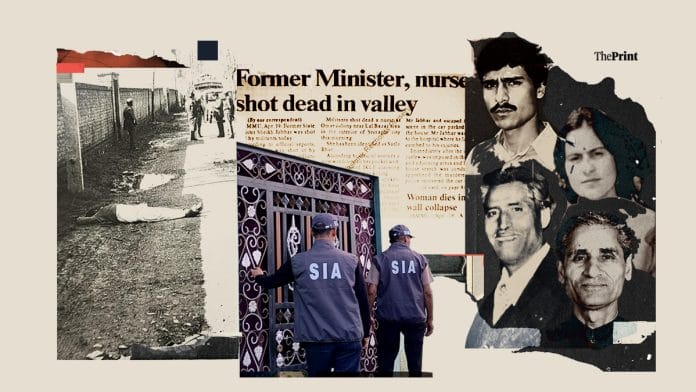
New Delhi: A fortnight before he was killed, lawyer Tika Lal Taploo received a box of toffees with a letter from Qazi Nissar, then leader of the Muslim United Front, warning him to leave Kashmir. He left his wife and son in Delhi, and returned to Srinagar alone.
Four days later, on 14 September 1989, three masked gunmen shot him dead as he left for the high court. More than three decades later, the murder case remains unsolved.
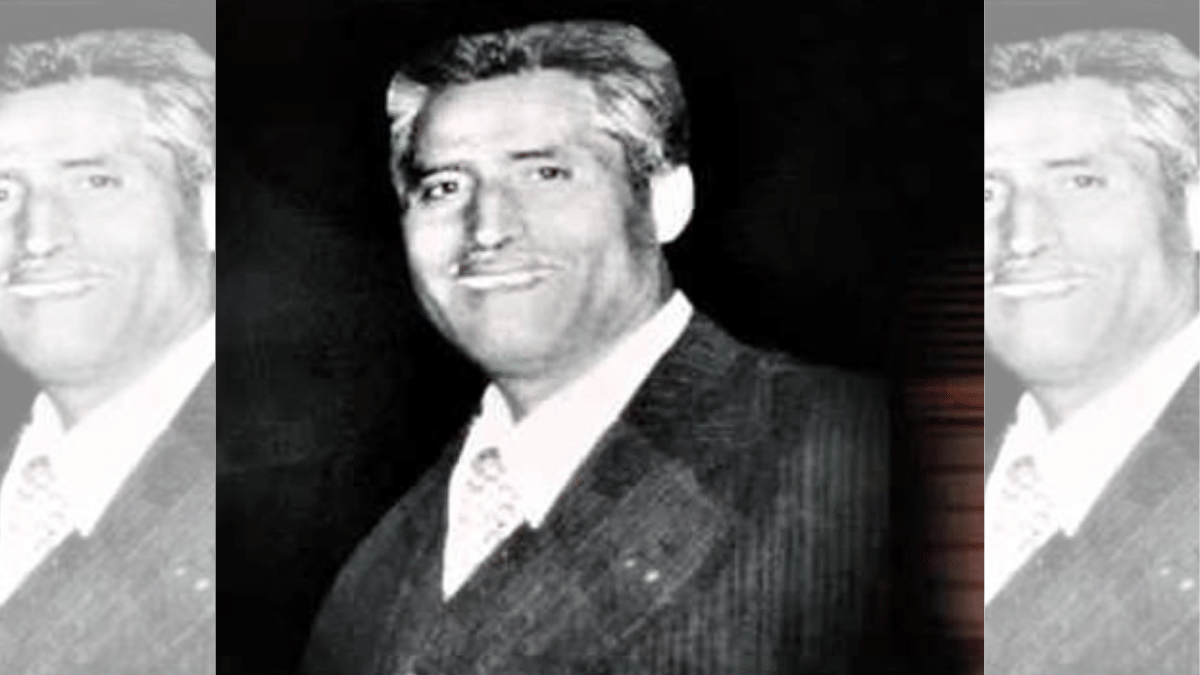
Less than two months after his killing, retired Sessions Judge Neelkanth Ganjoo was at the Jammu and Kashmir Bank in Srinagar on 4 November when three alleged JKLF militants shot him dead at close range. He was 67.
His son had not even reached home after dropping him off when the family learnt that Ganjoo had been shot. Ganjoo had sentenced JKLF founder Maqbool Bhat and another accused to death in 1968 for the murder of police inspector Amar Chand. Bhat was hanged in Tihar Jail in 1984. Ganjoo’s murder, too, remained unresolved—no arrest, no chargesheet. Untraced.
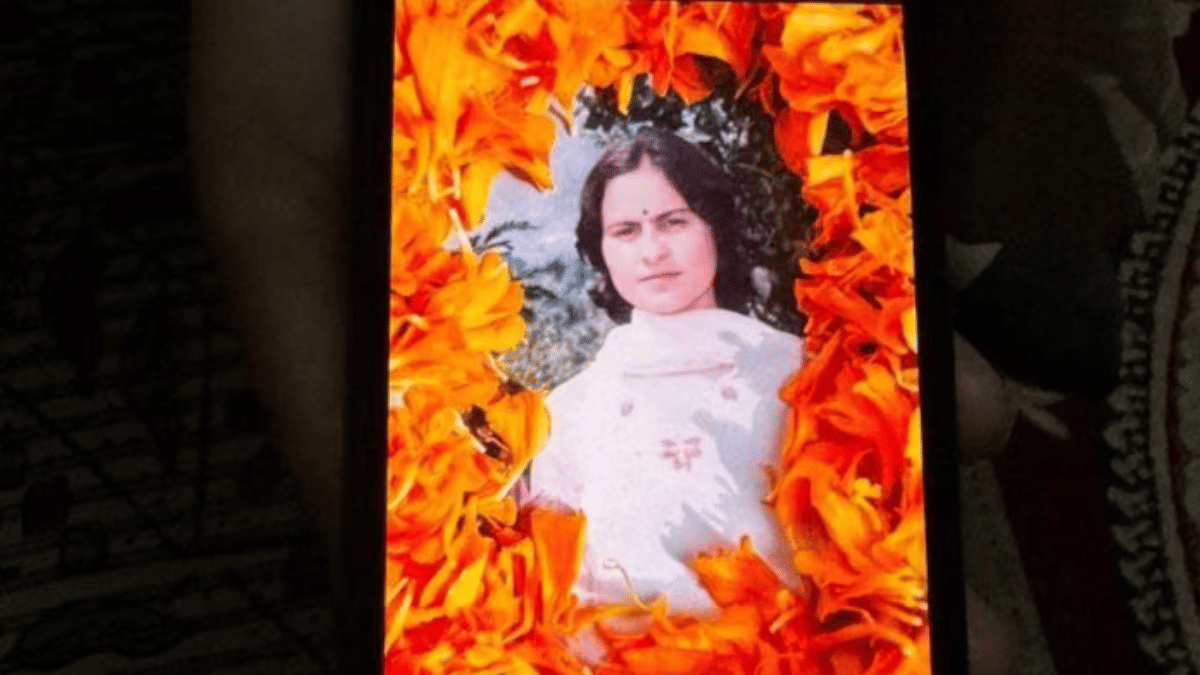
The following year, nurse Sarla Bhat was abducted from the Sher-i-Kashmir Institute of Medical Sciences (SKIMS), allegedly confined at a JKLF commander’s residence and shot dead. Her bullet-riddled body was found in downtown Srinagar on 19 April 1990, along with a note branding her a mukhbir (informer). For more than three decades, no one was brought to trial. Declared untraced.
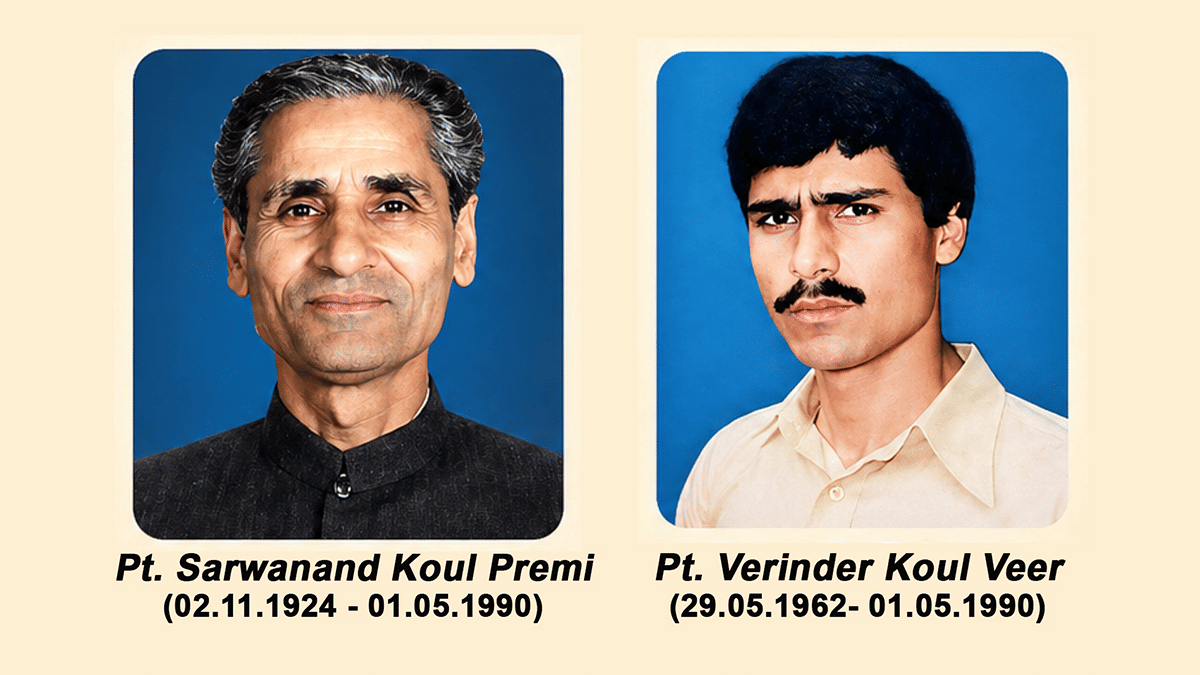
Days later, on the night of 29–30 April, three armed militants entered the home of poet Sarwanand Kodeul Premi, one of the Kashmiri Pandits who had remained in the Valley despite the exodus. After looting the house, the gunmen took Premi away, to meet their “commander”. His 27-year-old son Virender went with him.
Two days later, their bodies were found hanging from a tree in a forested area about 20 km from their home. They bore signs of severe torture—broken bones, gouged-out eyes and cigarette burns as well as gunshot wounds. Investigators failed to identify the perpetrators and the case was eventually marked “untraced”.
Eight years later came the Wandhama massacre. On the night of 25 January 1998, gunmen dressed in Army-style camouflage entered the village and shot dead 23 Kashmiri Pandits, including women and children, at close range.
An FIR was registered and militants suspected of involvement were subsequently killed in encounters, but no one was prosecuted for the massacre. The case was ultimately marked “untraced”
These were not the only cases that were never probed.
More than 200 Kashmiri Pandits were killed and around 140 cases registered during the years of militancy, yet hardly any reached a conclusion. In 115 cases, the perpetrators were not even identified.
‘Better late than never… every Kashmiri wants to see those responsible brought to justice. So far, it was not done. The silence was shameful, criminal,’ Rajinder Premi, son of Sarwanand Koul Premi who was killed in 1989.
Now, investigators are returning to those decades-old files—many containing little beyond an FIR, with crucial evidence, witness statements and investigative records either missing or never collected.
The Jammu and Kashmir State Investigation Agency (SIA) has begun revisiting some of the most prominent cases —Taploo, Ganjoo, Bhat, Premi and his son, and the Wandhama massacre— attempting to reconstruct, piece by piece, investigations left incomplete more than three decades ago.
“This is a mammoth task. It involves identifying surviving perpetrators and those who facilitated the crimes or provided logistical support. Tracing witnesses who may have died or relocated and retrieving records that are either missing or were never collected is a challenge. The biggest challenge is gathering fresh evidence, more than three decades later, that is strong enough to withstand judicial scrutiny and secure a conviction,” a source in the SIA said.
‘This is a mammoth task. It involves identifying surviving perpetrators and those who facilitated the crimes or provided logistical support,’ says an SIA source.
“Many Kashmiri pandits who are in their late 50s and 60s and had witnessed the persecution first hand, have come forward to help SIA,” he said.
In 2017, the Supreme Court refused to reopen 215 cases from 1990 cited in a petition by Kashmiri Pandit organisation Roots in Kashmir, stating that 27 years had passed and evidence was unlikely to be available. “Now tell us from where the evidence will come,” the bench had said. A review petition was subsequently rejected too, and in 2022 the court also dismissed the organisation’s curative petition.
The Supreme Court again declined to intervene in 2022 when Tika Lal Taploo’s son, Ashutosh Taploo, sought an investigation into his father’s 1989 murder, though it gave him liberty to pursue other remedies.
‘There were cases that were completely blind and had been closed. But there were others where some initial evidence existed on record that could still be developed,” says a serving IPS officer.
In 2023, following representations from community groups seeking justice in cases that had remained unresolved for decades, Governor Manoj Sinha ordered the J&K Police to prepare a list of killings from the 1990s, according to the SIA.
That led to old cases being taken up again, including Sarla Bhat’s murder. Ganjoo was the first case in which the investigation began.
Explaining how these cases came under review, a senior serving J&K Police officer said a committee headed by then IGP Crime Javaid Gilani was constituted in 2022 to review old cases, including multiple cases involving the killings of Kashmiri Pandits.
While some had been closed, others were identified as having sufficient material or investigative leads to warrant a fresh probe and take them to their logical conclusion.
“There were cases that were completely blind and had been closed. But there were others where some initial evidence existed on record that could still be developed. In some cases, the investigation had begun but, over time, lost momentum and reached a dead end. Cases where evidence survived and there was scope for further investigation were identified. Some were handed over to the SIA and others to the district police,” the officer said.
The officer said many investigations had stalled because conducting sensitive probes at the peak of militancy was difficult, when the police neither had the specialised training nor the wherewithal to pursue them effectively.
“Even among the cases taken up again, the results vary. There has been significant progress in some, while in others investigators have yet to make a breakthrough,” the officer added.
Also read: Kashmiri Pandits are on the edge again. Second threat letter targets 6 PM Package employees
‘Dedicated teams to trace witnesses, media reports’
Explaining why these five cases were prioritised despite several others remaining unresolved, the SIA source said they had come to symbolise the failure to deliver justice, with virtually no progress made in their investigation despite the horrific nature of the crimes and the attention they repeatedly received.
The source, however, stressed that this did not make these cases more important than others. “We have picked these cases to begin with. As we take them to their logical conclusion, we will move on to the others as well. All these cases are extremely challenging to probe, otherwise we would have taken up more,” the source said.
The SIA, J&K Police’s specialised anti-terror investigation wing, has constituted dedicated teams of six to 10 officers for each case, headed by an officer of the SP or DSP-rank.
“Each team is working exclusively on one case,” the source said.
Investigations into these decades old cases rely heavily on tracing witnesses and retrieving archival records, photographs and other material that either survived the years or can now be located and pieced together as corroborative evidence.
The investigation into Sarla Bhat’s 1990 murder offers a glimpse into how that process works.
When the SIA took over the case in March 2024, investigators had little to begin with—an image of Bhat and a black and white photograph of the crime scene among the material available to them. Over the next two years, they traced witnesses, some as old as 80, and persuaded them to testify. Among them were people formerly associated with the JKLF.
“There was a long list of witnesses, including people who worked with Bhat at SKIMS, her hostel mates, shopkeepers and bystanders who were present around the place where her body was dumped,” the source said.
The source said witness testimony becomes particularly crucial because much of the technical and forensic evidence ordinarily available in a contemporary murder investigation either does not exist or was never collected.
“A lot of these investigations are driven by witness statements and corroborative evidence. Which vehicle was used in an abduction, where a body was dumped, which route was taken. Details like these have to be reconstructed and corroborated through witness testimony,” the source said.
Old records and photographs are similarly being retrieved and used as corroborative evidence. The source said that media reports from that time have also been a key part in the probe.
“A lot of journalists who covered these incidents at the time or had even interviewed JKLF operatives and other active militants had to be approached and convinced to share the material they had preserved, including photographs documenting what happened,” the source said.
Finding witnesses, however, was only half the battle won. Investigators also had to persuade people to speak about events they had remained silent about for more than three decades, assuring them that they would not be harmed for cooperating with the investigation.
In Bhat’s case, for instance, the original police investigation had recovered cartridge cases but could not trace the weapon. It was during the fresh examination of witnesses that investigators reconstructed that Bhat had allegedly been shot with an automatic rifle at Omer Colony in Malbagh, Srinagar.
Moreover, investigators zeroed in on 10 JKLF suspects whose handwriting was examined against the note found with Bhat’s body. Searches were conducted at their residences to recover old handwritten material, which was subsequently sent to Delhi for forensic examination. The analysis found matches with the handwriting on the note, according to the source.
‘It is a process and no one should expect quick results, but the teams are on it,” says an SIA source.
“It took two years of painstaking work, including carrying out raids to recover material that was so old, and getting former JKLF members to testify, before enough evidence could be gathered to name JKLF chief Yasin Malik as a prime accused along with others,” the source said.
The two-year investigation culminated in a 737-page chargesheet filed in June 2026, 36 years after Bhat’s murder. The SIA named Malik, Khurshid Ahmad Chalkoo, Abdul Hamid Sheikh, Mohammad Yousuf Sofi alias Idrees and Ghulam Mohammad Taploo as accused in the alleged conspiracy, abduction and killing.
Of them, Sheikh, Sofi and Taploo are dead. Malik is lodged in Delhi’s Tihar Jail in a separate case, while Chalkoo remains absconding. The source said the SIA has similarly conducted multiple searches in the Sarwanand Koul Premi case and is gathering evidence with the aim of filing a chargesheet.
“It is a process and no one should expect quick results, but the teams are on it. We have made significant headway in the Premi case and hope to file a chargesheet soon. The same is true of the other three cases. The teams are working day and night,” the source said.
SIA’s public appeals
Although the SIA investigation into Sarla Bhat’s murder has made significant progress, culminating in a chargesheet and the collection of fresh evidence, the other cases remain at different stages of investigation.
In the Neelkanth Ganjoo case, investigators are working with the original FIR and attempting to trace witnesses and others who may have information about the assassination. The SIA issued a public appeal in 2023 seeking information from anyone with direct or indirect knowledge of the killing.
Beyond identifying the gunmen, the agency has said the reinvestigation is aimed at unearthing the “larger criminal conspiracy” behind the retired judge’s assassination.
“Rewards have been announced for anyone providing useful information. Their identities will, of course, be kept confidential. Any such information could help us reconstruct the case,” the source said.
In the Tika Lal Taploo case, fresh searches have been conducted as investigators attempt to identify surviving militants as well as those who may have facilitated or provided logistical support for the assassination.

The Sarwanand Koul Premi case, however, is at a more advanced stage. According to sources, the SIA has conducted searches at nine locations and identified Sher Khan of Gambhir Mugalan in Rajouri as the alleged mastermind of the abduction and murder of Premi and his son.
“We have also recovered documents and tapes, which are being examined. The investigation is continuing,” the source said.
The Wandhama massacre investigation, meanwhile, is still at an early stage. Unlike some of the other cases, however, investigators have a surviving eyewitness to work with, who was 14 at the time. He had hidden himself as the gunmen opened fire. He is the sole witness in the case. He told police that the attackers had been dressed in Army-style uniforms.
“We are reviewing the old evidence and attempting to bring the surviving witness on board as part of the fresh investigation,” the source said.
‘Hope & the long wait for justice’
As the SIA continues its probe, the families of Kashmiri Pandits who have waited decades for justice describe the development as belated, but say it’s better late than never. Many have been running from pillar to post for years, approaching government offices and authorities seeking fresh investigations. The reopening of probes has brought relief, though there is scepticism.
Speaking to ThePrint, Rajinder Premi, son of Sarwanand Koul Premi, said, “This is belated, but better late than never. Kashmiris are happy that this is finally happening. There is a feeling of belated justice. Every Kashmiri wants to see those responsible brought to justice. So far, it was not done. The silence was shameful, criminal.”
Rajinder said that his father spent his entire life serving Kashmir and its people but he was betrayed by the place and its people. “He was a man who never wanted to abandon his homeland. Kashmiri Muslims had assured him that no harm would come to him.”
‘I really don’t expect anything to come out of these probes. Killings of Sarla Bhat & others are symptoms of disease. We are trying to investigate the symptoms, but what caused the disease,’ says Amit Raina, Roots in Kashmir.
“He would even fund the marriages of Muslim orphan girls. He was valuable to Kashmiri society. Yet, he was betrayed. Everything he stood for was demolished in one night. It was a betrayal of Kashmiriyat, a murder of insaniyat,” he said.
Speaking about his 36-year-long struggle for justice, Rajinder said he was dejected, depressed and despite all his trying all he got was “lip sympathy” from all governments.
“My father was killed. My brother was killed too. Everything was looted—jewellery, valuables, everything. We were told that everything would be done, but no one bothered to properly investigate the case. That is when my journey, my struggle for justice, began, and it has continued ever since. We approached the MHA and ran from pillar to post. We were like frightened pigeons,” he said
“I was dejected, depressed. I was not asking for the moon. I was only asking for what is due. All we received was lip sympathy. But when it came to translating that sympathy into action, nothing was done,” he added.
He said he is now hopeful.
“I believe justice will finally be done. But I am still waiting for the day justice will be served, even after 36 long years. I also want to say all cases should be taken up, not just that of my father and brother,” he said.
Amit Raina of Roots in Kashmir, however, dismissed the reinvestigation as a “sham”, alleging that it was little more than an attempt by the government to demonstrate that some action was being taken.
“I really don’t expect anything to come out of these probes. The killings of Sarla Bhat and others are symptoms of a disease. We are trying to investigate the symptoms, but what caused the disease? Unless the root cause of what led to the killings, the ethnic cleansing and the exodus, there can be no real justice.”
He said that the SIA has said that it is probing who was behind the larger conspiracy in the Wandhama case, but everyone knows it was Hizbul.
“We know who executed these killings. We know Hizbul Mujahideen did it. But the larger question is what was done to stop it? Who enabled this environment? Who created people like Yasin Malik and gave them a free hand? What is being done now is essentially a police investigation into individual crimes. Unless the larger questions are addressed, justice will remain incomplete,” he said
He added that reopening a few cases is not going to solve the purpose.
“We have documented around 1,500 cases. The government wants to show that it did something, that it made an effort. I see this as little more than that. If there could be an SIT into the Gujarat riots, then when so many people were killed here and an entire community was forced to live in exile, does that not deserve even a basic SIT or a judicial commission to examine what happened and address the core issue?”
He added, “Today, Kashmiri pandits are again facing death threats. So what has really changed?”
Ashutosh Taploo, son of Tikalal Taploo, also voiced the same concern calling reinvestigation of these cases an “eyewash”.
“This reinvestigation is nothing but an eyewash. Kashmiri Pandits have been suffering since the 1990s, and successive governments have let us down. What will really change by reopening these cases? Even today, Kashmiri Pandits cannot return to the Valley without fear. Families continue to receive threats and live in fear. Nothing has fundamentally changed. (They are) reopening these cases just to create an impression that some action is being taken,” he said.
(Edited by Ajeet Tiwari)
Also read: ‘The home exists’— Kashmir Valley officials meet Pandits in Jammu for first time in 35 yrs