



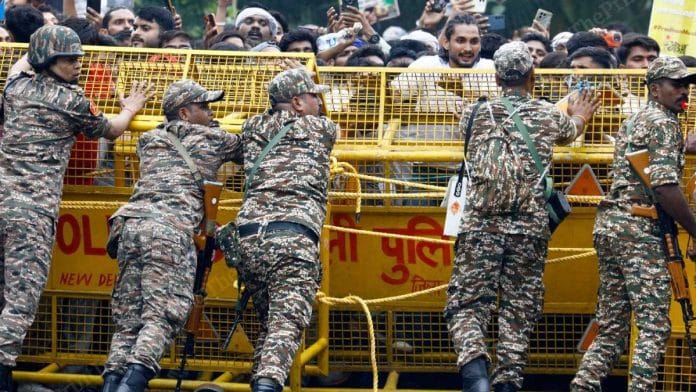
New Delhi: Delhi Police Friday denied permission for ‘Jantar Mantar 2.0’, a protest organised in the national capital Saturday (tomorrow) by political parties and student groups seeking the resignation of Chief Election Commissioner Gyanesh Kumar.
The demands for Gyanesh Kumar’s resignation stem from issues surrounding the Special Intensive Revision (SIR) of electoral rolls amid allegations of voter deletion.
At a press conference Friday, Delhi Police said preventive restrictions are in place in the New Delhi area, the heart of the capital, to maintain public order and safety under Section 163 of the BNSS (Bharatiya Nagarik Suraksha Sanhita). If anyone violates the provisions of Section 163 of the BNSS, proper legal action will be taken against them, they added.
Apart from this, Delhi Metro services and train arrivals at two of Delhi’s key railway stations, New Delhi and Hazrat Nizamuddin, are also being curtailed in view of the protest.
‘CJP didn’t keep word during July stir’
Addressing the press conference, Joint Commissioner of Police Nupur Prasad said police had received an application from Saurav Das, co-convenor of the activist group Cockroach Janta Party, seeking permission for the protest, but it came at short notice.
“The application was regarding an intimation for a protest on October 10, at Jantar Mantar. The protest was regarding the accountability of the CEC. This intimation was considered, and it was found that the intimation was given in a very short span of time, whereas as per the prescribed guideline, the intimation has to be received 10 days prior to the protest that is planned,” she added.
“It is also important to mention that on an earlier occasion, when the Cockroach Janta Party was given permission to hold a protest there, they did not follow the lawful directions and did not follow their own undertakings given at that point in time.”
Earlier this year, the CJP had organised a protest in the capital demanding the resignation of the then education minister Dharmendra Pradhan over NEET question paper leaks and larger
Prasad said, “Therefore, because of not following the legal directions, their own undertaking, and the prevalent law and order situation, and to maintain public safety, law and order, and traffic regulation, this time the permission is rejected; it is not approved.”
Delhi Metro, train services curtailed
Delhi Police Thursday asked the Delhi Metro Rail Corporation (DMRC) to reduce train frequency and close the entry and exit gates at 57 metro stations from 9 pm on 9 October (Friday) until “the situation normalises” on 10 October (Saturday), citing the proposed protest and the possibility of “unruly” crowds moving towards sensitive areas.
In a letter to the DMRC Managing Director, Joint Commissioner of Police (Transport Range-New Delhi) Rajneesh Garg said “in view of the proposed protests at Jantar Mantar and other locations in New Delhi District on 10.10.2026, and likelihood of unruly mob movement towards sensitive locations, frequency of Metro trains passing through the following Metro stations may be reduced and their entry/exit gates may be closed from 09:00 PM on 09.10.2026, continuing on 10.10.2026 till the situation normalises”.
The stations include Rajiv Chowk, Central Secretariat, New Delhi, Kashmere Gate, Mandi House, ITO, Patel Chowk and Supreme Court. The advisory also covers Hauz Khas, Lajpat Nagar, Jamia Millia Islamia and Sarai Kale Khan–Nizamuddin.
Earlier today, the Indian Railways also ordered the cancellation of all mail and express trains scheduled to arrive at New Delhi and Hazrat Nizamuddin railway stations between 4 am and 2 pm on 10 October, citing the possibility of severe road traffic congestion around the two stations.
Heavy security deployment in the city
Ahead of the protest, the government has mobilised one of the largest deployments of central forces for law-and-order duties. The Ministry of Home Affairs (MHA) has made available a total of 221 companies of the Central Armed Police Forces (CAPFs)—roughly 23,000 personnel—to the Delhi Police from 8 to 12 October.
For this, Central Reserve Police Force (CRPF) companies are being pulled out from the Jammu region of Jammu and Kashmir, where they had been retained following the Amarnath Yatra; West Bengal, where they have been stationed since last year’s elections; and Chhattisgarh, where they are specifically deployed for anti-Naxal operations.
The deployment is significantly larger than that seen during two previous major protests: the July Cockroach Janta Party (CJP) agitation and the farmers’ protests in 2020-21.
A total of 111 companies were made available to the Delhi Police for the July CJP protests. These included 41 companies of the Border Security Force (BSF), 18 of the Indo-Tibetan Border Police (ITBP), 16 of the Sashastra Seema Bal (SSB), 13 of the Rapid Action Force (RAF), 12 from the Central Reserve Police Force (CRPF, including five women companies), and 11 from the Central Industrial Security Force (CISF).
The additional deployment comprises 85 companies of the CRPF, 10 of the SSB, seven each of the RAF and the ITBP, and one of the CISF. Besides the CAPFs, at least 15,000 Delhi Police personnel will be deployed on the ground, multiple sources had told ThePrint earlier.
“These companies are being brought in for law-and-order duties amid the ongoing protests in Delhi to ensure there are no untoward incidents,” a source in the security establishment said. “The police felt the need for additional forces, and after consideration, it was decided that the deployment would be sanctioned from 8 to 12 October, following which the companies will be released.”
Edited by Sunanda Ranjan