



New Delhi: Months before the student protest that led to her fleeing to India, former Bangladesh Prime Minister Sheikh Hasina was already talking about an external threat, particularly by the US, to engineer a regime change.
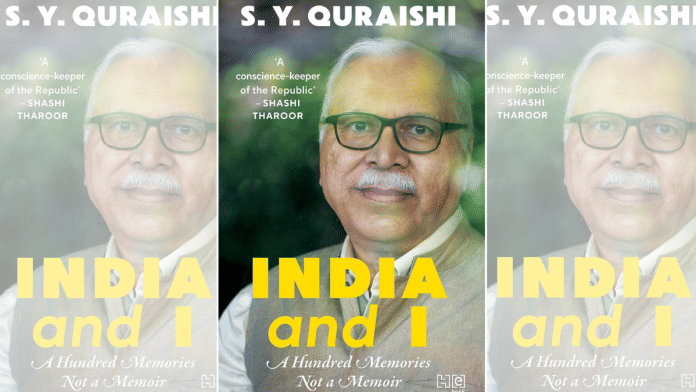
The revelations have been made by former Chief Information Commission S.Y. Quraishi in his new book, ‘India and I: A Hundred Memories, Not a Memoir’.
Quraishi talks about his meeting with Hasina in late 2023, when he visited Dhaka leading an election observers’ team that included Chief Election Commissioners (CECs) from the Maldives, Sri Lanka, and Nepal.
He mentions that the Bangladesh PM looked “visibly strained”. “She spoke bluntly about what she saw as external attempts, particularly by the United States, to engineer regime change,” he writes.
“Then she made a remark so sharp it could have been satire. She said the Americans wanted her to be friendly with Khaleda Zia and the opposition, and she would happily do so. ‘In fact,’ she added, ‘I will go and hug Khaleda Zia the day I see Donald Trump and Joe Biden even shaking hands!’,” the book, filled with 100 vibrant anecdotes, says.
Quraishi recalls another incident from 2012, weeks before the Assembly polls in Uttar Pradesh. Then Law Minister Salman Khurshid had made a controversial promise at the time, saying that the government would raise the quota for Muslims in jobs from 4.5 percent to 9 percent if the Congress party came to power.
On the Bharatiya Janata Party’s complaint of a Model Code of Conduct violation, Khurshid was ‘censured’ after a hearing. However, Quraishi says, what followed were voices alleging that the Commission had become ‘arrogant’ or ‘arbitrary’.
Disturbed by innuendos, Quraishi mentioned his grievance to Harish Khare, former Prime Minister Manmohan Singh’s press secretary. He recalls the promptness with which he received a phone call from Singh himself the next day, leading to a meeting the same day.
In their meeting, Singh is quoted as saying, ‘Harish told me what you said. If that is what you think, I will commit suicide.’
When Quraishi assured the PM that his concern was regarding other ministers, not the PM himself, Singh reassured the then CEC that if he had known about the remarks, he would have blasted the ministers. Singh told the CEC that he should just call the PM if he ever has something to say, and added, ‘The Election Commission is not just India’s pride; it is the soul of our democracy. If we lose that, we lose everything’.
The innuendos, Quraishi wrote, stopped after that interaction.
“I have met many powerful people in my life, but few who wore power so lightly, or felt its weight so deeply. In a profession that rewards a thick skin, Dr Manmohan Singh stood out for a rare sensitivity in the exercise of power,” the book says.
Meeting with Mohan Bhagwat
Quraishi was a part of a five-member Muslim delegation that met Rashtriya Swayamsevak Sangh (RSS) chief Mohan Bhagwat in 2022.
The delegation also included former Delhi Lt Governor Najeeb Jung, journalist Shahid Siddiqui, hotelier Saeed Shervani, and Lt. Gen. Zameer Uddin Shah (retired).
Quraishi now explains that the initiative was “entirely” theirs— “a small group of friends deeply worried about the growing insecurity among Muslims and convinced that dialogue is the only way forward.”
The book talks about the conversation that ensued as well.
It says that Bhagwat made three key points— that Hindutva was inclusive, that the Constitution was sacrosanct, and the Sangh was not seeking to replace it or disenfranchise Muslims. Third, that Hindus were deeply sensitive about two things: the cow and being called ‘kafir’ (disbeliever).
In response, among other things, the delegation told Bhagwat that if ban on beef helps harmony, ‘let’s all avoid it’. It also raised concerns over Muslims being branded as ‘jihadis’ or ‘Pakistanis’, to which Bhagwat was quoted as agreeing that such labeling must end.
‘Competence has no religion’
Quraishi speaks fondly of former BJP stalwart Sushma Swaraj.
An instance that he mentions is when Swaraj’s decision to appoint him as DG Doordarshan was criticised by her party colleagues, questioning a Muslim’s appointment to such a ‘sensitive’ post, especially in light of the fact that his wife was a journalist who often criticised the BJP’s policies.
“She faced them down. ‘I know this officer,’ she told them firmly. ‘He is as patriotic as any one of us. Competence has no religion.’,” the book notes.
Quraishi recalls former finance minister Arun Jaitley’s change of heart towards him as well.
“One leader who initially seemed suspicious of me was Mr Arun Jaitley. He had apparently perceived me as a protégé of his political rival, Sushma Swaraj. But I could see the frost gradually melting, as he recognized my even-handedness,” he wrote.
Jaitley later described Quraishi as ‘one of India’s most mature and credible Chief Election Commissioners’ while endorsing one of Quraishi’s books. He also found that Jaitley had recommended his name as an independent director of the Indian Premier League (IPL)— an appointment that never materialised due to a Supreme Court order deeming such appointments unnecessary.
An instance of discrimination
Quraishi also writes about the only instance in which he faced communal discrimination, in 40 years of civil service.
“In fact, I have sometimes said, half in gratitude and half in irony, that most of my glory came from Hindus, while many of my brickbats came from Muslims,” his book says.
The incident dated back to 1991, during the Haryana elections, when he was the Commissioner of Gurgaon Division and Resident Commissioner at Haryana Bhavan. However, when elections were announced, he was appointed as an election observer in another district.
This, he was later told, was because the Gurgaon Division included Mewat, with a substantial Muslim population. Therefore, it wasn’t ‘advisable’ for him to be on election duty there.
“If a Hindu officer could supervise elections in a Hindu-majority district without anyone imputing bias, why was a Muslim officer treated as a problem in a Muslim-majority area? The logic was crystal clear: my religion made me suspect. Not my record, not my integrity, but my religion,” his book says,
However, his appointment as the Chief Election Commissioner came as “poetic justice” to him, he writes. “The person deemed unsuitable to supervise one district because of his religion became responsible for the whole nation.”
(Edited by Tony Rai)