



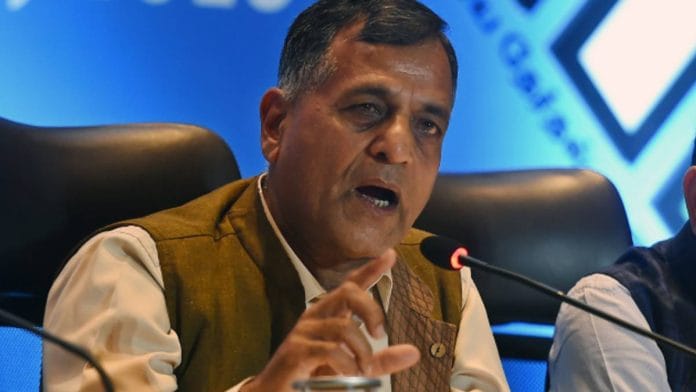

New Delhi: Former Election Commissioner of India Ashok Lavasa Saturday raised several questions for the Election Commission in relation to the Special Intensive Revision (SIR) exercise conducted by it throughout the country.
“Will the data be made public, that under Article 326, so many ineligible people have been discovered and deleted, because mind you, in the order, the Supreme Court said that within four weeks of such deletion, you should refer these cases to the foreigners’ tribunal,” Lavasa asserted. “I think four weeks are already over, so let us know how many people have been referred to the foreigner’s tribunals.”
In the judgement, the bench led by Chief Justice Surya Kant and Justice Joymalya Bagchi held that the SIR exercise that commenced with Bihar last June was undertaken with the objective to ensure integrity of electoral rolls that is the foundation of India’s democratic process.
Lavasa recalled that the Supreme Court said there is material on record to show that the piecemeal exercise of routine revision prescribed in law would not have served the purpose, and that material would have shown that electoral rolls probably needed a wholesale revision.
“What is that material on record? We don’t know. Nobody knows. At least it is not in the public domain. I don’t even think that it is part of any court records. So, what is the basis of that conclusion?” he asked.
Lavasa was speaking at the conclave on ‘One Nation-One Election, Federalism and Citizenship’, organised at the Constitution Club in Delhi Saturday.
The conclave was organised jointly by the Constitutional Conduct Group and the Group on Federalism & Elections. Also at the conclave were former Home Secretary Gopal Pillai, former Chief Election Commissioner S. Y. Quraishi, former Election Commissioner Ashok Lavasa, former chairman of the Law Commission of India Justice A. P. Shah, political scientist Niraja Jayal, and transparency advocate Anjali Bhardwaj, among others.
Lavasa ended his address with a nazm by Krishna Bihari ‘Noor’: “Zindagi Se Badi Saza Hi Nahin, Aur Kya Jurm Hai Pata Hi Nahin. Itne Hisson Mein Bat Gaya Hoon Main, Mere Hisse Mein Kuchh Bacha Hi Nahin (there is no greater punishment than life itself, and I do not even know what my crime is. I have been divided into so many fragments, that nothing is left for my share anymore)”.
Also Read: Why BJP is worried about SIR in Uttar Pradesh
The questions
Lavasa opined that the June 2025 notification announcing the SIR exercise “defies logical explanation”.
He then referred to other purposes listed for the conduct of the SIR.
One such purpose was to ensure that no ineligible person is retained in the electoral roll, and that the ECI wants to purify the rolls.
“So let us now subject the outcome of the SIR to these two purposes, and ask for evidence to show that the outcome of this exercise indeed fulfils the purpose,” he said.
Article 326 defines this eligibility, requiring electors to be 18 years old, citizens of India, of sound mind and should not be disqualified under any law.
“So, how many people were removed on this criteria?” he asked. “There is no data available in the public domain to show how many people have been deleted because they were ineligible. Yes, there was data to show that people were deleted because they had shifted from one place to another, that doesn’t make you ineligible. It only means that you should be registered somewhere else.”
Lavasa also raised questions over the lessons that the ECI may have learnt from the exercise and ways to assess the purity of the newly purified electoral rolls.
“So what is the degree of purity? How do you assess the health of the electoral roll in comparison to what it was earlier? I think this must be discussed and further, although there are questions about the manner in which the SIR was conducted, since the Supreme Court has upheld the might of the Election Commission to conduct the SIR, so probably it will go on.”
“So let us at least understand if any lessons have been learnt from that previous exercise and whether there are any improvements which the Election Commission proposes to bring,” he added.
‘Was SIR decision taken in MHA?’
Anjali Bhardwaj, co-convener of the National Campaign for People’s Right to Information and founding member of Satark Nagrik Sangathan, referred to allegations of bias and questions of partisanship against the ECI.
“There are extremely serious questions today surrounding the conduct of elections, and particularly concerning in this context, is the role of the Election Commission of India, and the role of the Supreme Court. The Election Commission, which has been mandated by the Constitution to hold free and fair elections in the country, has been working in a manner which has really eroded its credibility,” she asserted, adding that “today we have a long shadow cast on the integrity of the electoral process”.
Bhardwaj pointed out that the ECI has been accused of acting in a selective manner on complaints of model code of conduct violations, and highlighted the “lack of transparency in the functioning of the Election Commission”.
She spoke about the issue of voter turnout and the allegations surrounding the figures pertaining to voter turnouts.
She also highlighted that the SIR was conducted “without offering any reason for conducting the exercise, without any consultation being held with any political party or with the people of the country”.
In response to Right To Information (RTI) applications demanding reasons for SIR, Bhardwaj said the ECI said it did not have any documents listing the reasons for the exercise, and that the response said the decision to hold the SIR had not been taken in the Election Commission.
“That begs the question, where was this decision taken? Was it taken in the BJP headquarters? Was it taken by the Ministry of Home Affairs (MHA)?” she asked.
A rebuttable presumption
Lavasa said he was unsure that when the Constitution was adopted and implemented, whether its makers’ thought of a day when “so casually, the issue of citizenship would be reopened and it will become a source of immense anxiety to citizens”.
He pointed out that when the Constitution was adopted, the broad principles of citizenship were defined. One such principle was the “presumption of citizenship”, and the second was the continuation of that presumption.
“Now, the latest judgement, which was delivered on 27 May by the Supreme Court, ironically on the death anniversary of Jawaharlal Nehru. It says this is a rebuttable presumption. If your name is included in the head electoral roll because you are a citizen of India, that presumption that you are eligible, that can be rebutted,” Lavasa said.
He pointed out that the first electoral roll, which was created in 1950, was made even when the Census figures of 1951 were not available, and 1941 Census figures were available instead.
“But 1941 was a different context… in that environment, the Election Commission went about creating an electoral roll,” he said, pointing out that when the electoral roll was compared with the Census data which was released subsequently, the ECI had managed to enrol 17.30 crore voters as compared to around 18.02 crore in the Census.
(Edited by Nida Fatima Siddiqui)
No injustice should be done to any one under the guise of SIR
The whole SIR should’ve been made illegal.
Modi and Shah have turned out to be financially and morally corrupt. They will not reveal the numbers deleted from the electoral rolls. It would be interesting to see the demography of people deleted if they ever release the list.
All institutes have been degraded. SAD.