



New Delhi: In the backdrop of the West Asia conflict that has led to a surge in crude prices globally, the 11th Governing Council meeting of federal think tank Niti Aayog saw Prime Minister Narendra Modi and chief ministers talk about making energy “available and reliable”, and their prices “competitive”.
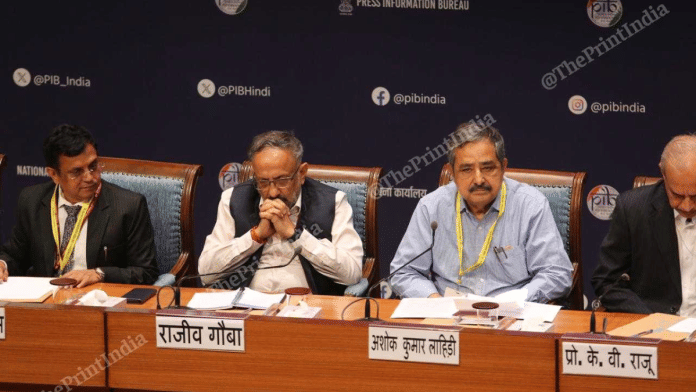
Briefing reporters after the meeting chaired by PM Modi, Ashok Lahiri, the newly appointed vice chairman of Niti Aayog, said that the CMs, who are members of the Governing Council, also talked about installing solar energy capacity on rooftops, in residential buildings, schools, hospitals, government buildings so that the “dependence of households on grid electricity is reduced and the subsidy problem becomes manageable.”
“The Prime Minister emphasised how at a time when many major economies are facing uncertainty and economic challenges, India’s growth story continues to move forward with confidence and determination,” Lahiri said.
The PM also emphasised the need to further strengthen the nation’s resolve towards self-reliance and highlighted the importance of adopting and implementing global best practices, particularly in the renewable energy sector.
Niti Aayog member Abhay Karandikar said that the CMs also talked about nuclear energy and the SHANTI Act that was passed last December, opening the sector to private players. “…this could become a good source of energy particularly when many of the states are looking forward to setting up data centres,” he said.
In a departure from the past, when Governing Council meetings were marked by CMs who were either absent or boycotted, Thursday’s meeting saw the CMs of all 28 states, including those of seven ruled by opposition parties, in attendance.
Lahiri said that India is playing its role in managing the West Asia crisis, but as “we are growing with the fastest growing major economies of the world, we have to keep doing our homework, which is actually to develop human capital”.
“Just because the West Asia crisis is there, we can’t be paralysed. We have to keep doing our work, develop our human capital,” he said.
The theme of the 11th Governing Council meeting was “Inclusive Human Development for Viksit Bharat@2047.
Productive employment, manufacturing, planned urbanisation
The meeting also saw the prime ministers and CMs discuss employment and skilling issues. Lahiri said that the PM stressed the need to adapt to new technologies with changing times.
“Another thing that the PM emphasised in the skill formation was partnership with industry. It was felt that a great collaboration between industry and a skilled institution is very important.”
On manufacturing, Lahiri said that most of the CMs and PM were very clear that “we will have to up our manufacturing”.
“The PM spoke about the next generation of manufacturing,” Lahiri said.
Referring to India’s recently concluded trade agreements with several countries, the PM encouraged states to “create opportunities for youth and MSMEs and to equip stakeholders to effectively leverage the benefits arising from these agreements.”
The PM also urged states to actively attract investments from partner countries, a release issued by the Press Information Bureau said.
Many CMs and the PM also talked about addressing disorderly urbanization.
“I think our leadership including the PM and CMs and members of the governing council are fully aware of the fact that we need planned urbanization. There was talk of industrial parks, which can be plug and play, where you need housing, where you need sewerage system, you need roads, schools, parks, all sorts of facilities,” Lahiri said.
He added that all the CMs who spoke at the meeting said the solution is not in building highrises and then worrying about roads, sewerages, etc. “They said that we should plan in advance.”
What the CMs said
Lahiri said that none of the CMs raised specific state demands but added that he was very impressed with the Tamil Nadu CM Vijay who said that he wanted the state to grow to a 1.5 trillion economy by 2035.
Asked about the issues raised by West Bengal CM Suvendu Adhikari, Lahiri said there was no elaborate discussions. “The CM tangentially mentioned that because of the history of the state, he may need support but nothing concrete.”
The PM also underscored the importance of cooperative federalism, the release issued by the PIB said.
“The Prime Minister stated that the Centre and the states must work together to achieve the goal of a Viksit Bharat. He stressed that the vision of Viksit Bharat should become the collective resolve of every state, district, block and village,” the release stated.
Highlighting the strength of India’s demographic profile, PM also observed that the country’s youth constitute its greatest asset, with nearly 70 crore Indians below the age of 25 years.
Calling this a demographic dividend, the PM urged states to focus on transforming it into a development dividend through education, skilling and capacity-building initiatives that prepare young people for future opportunities and challenges.
(Edited by Ajeet Tiwari)