



Gurugram: The Haryana government has begun the development of Namo City, a greenfield city planned around the Kundli-Manesar-Palwal (KMP) Expressway and the upcoming Delhi-Katra Expressway.
The Haryana Shehri Vikas Pradhikaran (HSVP) has identified villages across Jhajjar, Sonipat and Rohtak districts for the roughly 9,000-acre project, asking farmers there to give their consent on the e-Bhoomi portal by 31 October.
What is Namo City?
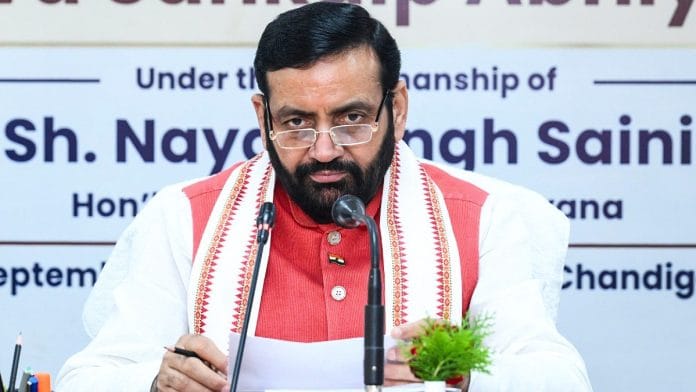
Chief Minister Nayab Singh Saini first announced the idea of Namo City in late June this year, when he met trade representatives from Delhi and pitched a 5,000-acre commercial township to draw wholesale traders out of the Capital’s congested markets.
Saini’s pitch was: a city with wide roads, modern infrastructure, single-window and time-bound clearances, and incentives linked to investment and employment. A senior officer of the Haryana government told ThePrint on Friday that the concept of Namo City is also a part of the larger, older idea for the KMP belt.
Back in 2018, the Haryana Cabinet had cleared the Panchgram Development Bill, envisaging five new cities over 50,000 hectares that would straddle the expressway across eight districts: Sonipat, Rohtak, Jhajjar, Gurugram, Rewari, Mewat (Nuh), Faridabad and Palwal.
Besides, the National Capital Region Planning Board (NCRPB) had on 16 June discussed setting up ‘Namo cities’ as self-reliant, environmentally sustainable urban centres along the Namo Bharat Regional Rapid Transit System (RRTS) corridors, a related but distinct strand of the same branding.
In fact, the Namo City branding itself traces back to a decision in that meeting, where the board proposed four semi-greenfield cities to be developed as mixed-use, transit-oriented developments at select existing and upcoming stations along the Namo Bharat (RRTS) corridors. These are to be named ‘Namo Cities’ and will be chosen through a competitive process among the National Capital Region’s participating states.
To push the scheme forward, the Board approved a performance-linked incentive of Rs 5,000 crore, structured as a mix of grant, loan and guarantee support, including a Rs 1,000-crore grant component, with NCRPB funding meant to catalyse growth at these nodes.
Haryana’s KMP-linked Namo City draws from both lineages: the trader-relocation logic of June’s announcement and the older ambition of planned satellite cities along the expressway, the officer explained.
The HSVP’s land procurement advertisement, published on 1 September, listed Namo City as a 9,000-acre component within a larger 64,000-acre drive that also covers ordinary residential-commercial-institutional expansion and Transport Nagar schemes across dozens of towns, including in Sonipat, Rohtak and Jhajjar, the same three districts earmarked for Namo City.
The HSVP has identified 10 revenue villages specifically for Namo City: Hasangarh in Rohtak (1,320 acres); Nilothi, Khedi Jasaur, Jasaur Khedi and Loharhedi in Jhajjar (1,731, 2,269, 1,315 and 1,117 acres respectively); and Pai, Barauna, Khurmapur, Rohna and Kidholi in Sonipat (1,040, 174, 440, 516 and 30 acres respectively), adding up to just short of 10,000 acres.
Farmers in these villages have been asked to record their consent on the e-Bhoomi portal by 31 October, after which HSVP says it will proceed to purchase the land as per policy and take up development.
Also Read: Haryana rolls out red carpet for Delhi traders with 5,000-acre commercial township plan—‘Namo City’
What the city is meant to have
The HSVP describes Namo City as a mixed-use urban centre with residential, commercial and industrial zones, built around housing, employment, education, health care and recreation. The blueprint speaks of world-class schools and hospitals, parks and organised shopping centres, and a transport network designed so residents can reach public transport within 30 minutes of home.
The city is also proposed to be linked to the Namo Bharat regional rail network, tying it into the wider Regional Rapid Transit System (RRTS) grid taking shape across the National Capital Region.
The state government is to build the basic infrastructure, while private investors are expected to be brought in to develop the city itself, a public-private model similar to what HSVP has used in other new sectors.
Farmers’ response could be a challenge
The Namo City push comes even as the HSVP’s projects barely a few kilometres from these villages remain stuck because a lackadaisical response from farmers.
Under Bahadurgarh’s Master Plan 2041, HSVP had proposed 29 new sectors requiring close to 6,355 acres and had similarly turned to the e-Bhoomi portal to acquire land voluntarily from farmers.
The response has been abysmally poor. Land was sought across 15 villages, including Sankhol, Sarai and Sadpur, but most farmers stayed away, unwilling to part with land at government rates as market prices have climbed; some are said to have sought as much as Rs 10 crore an acre.
Political friction from within
Even the larger Panchgram project of which Namo City is said to be a part has not been without political friction. Rao Inderjit Singh, Member of Parliament from Gurugram and a Union minister, has repeatedly warned that the project could come at the cost of farmers, cautioning that agricultural land in the Rewari-Gurugram belt risked being “squeezed like a lemon”, and indicating he was prepared to take the matter to the Prime Minister’s Office if the state pressed ahead without addressing his concerns.
He renewed his objections in June, after the NCR Draft Regional Plan 2041 revived the Panchgram proposal, this time raising a second question: where would these new cities would get their water from?
(Edited by Nardeep Singh Dahiya)
Also Read: For CM’s orders, Haryana officials instructed to ditch ‘Dekh Len’ for action-oriented approach
Politician are fcknn societal clowns
Power makes us desperate and dirty
They are too dumb and blind in their maternal needs to understand what their decisions can affect heavily in future for long term or even can have a helping part accelerating the global pandemics .
There should be a rule to teach every politician about environment, Earth’s origin and near posible consequences and effects of modern human actions that can affect nature