



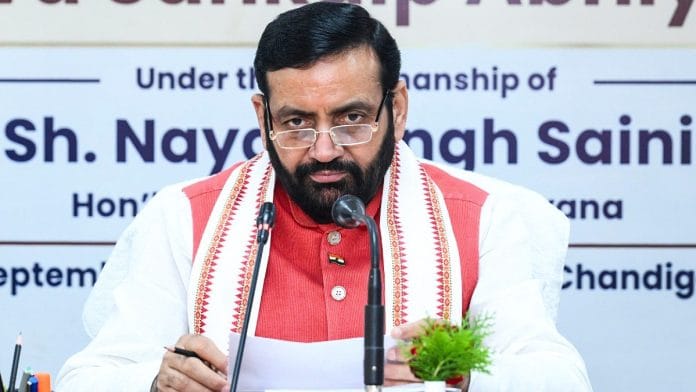
Gurugram: For years, every kind of decision taken in a meeting chaired by the Haryana chief minister often ended the same way on paper—an officer would write “Avashyak Karyawahi Karen” (necessary action be taken), or “Sheeghra Karyawahi Karen” (prompt action be taken), or simply “Dekh Len” (look into it).
The file would move but nobody could say who was to do what, or by when.
That practice is now banned.
The Haryana government’s Human Resources department has issued a standard operating procedure (SOP), an eight-page document, mandating that every decision taken in a meeting chaired by the chief minister be broken into a specific “action point”.
Each action point must answer five questions: what is to be done, who will do it, with whose help, by what date, and what is the expected result.
The order issued Tuesday by Chief Secretary Anurag Rastogi was sent to every administrative secretary, head of department, managing director of state boards and corporations, divisional commissioner, deputy commissioner, sub-divisional officer and university registrar in Haryana.
The SOP came into force with immediate effect and will apply to all future meetings chaired by the chief minister, and, as far as possible, to pending action points of meetings already held. The order warned that any unnecessary delay or disregard of the instructions, at any level, will be viewed seriously.
A senior officer in the Haryana government told ThePrint Wednesday that the order was triggered by a pattern the government noticed on its own: minutes of meetings were being prepared inconsistently, decisions were not being converted into clear, trackable points, and compliance reporting had no uniform format.
Also Read: Haryana reshuffles 26 IAS, HCS officers; town planning, urban local bodies depts change hands
Action begins before the meeting
The application of the new rules begins well before officers walk into the room where the chief minister is to chair a meeting. Departments are now required to circulate the agenda and a background note at least three working days ahead of any meeting chaired by the chief minister.
Only subjects that genuinely need a decision or a review can go on the agenda.
Every agenda item must have seven particulars in brief: the current status, decisions taken earlier on the subject, action taken so far, achievements and obstacles, the financial or administrative position, the decision being sought, and a proposed timeline.
Minutes not just a summary
Once such a meeting is over, the minutes cannot simply record what was discussed. The SOP is explicit on this point—minutes must be “decision-oriented and action-oriented,” not a general account of the conversation.
Every action point recorded in the minutes must be written clearly enough that compliance can be measured objectively later. Further, vague, catch-all phrases like “Avashyak Karyawahi Karen”, “Sheeghra Karyawahi Karen”, “Dekh Len” are to be avoided “as far as possible”.
Draft minutes have to be ready within three working days of the meeting. The department that coordinated the meeting is responsible for the first draft and if several departments were involved, one lead department is responsible for the final, approved version. Once approved, the minutes cannot be altered and any factual correction would require a separate corrigendum cleared by the competent authority.
The paper trail: Action Taken Report
For every action point, departments must file an Action Taken Report (ATR), described in the SOP as an “evidence-based compliance report,” not a formal write-up.
Each report has to mark the point as Completed, In Progress, Overdue, Not Started, or Not Feasible/Issue Requiring Decision. If a department wants to mark something Completed, it is required to show the order, notification, approval, progress report, photograph, portal report or statistical data behind that claim.
The days of “Karyawahi ki ja rahi hai” (Action is being taken) without specifics are over, as the SOP asks for the exact action taken, the reason for delay, and a revised completion date wherever a point is still pending. The first ATR is due within a month of the minutes being circulated. If an action point is still open after that, an updated report has to be filed in the first week of every following month, without fail, until it is closed.
Escalation if nothing moves
The action points that keep missing their deadlines will not be allowed to merely lie in a file without any follow-ups.
Under the SOP, the administrative secretary or head of department must review the reasons for delay.
If the hold-up lies with another department, that has to be stated plainly in the report. If an action point sees repeated delay, the matter can be escalated to the Chief Secretary.
CM Meeting Monitoring Portal
The government’s other lever is a portal, the CM Meeting Monitoring Portal, that will now serve as the central tracker for every decision taken at these meetings.
Departments have two working days after the minutes are approved to upload the relevant action points, along with the responsible officer, deadline, current status, supporting evidence and reason for any delay.
Each department must appoint a senior officer as its nodal officer for the portal, and they would be responsible for keeping the information accurate and current.
(Edited by Chingkheinganbi Mayengbam)
Also Read: Haryana Lokayukta report card: FIRs and land records for sale, a decade of official silence