







Gurugram: Anyone who has tried driving a car into Delhi’s Sadar Bazar or Chandni Chowk on a weekday knows the challenge. Narrow lanes built for handcarts and cycle-rickshaws are choked with delivery vans, e-rickshaws and parked vehicles. For traders dealing in bulky items, like iron, marble or electronics, in Delhi, loading and unloading goods can take hours.
The Haryana government now wants to turn Delhi’s gridlock into an opportunity.
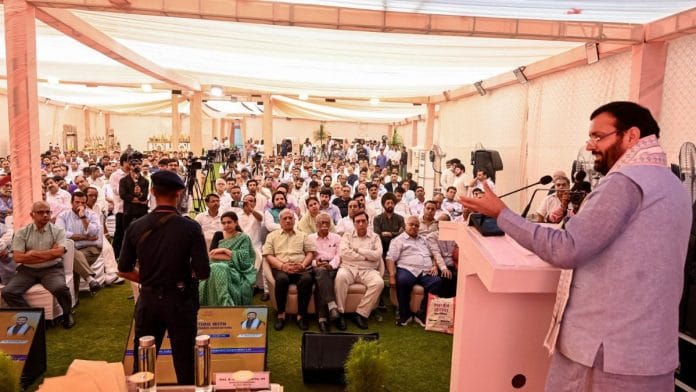
Chief Minister Nayab Singh Saini Monday met representatives of 26 Delhi trade associations at Haryana Bhawan in the capital and made a direct pitch: shift your business to Haryana, where the state promises wide roads, modern infrastructure and hassle-free approvals.
Saini told traders that Haryana intends to develop a large commercial market and industrial ecosystem in areas adjoining Delhi, giving them the space that Delhi’s markets no longer have.
The centrepiece of the plan is ‘Namo City’, a proposed township spread over nearly 5,000 acres that will house both commercial establishments and public facilities.
Saini said the market will be designed keeping the next 50 years in mind, with wide roads for smooth traffic movement and green spaces, unlike Delhi’s cramped wholesale markets.
As part of the plan, the chief minister said the government is offering customised incentive packages, employment-linked incentives, single-window clearances and time-bound approvals to investors.
He said dry fruit traders from Khari Baoli have already picked up around 280 plots in Haryana, while traders from the Ludhiana dry fruit market have taken roughly 180 plots, signalling that the shift has already begun even before the new township is fully ready.
“Today, at Haryana Bhawan, New Delhi, I held a direct dialogue with the esteemed business brothers of Delhi and listened to their views and suggestions. Trade and industry are the strong foundation of the economy of any state,” Nayab Saini wrote on X with pictures of the meeting after the Haryana Bhawan event.
“Under the guidance of the Hon’ble Prime Minister Shri @narendramodi Ji, our double-engine government is continuously working to provide a hassle-free, transparent, and investment-friendly environment for business. The suggestions of the business class will play an important role in giving new momentum to the resolve of a developed Haryana and a developed India,” he added.
आज हरियाणा भवन, नई दिल्ली में दिल्ली के सम्मानित व्यापारी बंधुओं के साथ सीधा संवाद कर उनके विचार और सुझाव सुने।
व्यापार और उद्योग किसी भी राज्य की अर्थव्यवस्था की मजबूत आधारशिला हैं। माननीय प्रधानमंत्री श्री @narendramodi जी के मार्गदर्शन में हमारी डबल इंजन सरकार व्यापार के लिए… pic.twitter.com/dAspwdZNZp
— Nayab Saini (@NayabSainiBJP) June 29, 2026
An old trend
This is not the first time traders and industries have looked beyond Delhi’s borders.
Over the past few decades, as the capital’s markets and industrial areas became increasingly crowded and pollution norms tightened, a steady stream of units moved out to neighbouring towns.
Gurugram attracted numerous corporate offices and manufacturing units from the 1990s onwards. Faridabad, already an old industrial town, attracted more factories seeking cheaper land and easier logistics. Bahadurgarh, sitting right on the Delhi border along the Rohtak road, became a hub for plywood, furniture, footwear and small-scale manufacturing units that could no longer expand inside the capital.
Sonipat’s Rai Industrial Estate, too, picked up several units over the years, helped by its proximity to the Delhi-Panipat national highway.
The new plan announced this week is essentially an attempt to repeat that pattern on a much larger and more organised scale, this time targeting Delhi’s wholesale trading markets rather than just factories.
The relocation plan
An officer with the Haryana State Industrial and Infrastructure Development Corporation (HSIIDC) told The Print that the proposed wholesale markets are likely to come up on the outskirts of Delhi in Sonipat district, building on the area’s existing industrial base.
The officer said Monday’s meeting was productive, with nearly 400 trader representatives from Sadar Bazar, Chandni Chowk, Gandhi Nagar, Khari Baoli, Nehru Place, Chawri Bazar, Bhagirath Palace and Azadpur showing interest in the proposal.
Industries Minister Rao Narbir Singh, who was also present at the meeting, said Delhi’s markets are bursting at the seams and that Haryana is building dedicated industrial clusters to give traders the facilities they need.
He cited the state’s law and order record, road connectivity, and the fact that 14 of Haryana’s districts fall within the NCR region as reasons traders should consider relocating.
Traders from the iron market, the marble association and other groups raised their concerns directly with the chief minister, who assured them the government would address their issues and keep his office open for further discussions.
During the meeting, the chief minister pointed to Maruti’s upcoming plant near Rai, expected to produce nearly one million vehicles a year, and the IMT and Electric Vehicle Zone coming up at Kharkhoda as proof that big projects are already underway in the state.
He also mentioned a 600-acre horticulture market under construction near Ganaur in Sonipat that will connect Haryana with Uttar Pradesh, Rajasthan, Punjab, Himachal Pradesh and Jammu and Kashmir.
(Edited by Sugita Katyal)