



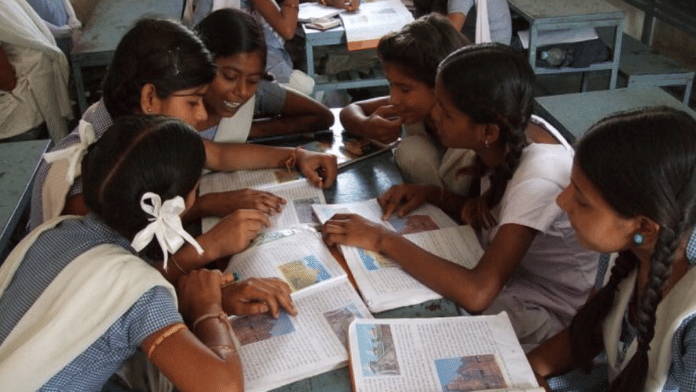

New Delhi: The Gen Alpha seem to have taken a leaf out of Gen Z’s book as they take to the streets to protest poor infrastructure and shortage of teachers in schools across states.
Government data shows the scale of the problem. According to the government’s UDISE Plus report and a Parliamentary panel report, nearly 10 lakh posts are vacant across India’s school education system; 95,000 schools are without functional electricity, and 5.42 lakh don’t have functional computers.
The UDISE Plus report 2025-26 released in July also said that 4.77 lakh schools lack internet facilities, while 10.67 lakh don’t have functional mobile phones for teaching.
For a generation growing up with smartphones, social media and artificial intelligence, the contrast is striking.
The protests are not confined to one state.
From Uttar Pradesh to Bihar, Maharashtra to Rajasthan, students have been raising their voices against gaps in the school system.
The protests have prompted state governments to act. Following the student protests, the Uttar Pradesh government, for instance, issued a 14-point checklist for nearly 40,000 government schools covering basic facilities such as drinking water, toilets and electricity.
In Rajasthan, the government announced a Rs 12,500-crore, three-year plan to overhaul government-school infrastructure.
The issues raised by these students are not isolated grievances; they echo gaps documented in the government’s own data.
The Union education ministry’s annual Unified District Information System for Education Plus or UDISE+ report 2025-26, released last month, lists a total of 14.67 lakh government and private schools, serving 24.72 crore students with 1.03 crore teachers, making it one of the world’s largest school education systems.
Of them, government schools account for 10.05 lakh, or 69 percent, and cater to 11.89 crore students, covering a major part of India’s school network.
The UDISE+ data shows that 1.39 lakh schools do not have a library, 2.65 lakh have no playgrounds, 13.62 lakh do not have a digital library, while 71,959 lack functional girls’ toilets and 1.12 lakh lack functional boys’ toilets.
Also Read: Modi’s I-Day outreach to Gen Z & Gen Alpha: Free online coaching for competitive exams, talent hunt
Gap between expectations and reality
Educationist Meeta Sengupta said the protests reflect a growing gap between what Gen Alpha expects and what it experiences.
“Gen Alpha finds itself visibly staring at the gap between their aspirations, which are made visible by the progress seen all around them, and their own reality,” she said.
She said basic school amenities are essential for a safe and healthy childhood, and called for “stronger community-led school governance” so that students are not forced to advocate for themselves.
A NITI Aayog report, School Education System in India, also released last month, says around one in 15 schools still lacks a functional girls’ toilet.
It notes that universal access to safe and functional toilets is essential not only for health and dignity, “but also for improving attendance, retention and transition rates, particularly at the upper-primary and secondary levels”.
While UDISE+ data shows that 95,000 schools still do not have functional electricity, the NITI Aayog report says the share of schools with electricity rose sharply from 55.96 percent in 2014-15 to 91.9 percent in 2024-25.
The report credits the sustained improvement to policy efforts and investment in school infrastructure. However, it highlights that nearly 7 percent of schools still lack electricity, underlining the need to “bridge last-mile gaps, particularly in difficult geographies, to achieve universal coverage and support technology-enabled learning”.
The NITI Aayog report also highlights gaps in water and hygiene facilities.
While the share of schools with drinking-water facilities increased from 96.5 percent in 2014 to 99 percent in 2025, 14,505 schools still lack functional water sources and nearly 59,829 lack hand-washing facilities.
The report notes that such gaps “translate to schools not being physically fit for children to continue, and hamper education and basic public health”, particularly in the aftermath of the COVID-19 pandemic.
Ashok Agarwal, a Supreme Court lawyer who has been working on issues related to public education and health, said the situation on the ground is often worse than what official data captures.
“We keep visiting schools and forget basic amenities. Many schools are still running out of tents, while students are forced to sit on the ground or floors because there are no proper classrooms or furniture,” Agarwal told ThePrint.
“Government data does not capture these ground realities. There is a reason students are feeling so disgruntled and have started protesting,” he added.
High teaching vacancies
A Parliamentary committee report released last August flagged about 10 lakh teaching vacancies across the country’s school education system in 2024-25, including in central institutions such as Jawahar Navodaya Vidyalayas (JNVs) and Kendriya Vidyalayas (KVs), as well as state-run schools.
The concern is also highlighted in the NITI Aayog report, which says “teacher vacancies show a critical gap in the availability of qualified teachers across several Indian states”, particularly at the elementary, secondary and senior secondary levels.
The report points to Bihar, Jharkhand and Madhya Pradesh as states with particularly high vacancy levels.
Bihar alone has 2.08 lakh vacancies at the elementary level, 36,035 at the secondary level and 33,035 at the senior secondary level.
Other states, including Karnataka, Haryana and Maharashtra, also report significant shortfalls, pointing to the “systemic nature of the challenge”, the report says.
The NITI Aayog data also shows 47,122 elementary, 2,877 secondary and 2,020 senior-secondary vacancies in Madhya Pradesh; 3,856 elementary, 1,365 secondary and 14,949 senior-secondary vacancies in Rajasthan; and 80,341 elementary, 18,343 secondary and 881 senior-secondary vacancies in Jharkhand.
Major gap in digital infrastructure
While India is implementing the National Education Policy (NEP) 2020, which places strong emphasis on digital education, AI integration and online learning, government data shows that nearly one in three schools does not have computer facilities.
The digital divide is not merely reflected in government data.
On July 28, nearly 1,500 students at a government school in Uttar Pradesh’s Fatehpur district protested over poor infrastructure, demanding, among other facilities, a computer lab. Students said the school had no computer lab or library.
The gap is even wider when it comes to functional computers. UDISE Plus data shows that of the country’s 14.67 lakh schools, 5.42 lakh do not have functional computers, while 4.77 lakh do not have internet facilities.
The data also highlights a significant gap in access to mobile devices for teaching. More than 10.66 lakh schools do not have functional mobile phones used for teaching purposes, meaning nearly three-quarters of schools lack this facility.
The NITI Aayog report also flags gaps in digital infrastructure. It notes that while the past decade has seen a rapid expansion of computer facilities across most states, more than one-third of schools still lack computers, with wide interstate disparities persisting.
It adds that as digital pedagogy becomes more central to classroom practice under NEP 2020, reliable connectivity has become increasingly important, yet over “one-third of schools remain without connectivity, underscoring the persistent issue”.
(Edited by Sugita Katyal)
Also Read: What’s in the Delhi Private Universities Bill & why it has raised privatisation concerns