





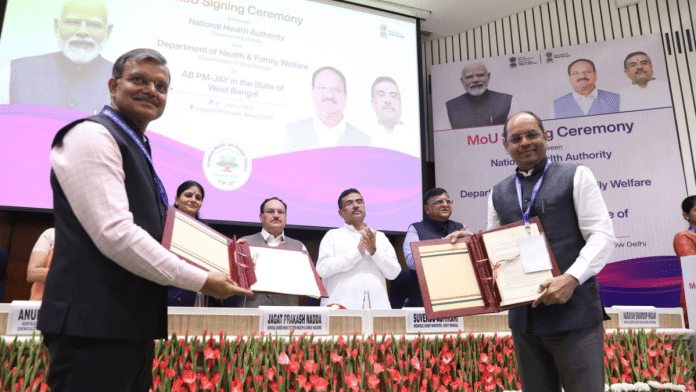


New Delhi: West Bengal officially became the 36th state/UT to implement the Ayushman Bharat Pradhan Mantri Jan Arogya Yojana (AB PM-JAY), bringing 1.43 crore families under the Centre’s flagship health assurance scheme.
The state government signed a MoU with the National Health Authority (NHA) at Vigyan Bhawan on Monday in the presence of Chief Minister Suvendu Adhikari and Union Health Minister J.P. Nadda.
Nadda said the state’s inclusion would extend the benefits of the health coverage programme to lakhs of families who had remained outside it since its launch in 2018.
Highlighting the impact of the Ayushman Bharat health insurance scheme, Nadda said that treatment worth over Rs 1.7 lakh crore had been provided to beneficiaries under the programme.
“The scheme, which initially covered 10.74 crore families, has been expanded to include all citizens aged 70 years and above as well as ASHA and Anganwadi workers, bringing an estimated six crore additional individuals under its ambit,” he said, adding that out-of-pocket health expenditure had fallen from 62.6 percent before 2018 to 43.4 percent.
Highlighting a significant milestone in India’s cancer care journey, Union Health Minister Shri Jagat Prakash Nadda noted at the MoU Signing Ceremony for the implementation of Ayushman Bharat PM-JAY in West Bengal that, according to a Lancet report, 90% of people diagnosed with… pic.twitter.com/MIZwlf4QCi
— Ministry of Health (@MoHFW_INDIA) June 8, 2026
Citing a report published in The Lancet, he said 90 percent of cancer patients in India begin treatment within 30 days of diagnosis. He added that Ayushman Bharat offers cashless, paperless and fully digitised healthcare services to beneficiaries.
According to the NHA, around 1.24 crore economically vulnerable families in West Bengal, approximately 3 lakh ASHA and Anganwadi worker families, and senior citizens aged above 70 years will be covered under the scheme, taking the total beneficiary base to around 1.43 crore families.
Launched in September 2018, the scheme provides cashless health cover of up to Rs 5 lakh per family per year for secondary and tertiary care hospitalisation, including surgeries, medical treatments and day-care procedures, at empanelled public and private hospitals.
It targets the bottom 40 percent of the population by economic status for which the beneficiaries are identified primarily through the Socio-Economic Caste Census database. There is no cap on family size and beneficiaries do not pay any premium.
One of the scheme’s key features is portability, allowing beneficiaries to access treatment at any empanelled hospital across India, irrespective of their registration
Calling the agreement a historic step for the state, CM Adhikari said, “Today, more than 6.5 crore people stand to benefit.”
He added that one of the scheme’s biggest advantages was its portability, which would particularly help migrant workers from districts such as Malda, Murshidabad and Nadia who travel to other parts of the country for employment.
“If they need treatment and have an Ayushman Bharat card, they can get treatment in any empanelled hospital in the country,” he said.
According to NHA CEO Dr Sunil Kumar Barnwal, the programme covers more than 60 crore beneficiaries and has facilitated over 12 crore hospital admissions so far. The total value of treatments provided under the scheme has crossed Rs 1.82 lakh crore.
The scheme covers nearly 1,961 treatment packages across specialities, including oncology, nephrology, cardiology, orthopaedics and transplant-related procedures, and is implemented through a network of more than 36,000 empanelled hospitals.
Also Read: Haryana to Manipur—private hospitals struggle with Ayushman Bharat. Govt owes Rs 1.2 lakh cr
Why Bengal stayed out
The previous Trinamool Congress government led by Mamata Banerjee declined to join the programme, citing concerns over the Centre-state cost-sharing arrangement and objecting to the scheme carrying the Prime Minister’s name.
Instead, it operated Swasthya Sathi, a health insurance programme launched in 2016, offering cashless treatment of up to Rs 5 lakh per family annually at empanelled hospitals within West Bengal.
While the Swasthya Sathi provided similar financial coverage, it lacked nationwide portability, meaning beneficiaries could not access treatment outside the state.
At the MoU signing event, Nadda said that portability would be among the biggest advantages for West Bengal residents, particularly migrant workers employed in other parts of the country.
“If a person from Bengal is working in Chennai or elsewhere in the country, treatment can be provided there itself and the payment will go directly to the hospital. It will be completely cashless,” he said.
The Centre had already released the first instalment of Rs 527 crore to West Bengal under the National Health Mission after the new government took office, Nadda said, adding that the state would receive a total of Rs 3,505 crore, of which the Centre’s share would be approximately Rs 2,350 crore.
Barnwal, meanwhile, said implementation work had already begun, with teams from the NHA and the West Bengal government working on integration of beneficiary databases, hospital empanelment and onboarding of state systems onto the national digital platform.
(Edited by Tony Rai)
Also Read: Why nearly dozen multi-speciality private hospitals in Delhi aren’t too keen on AB-PMJAY empanelment