





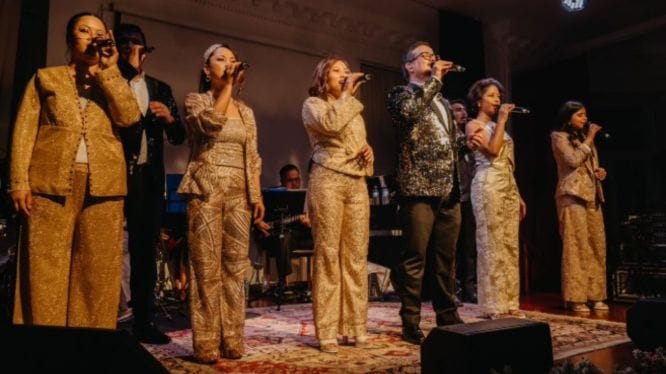


Shillong (Meghalaya): When people in Meghalaya were being shot point-blank and streets emptied under insurgent diktats in the early 2000s, a choir began singing hymns in Shillong’s street corners, drawing wary residents out. A citizens’ group called Shillong We Care would try to convince people on curfewed nights that it was safe to step out. Look, teenagers are singing, they said.
Twenty-five years later, the Shillong Chamber Choir has become the poster child of Meghalaya. The group is booked years in advance, performing across the world in 40 languages — and, after the death of its formidable and exacting founder, still refusing to fall apart.
The choir’s present-day scale sits in sharp contrast to the Shillong it emerged from in 2001, a city once marked as much by insurgency and extortion as by music. Or that after the sudden death of founder and conductor Neil Nongkynrih in 2022, many assumed the choir would not hold.
It did, and it’s going stronger than ever.
Over time came appearances that would once have seemed improbable for a choir from Shillong — performing for the royals of Rajasthan, former US President Barack Obama, collaborations involving Amitabh Bachchan and Zakir Hussain, opening for Coldplay, global tours, and broadcasts that carried their “Vande Mataram” arrangement into homes during ISRO’s Chandrayaan-1 mission.
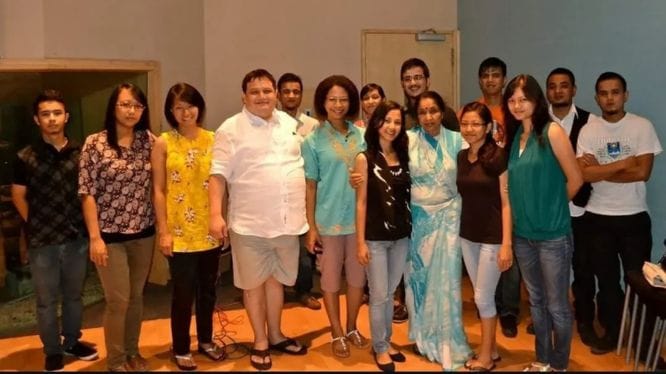
Twenty-five years after ‘Uncle Neil’ began gathering young singers in Shillong — amid a turbulent political moment in Meghalaya, when locals were using music and civic action to push back against gun culture and insurgency — the ensemble he founded is touring relentlessly, adapting, arguing with commerce, carrying his unfinished ideas, and negotiating the harder question of what it means for a collective to outlive its charismatic creator.
Its story, members insist, has never been only about music.
It is also about discipline, prayer, collective ego surrendered to harmony and as longtime observers say, it was about helping change “the face of Shillong from insurgency to music.”
“The top five things when you think of Meghalaya are that it is the place of living root bridges, the place of Lakadong turmeric, the place for waterfalls, caves, and it is the home of the Shillong Chamber Choir,” Dr Vijay Kumar D, Commissioner and Secretary of the Meghalaya government overseeing tourism, finance and other departments, told ThePrint.
The members
The story of how the choir became an institution can begin with a prodigy who, in a way, altered its fate.
It was as if Lata Mangeshkar trained in opera and gospel and carried it on stage with the poise of Shreya Ghoshal.
Only, Ibarisha Lyngdoh was just an 11-year-old schoolgirl carrying two songs to an audition she barely understood might change her life and the direction of the choir.
At the time, Nongkynrih was imagining something closer to an all-boys ensemble. Ibarisha had reached him through hearsay — stories of a child prodigy with an angelic voice. She arrived nervous, conscious of the formidable reputation of the man everyone called ‘Uncle Neil’.
Then she sang.
Within the choir, the story has since become part origin myth, part institutional memory: that Nongkynrih and a colleague listening to the audition were so moved they stepped away in tears before deciding the all-boys idea would have to give way.
Ibarisha, 33, tells it with less drama than others do. For her, the greater story lies in what followed.
She grew up inside the institution. Her first major performance in the children’s choir was for former President APJ Abdul Kalam. There were recitals abroad, relentless rehearsals, and the long discipline of learning harmony over solo instinct. But when she speaks of Nongkynrih’s influence, she returns first to character.
“He taught me two hours of singing, eight hours of humility,” she said.
Nongkynrih often warned that talent without humility ruins everything. That ethic, Ibarisha believes, is why the choir endured.
There were testing times, too.

A few years ago, in the midst of touring and performance, she lost the voice that had defined her. For a singer shaped so completely by music, the possibility that she might not sing the same way again was devastating.
“It felt like everything was falling apart. I didn’t think I would ever be able to sing the same way ever again,” Ibarisha said.
Within the ensemble, members recall the period as one of collective anxiety, watching one of their central voices struggle with something no amount of rehearsal could fix.
Years later, she speaks now of recovering her voice through care, faith and patience.
Others in the choir describe the collective itself in similar terms.
For 37-year-old William Richmond Basaiawmoit, a soloist who joined in 2008 after Nongkynrih heard him sing in his sister’s choir and invited him to try out, the journey has been “more one of spiritual development” than music alone.
He was not, he said, a Christian “per se” when he joined, but the communal life of the choir — prayer, discipline, and shared struggle — kindled something in him.
“The Shillong Chamber Choir is a holy name,” he said.
The members don’t think of the choir as just a profession; for them, it is a vocation. That also shapes how he understands Nongkynrih’s legacy.
“It outgrew him,” William said. “It became bigger than him.”
Vijay also agreed.
“Greatness is only when what you’ve created lasts beyond you, right?” he said of Nongkynrih, whom he referred to as “probably Meghalaya’s greatest.”
For many in Shillong, that is the highest proof of what the founder built: an institution able to survive the founder, who was an institution in himself.
Also read: The all-new Hansraj College. Cows, Gayatri mantra, BJP videos, FIRs & principal Rama Sharma
The ‘Outsider’
For Rishila Jamir, 37, the journey into the choir began outside Meghalaya altogether.
Raised in Nagaland and studying at St Stephen’s College in Delhi, she had imagined music might take her elsewhere — probably even beyond India. Her father had pushed her into instruments and singing early, and she had flirted with ambitions of a professional musical career. But it was through college friend and now choir member, William, who had just joined the choir then, that she first encountered the group.
He invited her to sing with them at a Christmas performance at the Lotus Temple.
“That one meeting changed my life,” she said.
What drew her, she insists, was a larger sense of purpose. After finishing her studies, despite her family’s anxieties, she packed her bags and moved to Shillong, unsure whether Nongkynrih would even accept her into the choir.
He did take her in.
Rishila often speaks of belonging while talking about the choir. As the ensemble’s most visible member from outside Meghalaya, she said that the choir and the state became a second home. In a region often spoken of externally as one block, her presence also widened the choir’s Northeast identity.
And like others, she describes the journey as becoming far more than music.
“It changed my entire point of view of life,” she said.
Also read: Now, 10-minute delivery of fresh air, escape. Delhi’s affair with hidden lakes, secret trails
From Shillong secret to national phenomenon
If the choir’s moral and musical foundations were forged long before television, national recognition arrived with a rupture.
When quizmaster and producer Siddhartha Basu was putting together the second season of India’s Got Talent in 2010, he was looking for acts that could expand what Indian audiences thought a talent show could hold. Someone on the team mentioned a remarkable choir from Shillong.
They arrived for the auditions in Kolkata carrying little of reality television’s usual flamboyance — 13 singers, intricate arrangements, disciplined stagecraft, a repertoire steeped in Western classical and gospel sensibility.
Everyone was struck. But even the choir had to learn the logic of television.
At one stage in the competition, Basu said, voting patterns suggested they were not connecting enough beyond admiration. It was he who nudged Nongkynrih to think more strategically about repertoire; to retain complexity but make it travel farther.
That is where the medleys that later became part of the choir’s signature began to take fuller shape. Classical harmonies met Hindi melodies. ‘Ode to Joy’ could sit beside ‘Aashayein’. Choral technique widened beyond the ordinary.
Soon, the choir won the show.
“We just produced the show,” Basu said. “They did it all on their own.”
For many in India, that was the first encounter with the Shillong Chamber Choir. For Meghalaya, it was confirmation of something already known.
Shillong Times Editor Patricia Mukhim remembers those years as a turning point when a regional musical institution became a national one. The Shillong Chamber Choir was everywhere.
But their beginnings were far more humble.
Mukhim said that the choir’s earliest years were when Nongkynrih was part of a ferment against insurgency. Independence Day and Republic Day were not celebrated in the town as armed insurgents threatened everyone to stay indoors. Civic groups like Shillong We Care, led by Patricia, took out marches and reassured people to come out of their homes, that it was safe. Then music was introduced as bait.
Sometimes, she said, after anti-bandh street meetings in Police Bazaar, the choir would sing in the open.
“It was how Neil imagined another Shillong,” she said.

The choir has come a long way since then. Yet members and observers alike resist telling this as a fame story alone. Because the harder test came later.
There is, several members suggested, a before and after in the choir’s history — before Nongkynrih’s death at 51, after a bout of illness, and after.
Before, there was the singular force of the founder: exacting, paternal, restless, composing at odd hours by sacrificing his health and sleep, thinking in large arrangements and improbable collaborations.
After came the question of whether the system he built could function without him.
People assumed it would crumble, Mukhim said. What has changed, members said, is the texture of the choir.
The old communal intensity has loosened, but the egalitarian framework where no one is above another remains.
“Neil was clear, nobody can become a prima donna,” Mukhim said.
In practice, that meant a system that bordered on cloisters.
In the early years, members had jobs, separate lives, and would come in for rehearsals. They were late, distracted, pulled in different directions.
“For Neil, 9 am meant exactly 9 am,” Mukhim, who had known Nongkynrih since he was 10, said.
Nongkynrih put an end to that. If the choir was to work, he decided, it had to function as one unit. Members began living together — first informally, then by design — at what would become Whispering Pines. A chicken shed converted into a concert room. People quit their jobs, and their lives were reorganised around music and the choir.
They sang, ate, travelled and prayed together — several times a day.
His first concerts already carried the stamp of severity that became legend. At Pinewood Hotel, where one of the earliest performances was staged, doors were shut on the dot. Latecomers were locked out. Mobile phones were not allowed.
Nongkynrih was a purist, musically and otherwise; he was also against the Covid vaccine. Faith, members said, became one of the forces that held egos in check. Relationships were not forbidden, but neither were they encouraged. The emphasis was always on the collective.
And Nongkynrih followed this discipline himself.
He did not draw a personal salary; earnings were reinvested into the group‘s property, infrastructure, and training.
“He wanted to build something that would last,” Patricia said.
Before his death, the choir revolved around that system: centralised, exacting, tightly held together by one man with rigorous practice lasting several hours daily.
After his death, the centre dissolved.
Leadership is now distributed among members, but they say the void ‘Uncle Neil’ left cannot be filled.
Riewbankit Lyndem, 35, now leads most of the arranging, though everyone describes musical decisions as increasingly shared.
“A good leader will teach others to be leaders,” Riewbankit said of Nongkynrih.
Individual lives — marriages, homes, children — have expanded in ways less imaginable in the earlier years.
Many have moved out, many took up different roles within the group — like Kynsaibor Lyngdoh, who was in the winning India’s Got Talent group but has now stepped back from singing and manages the choir instead.

Ibarisha and Riewbankit have also expanded their skills, composing music for the Boman Irani-directorial Mehta Boys (2025).
But members insisted that what held before still holds now, despite Neil’s death.
Basu attributes this enduring legacy has been sustained because of their dedication and unwavering faith.
“They have become the brand ambassadors of Meghalaya,” he said.
Also read: NIMHANS set to bring India’s first digital repository of psychiatric disorders
Bach, Bollywood and what pays for art
Backstage at a private wedding in Jaipur’s Rambagh Palace, the Shillong Chamber Choir stands in ritual silence — nine singers in white, seven musicians in black — tuning guitars, percussion and keyboards. They do not chat before a performance. Their focus is solely the stage, the mic, and the music. Then the first notes rise.
Coldplay’s ‘A Sky Full of Stars’ folds into Hindi melody, jazz slips into Baar Baar Dekho, Boney M into garba rhythms, ABBA into Bollywood. It is part choir, part orchestra, part revue, but unmistakably still their own sound — the layered harmonies that made the Shillong Chamber Choir famous.
For nearly three hours, they move through English standards, Khasi touches, disco medleys, wedding dedications and devotional precision. The audience dances, the choir grooves, but the arrangements never lose their discipline.
If India’s Got Talent expanded the choir’s audience, it also sharpened a question that has followed the ensemble ever since: how does a choir rooted in Western classical, gospel, and Khasi choral traditions survive in a performance economy increasingly shaped by private events, corporate gigs and popular demand?
Members answered with unusual candour.
Bollywood, as William said, puts food on the table.
Destination weddings, corporate performances and elaborate private events now form a large part of their calendar. But members resist the suggestion that popular repertoire has diluted the choir’s identity. They see it instead as adaptation through arrangement.
For William, the question has never been whether the choir has moved away from its roots.
“The tree is getting bigger, the fruits are getting more varied, but the roots remain the same,” he said.
At one point, he recalled, Nongkynrih even considered dropping “Chamber Choir” from the group’s name and calling it simply ‘Shillong’, because the sound had evolved beyond what the term seemed to contain.
They did not; the name had become a brand too large to abandon.
But the anecdote reveals something: even the purist founder was himself negotiating reinvention. And that negotiation is still ongoing.
“We did not just jump into rap over tracks,” Kynsaibor, 44, said, describing the move into Hindi and popular music as gradual, considered, but never opportunistic.
For William, collective singing far predates church music. It exists in war chants, tribal celebrations, communal rituals — human beings coming together in voice. Choral form, in that sense, is not a narrow genre but an extension of something older.
That idea also helps explain why they reject the notion that performing Bollywood medleys is somehow a betrayal. For them, it is another idiom through which harmony can travel. And yet the tension is real.
How to keep the sanctity of choir music intact while giving audiences what they want is a practical question for the group. They sing in 40 languages now, including Malayalam, Bengali, French, Italian — even composing songs in several languages.
It is also, members suggested, one reason the choir has endured, because of this balancing act of a strategic manoeuvre from their roots.
The evolution from Bach to Bollywood may not be a departure at all.
Also read: ‘Calendar artist’ to Rs 167 cr sale—how Raja Ravi Varma still defines India’s imagination
The legacy
If the choir’s endurance after Neil Nongkynrih is one part of his legacy, another stands at Whispering Pines.
The sprawling property is located at the end of the road in Pohkseh Central, just outside Shillong, and the campus has long been more than a rehearsal base or residence. For years, members lived, practised, prayed and travelled from here, with Nongkynrih as their mentor and guide. He brought them all in to stay under the same roof — first rented, now paid off.
Rumours about the choir members never being romantically involved because of Nongkynrih’s strict no-dating policy were rubbished by Mukhim.
“Neil always referred to the members as his kids, and he was never against them marrying, provided they knew that it was the right person and that he must know who they’re marrying,” Mukhim said. “He was very paternalistic, like a patriarch.”

That life has changed. Members have married, even within the group, moved into separate homes, and the old structure has softened.
But Whispering Pines remains the place they return to.
Its walls hold trophies and memorabilia from decades of touring; there are old photographs of Nongkynrih and his family, but it is no museum or shrine. The members still unconsciously refer to Nongkynrih in the present tense.
Music rarely seems to begin or end with formal rehearsal at Whispering Pines.
Conversations drift into impromptu performance. At one point, right before a rendition of Queen’s ‘Somebody to Love’, there was a brief exchange among members, barely seconds of whispered coordination, and then full harmony — precise and seemingly instinctive. Then, a spontaneous turn by Kynsaibor into ‘Kabhi Alvida Naa Kehna’, and, at one point, Ibarisha breaking into the Italian song Parla più piano (the Godfather theme) with operatic ease.

Students pass in and out of corridors as their voices swell. The choir has kept the legacy of ‘Uncle Neil’ alive by passing down the baton.
In 2010, Nongkynrih founded the Shillong Chamber International School with 13 students, imagining music as central to education. Today, under Kynsaibor — also school principal and choir manager — the school combines formal academics with voice, violin, piano, drama, and art.
Students have performed alongside the choir in India and abroad. They still hold auditions from the school and beyond: new members come in when older ones leave.
Proof, they said, that Nongkynrih was building more than a performing ensemble: he was building a musical ecosystem.
Also read: Punjab farmer who climbed tower says, ‘Don’t want to get into politics, want to do Guru’s seva’
The harmony after
If the old life of the choir was once built around a near-monastic togetherness — living under one roof, rehearsing to a punishing schedule — what is striking now is how much it has adapted.
The members have grown older. They have married, moved out, and started families.
William is expecting a child. Rishila has recently become a mother. Kynsaibor also got married. Lives once organised almost entirely around the ensemble now carry other centres of gravity.
Yet, they keep returning to sing.
There is something telling, too, in how many among them had once imagined very different futures.
Banlam Lyndem, 38, always wanted to do business, not music. His brother Riewbankit once thought he would join the Army.
It is almost an inversion of the usual artist’s story — where people pursue practical professions while dreaming secretly of music. For them, music was always the deeper instinct; it was other professions they once imagined from the margins.
Then the choir intervened.

Banlam jokes he joined for one concert and never left.
Riewbankit described entering almost by accident, “going with the flow,” only to discover, over two decades, that the flow had become life.
Both brothers now help anchor the ensemble Nongkynrih built.
And perhaps no story captures how the collective has moved into a different adulthood more tenderly than the marriage of Riewbankit and Ibarisha.
She was 11 when she joined. He was 13.
Years later, in 2023, after a difficult period in which Ibarisha struggled with her voice and travelled less, they found themselves on a flight back from a performance. It was there, she recalled, that he proposed, after earlier hesitation.
What moved her was his admission when she asked him whether he understood the burden of loving someone dealing with illness.
“If I had not had that in mind,” he had replied, “why would I even propose?”
She wept through much of the flight.
When they landed, she said “yes”.
(Edited by Saptak Datta)