





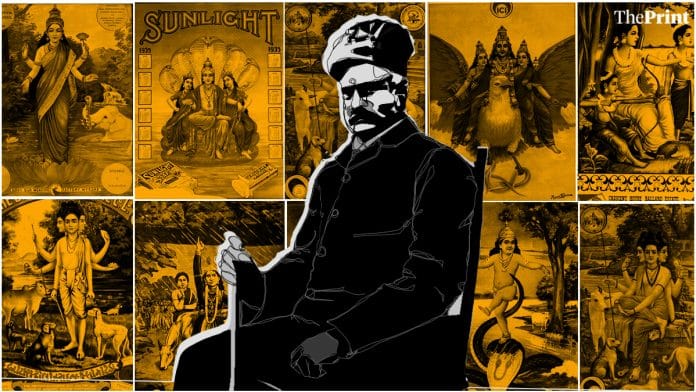


New Delhi: To understand how India visualises its gods, its epics, and even its past, the nation often arrives at Raja Ravi Varma.
In many ways, Raja Ravi Varma’s work is to the Indian public imagination what Norman Rockwell is to the American mind. An accessible, relatable art that felt simple and universal.
“When we think of Sita or Draupadi or Shakuntala or Damayanti, the image that comes to our mind is always the image that he has created,” said Kishore Singh, art historian and curator.
Sita waiting, Shakuntala turning back, a mother holding Krishna. These images feel ancient and timeless, and many can be traced back to a single hand: Raja Ravi Varma. And now the 19th-century artist has asserted his primacy in the auction house too.
In April 2026, his painting Yashoda and Krishna, an 1890s oil painting, set a record at Saffronart’s Mumbai auction. It sold for Rs 167 crore, far above its estimate of Rs 80-120 crore, and higher than any Indian artwork before it. The previous record, set last year by MF Husain’s Untitled (Gram Yatra), was around Rs 118 crore. The buyer of Yashoda and Krishna, biotech billionaire Cyrus Poonawalla, called it “a masterpiece that captures the soul of Indian devotion.”
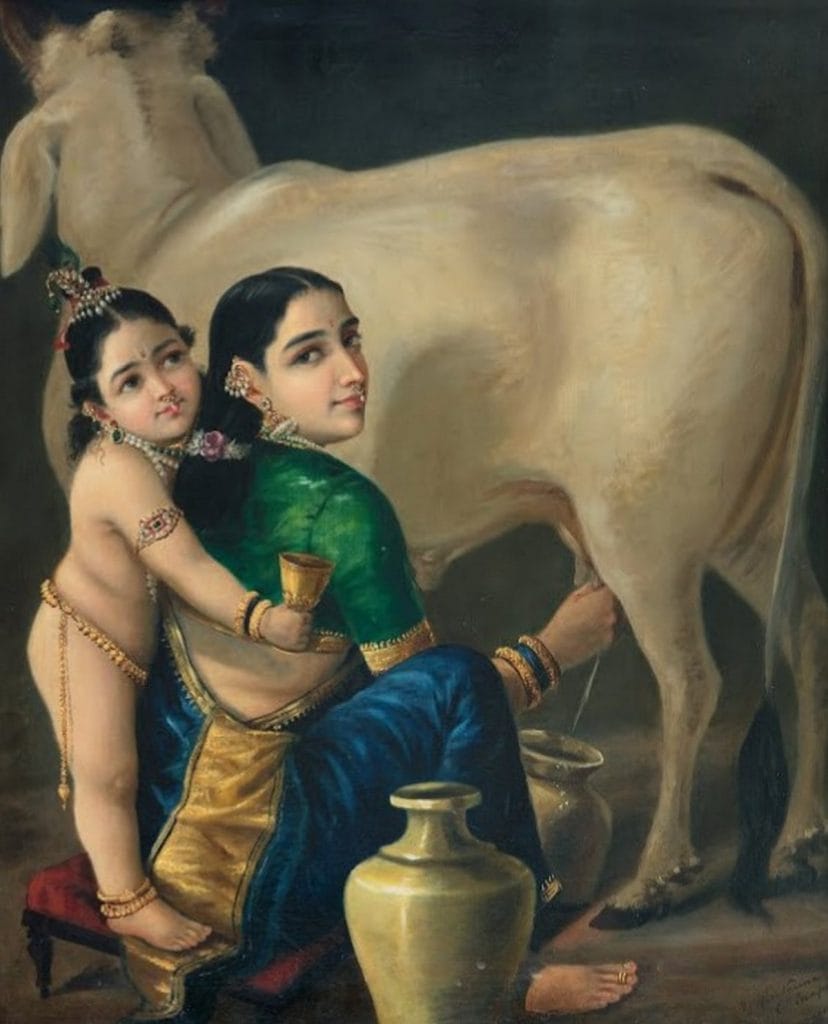
Varma’s trajectory — from royal patronage to mass-produced prints, from modernist critical dismissal to record-breaking auctions — places his work at the intersection of art, commerce, and cultural identity. It also raises a question: who gets to define what a nation sees when it looks at itself?
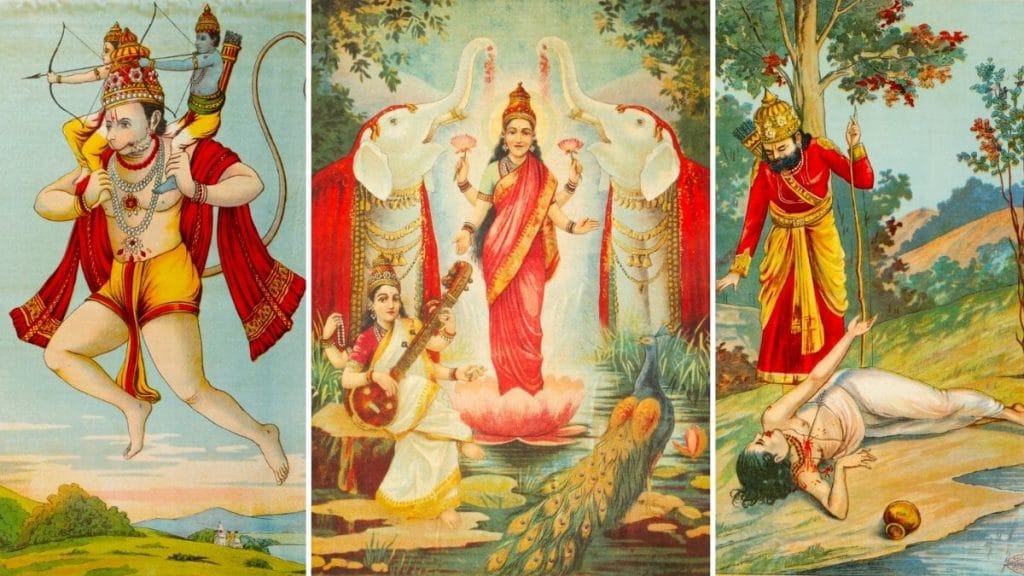
The aristocrat-painter from the princely state of Travancore (now Kerala) transformed Indian art by blending European oil techniques with Hindu epics, pioneering oleographs — affordable, mass-produced colour prints— that made sacred imagery accessible to millions.
His paintings standardised the visual vocabulary of Indian mythology and transcended elite spaces, finding their way into prayer rooms, calendars, Amar Chitra Katha comics, cinema, and now, digital imagery. By painting commanding goddesses and legendary heroes, he offered a powerful alternative to colonial perspectives while enjoying patronage from the royal courts of Travancore and Baroda.
He rarely touched money—only once a year, on Vishu, when he would ritually offer it to God
-Prem Kandwal, curator and art historian
The astronomical sale of Varma’s painting this month signals a moment where India’s new capital class is aggressively reclaiming its old soul through heritage art. Two decades ago, the top end of the Indian art market depended heavily on overseas buyers. Today, the majority of buyers are Indian or based in India, and gallerists report that 60-80 per cent are new to the market, according to an Art Basel article in February.
Varma’s mythic realism—once dismissed as ‘calendar art’—is the centrepiece of this resurgence.
“Ravi Varma’s position in the art world is not a fixed peak but part of an evolving trajectory—one that will continue to be redefined as time passes. This record is going to be broken, too,” said Singh.
What endures is not the market record, but the emotional resonance of his work.
“The painting is a very humanitarian subject of a mother and child. Across cultures, it addresses a certain emotional chord in all of us. It’s emblematic of everything that is beautiful in India and speaks culturally of India,” Singh added.
ThePrint reached out to Saffronart and AstaGuru, but both auction houses declined to comment.
Also Read: Delhi exhibition brings together North and South India—through devotional art
The art of looking
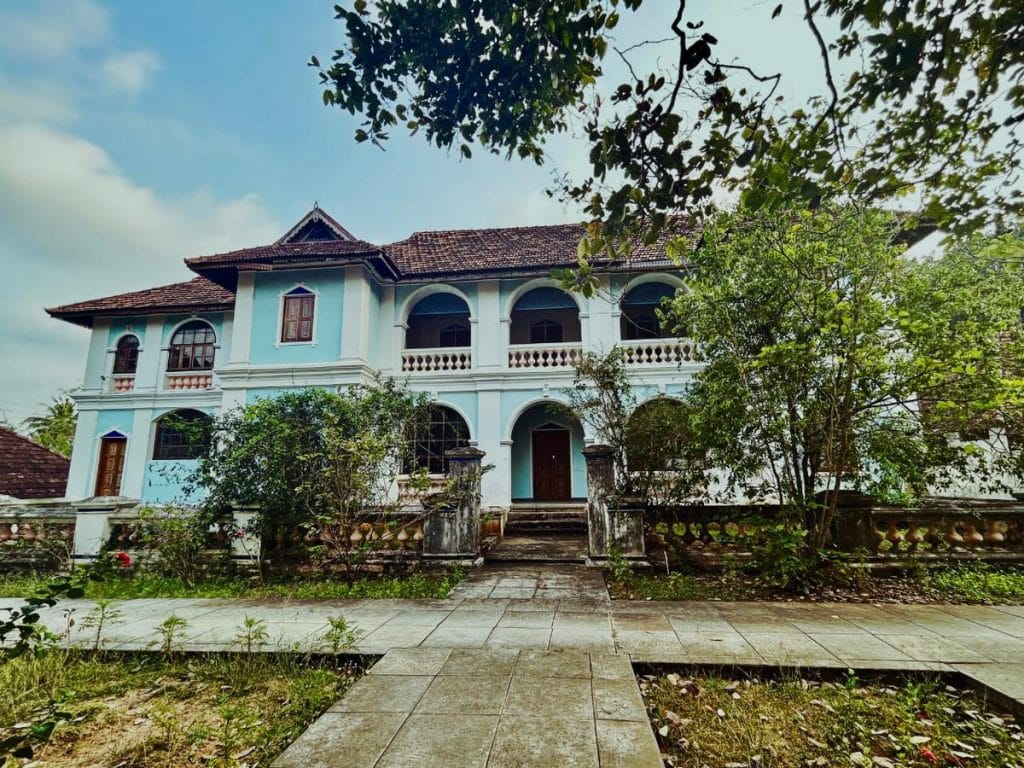
In the red-tiled Kilimanoor Palace in Thiruvananthapuram district, a nearly 300-year-old banyan tree stands as a living witness to the boy who would become Raja Ravi Varma. Here, he would pick up charred sticks from the hearth to sketch elephants and tigers on whitewashed walls, oblivious to the scoldings from servants who later scrubbed away his doodles.
“He used charcoal and observed everything around him. Animals, birds, even the everyday life of the palace—servants, visitors, all of it. He would capture whatever was happening in front of him,” said Rama Varma Thampuran, a descendant of Raja Ravi Varma, who still lives at the palace and is chairman of the Ramavarma Foundation for Art and Culture, which preserves and promotes the painter’s artistic and cultural legacy.
Family legend has it that a falling leaf from a pala tree, believed to be home to a yakshi, startled the pregnant Uma Amba Thampuratty on her way back from evening prayers. An oracle declared it a blessing: the spirit was not a bala bhakshini (child-devourer), but a bala rakshini (child-protector), and the unborn baby would achieve greatness. It was with this reassurance that Uma gave birth in 1848 to Ravi Varma.
Growing up in a family linked to Travancore’s matrilineal royals, he was immersed in Kathakali, Bhagavata music, and the Tanjore-style paintings of his uncle Raja Raja Varma. But his formal instruction was limited. When he met experienced oil painters, they often refused to teach him directly. Varma instead learned through the ‘theft’ of observation and picking up techniques on his own.
“Other artists were hesitant to teach him directly. He would just stand and watch how they painted. That was enough for him—he learned by observing everything,” said Thampuran.
Learning without being taught helped in shaping an artist who was both intuitive and self-directed, able to decode technique and adapt it into something entirely his own.
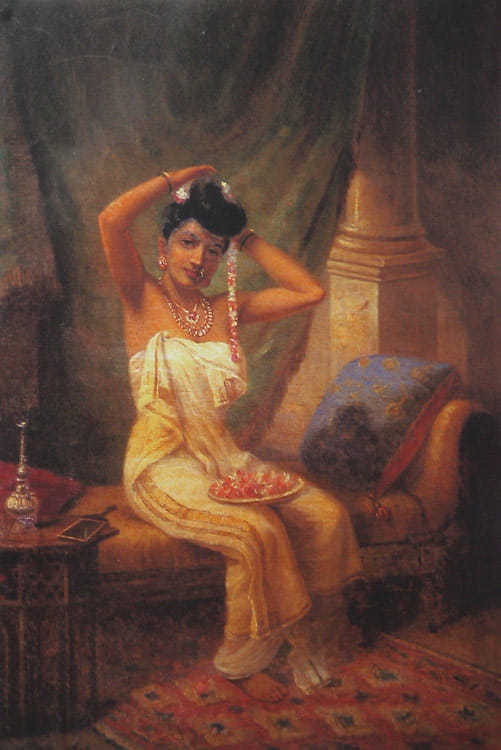
As he grew older, patronage from the Travancore court allowed him to paint formally and refine his portraiture. His reputation expanded quickly, and in 1873, he won a first prize at the Vienna World Exhibition for Nair Lady Adorning Her Hair and three gold medals at Chicago’s 1893 World’s Columbian Exposition.
He was building a new visual language that merged European realism with Indian subjects.
An artist of the people
Varma’s art might have stayed within rarefied circles had it not been for T Madhava Rao, the Dewan of Travancore, who urged him to send a few works to Europe to be oleographed.
“There are many of my friends who are desirous of possessing your works. It would be hardly possible for you, with only a pair of hands, to meet such a large demand,” Rao wrote in an 1884 letter. “Send, therefore, a few of your select works to Europe and have them oleographed. You will thereby not only extend your reputation, but will be doing a real service to the country.”
However, it would be a decade before the artist acted on this suggestion. And when he did, he went a step further. Rather than creating prints abroad, he set up a lithographic printing press in Bombay.
He was painting Indian subjects, from an Indian perspective, for Indian audiences
-Kishore Singh, art historian and curator
By the time the press came together, Varma, commissioned by the Maharaja of Baroda, had spent years travelling across India — observing landscapes, textiles, people, the way a sari was tied. That pan-Indian eye gave his gods and goddesses a recognisability that almost anyone could connect with: a Krishna in a Bombay home and a Krishna in a Bengal mansion could now look the same.
The first oleograph, Birth of Shakuntala, was reportedly sold for Rs 6, while Laxmi and Saraswati were priced at Rs 2 each.
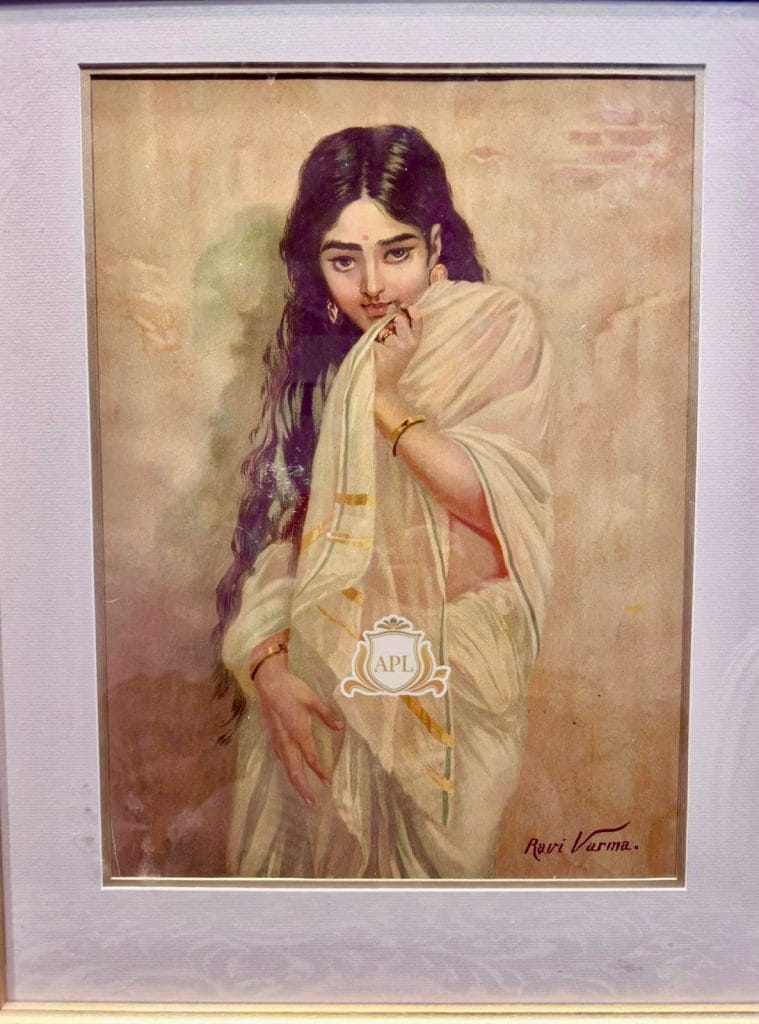
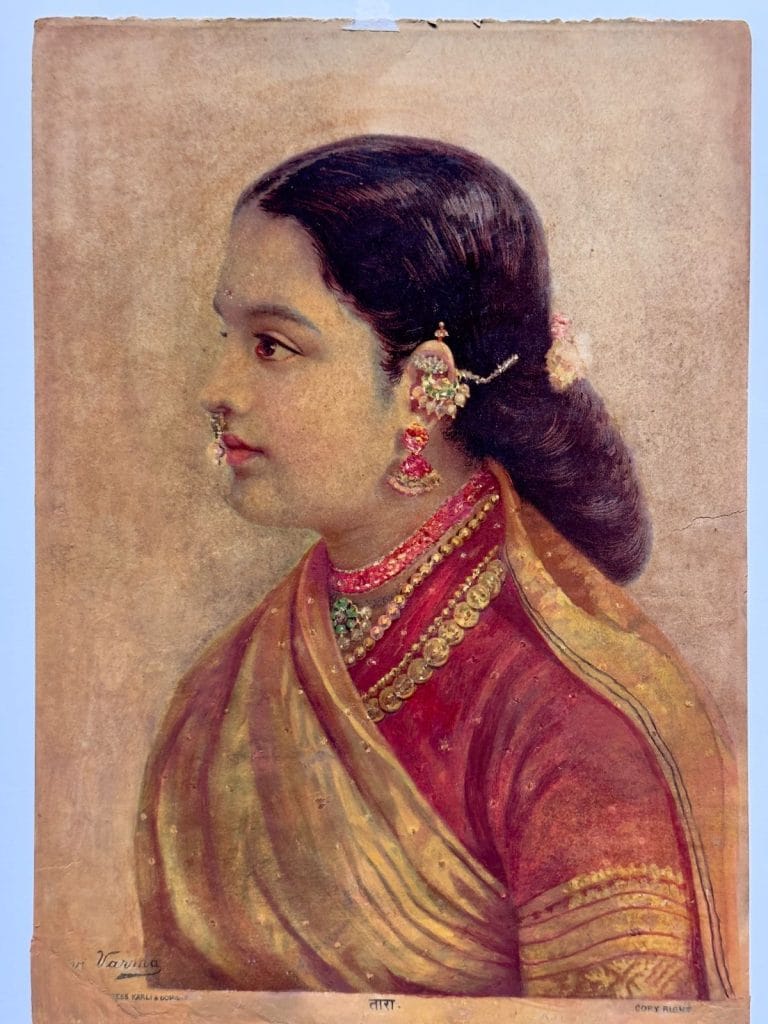
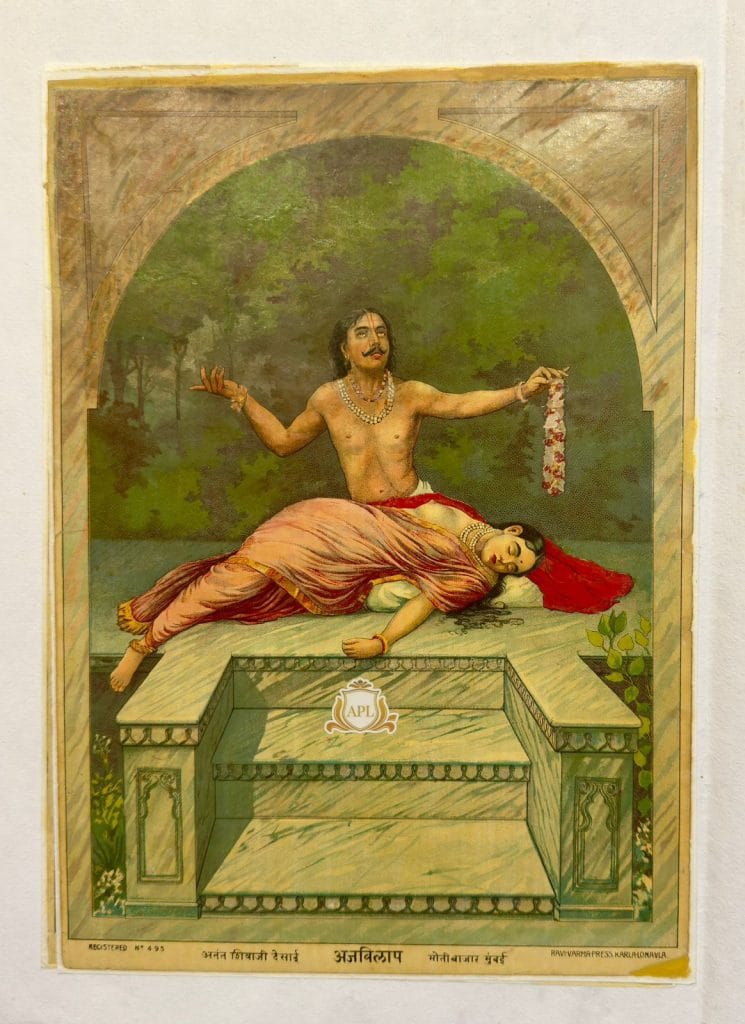
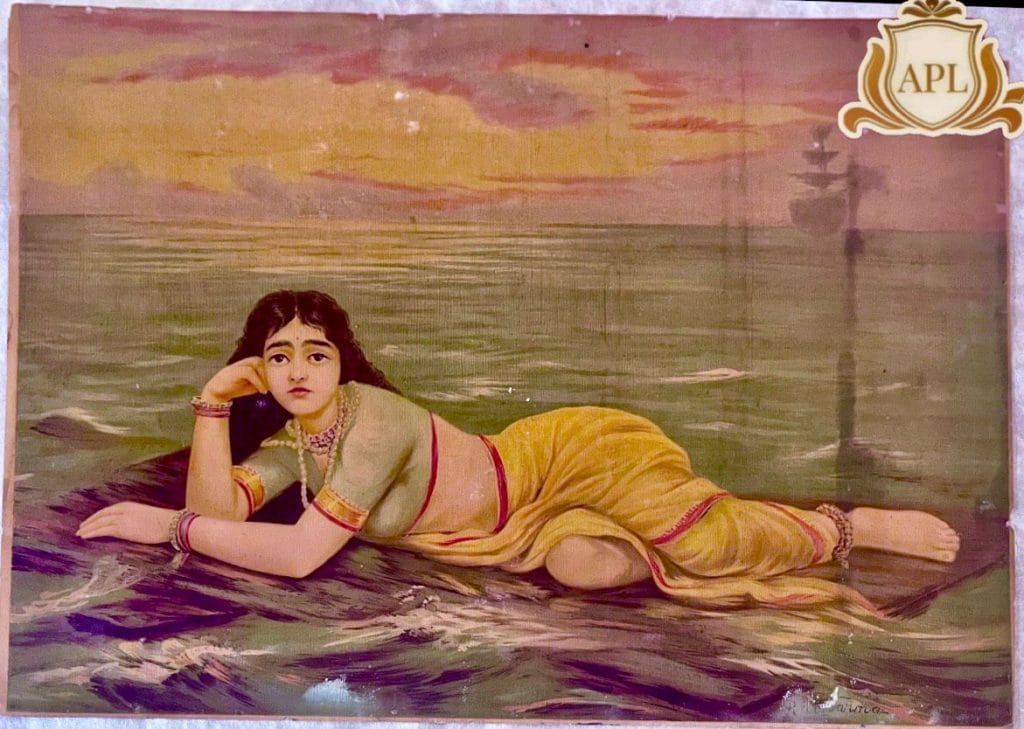
“His mission was to reach everyone, not just elites. Even ordinary people should be able to see and own art—that’s why he started the printing press,” said Thampuran.
This broader ecosystem of visual storytelling also influenced emerging art forms. Artists like MV Dhurandhar, who focused on everyday life rather than mythological grandeur, contributed a parallel visual language rooted in gesture and narrative clarity.
“Ravi Varma painted myth and majesty, while Dhurandhar captured the rhythms of everyday life. Both were building different visual worlds,” Singh said.
He was working on a painting when the brush slipped from his hand, and that is how he passed away
-Rama Varma Thampuran, a descendant of Raja Ravi Varma
His influence extended beyond painting, too. At his press, he worked with collaborators who would later shape early Indian cinema. One of them was Dadasaheb Phalke, who drew heavily from Ravi Varma’s visual storytelling and composition style while crafting films like Raja Harishchandra.
But the democratisation of his art came at a personal cost. By 1901, mounting losses and a flood of pirated copies forced him to sell the press and copyright permission for more than hundred paintings to German technician Fritz Schleicher for Rs 25,000. The press later faced harsh criticism for being too ‘commercial’, and some prints, such as Ashtabhuja Devi—which depicted Durga slaying Mahishasura— were even banned under British press laws for their nationalistic undertones.
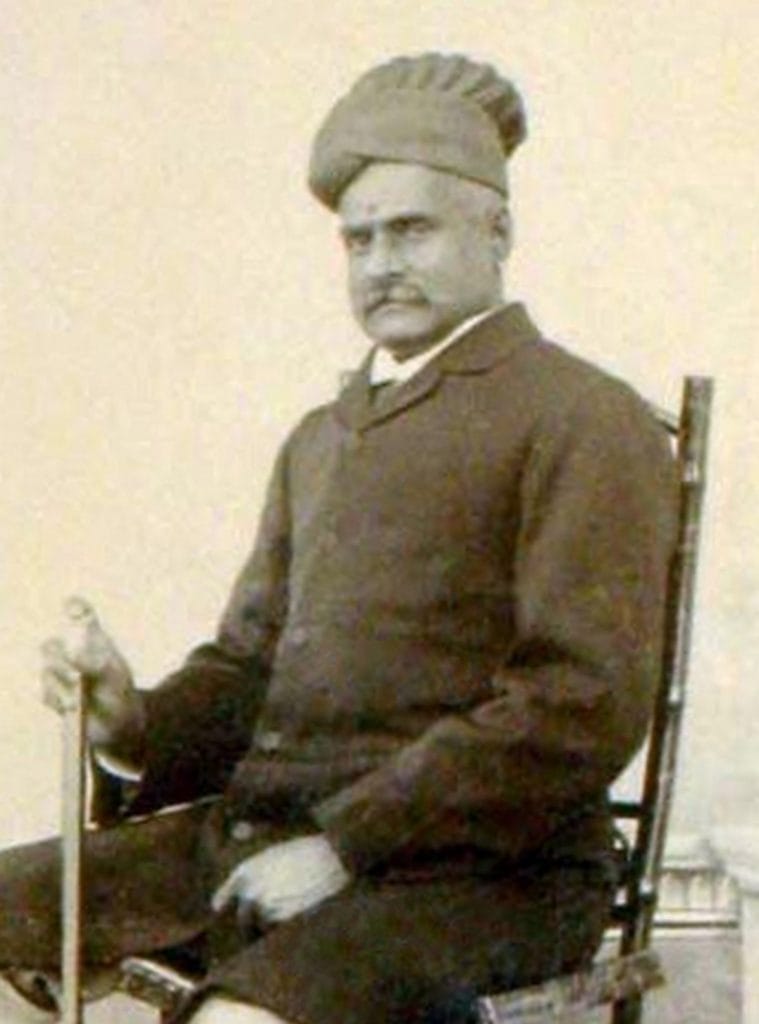
Around the same time, he was also battling diabetes, but the biggest blow of all was the death in 1905 of his brother C Raja Raja Varma, who was also a painter and his partner in the press. Together, they were famously called the ‘Ram and Laxman of Indian art’. When Raja Ravi Varma died on 2 October 1906, several obituaries put it down to fraternal heartbreak. One, in the Madras Mail, observed that he had “never wholly recovered” from his brother’s passing.
In his final days, he was painting his unfinished oil, The Parsi Lady, at Kilimanoor Palace. Until the very end, he remained at his easel.
“He was working on a painting when the brush slipped from his hand, and that is how he passed away,” said Thampuran.
‘Bazaar artist’ to auction darling
Money and Raja Ravi Varma always had an uneasy equation. Even his first commission, in 1870, was attributed to divine blessing by his great-great-granddaughter Aswathi Thirunal Gowri Lakshmi Bayi.
In her write-up on the artist, she described how, at the age of 22, Varma walked to the Sree Mookambika Temple in Kollur and stayed for 41 days, seeking the blessings of the goddess of learning and the arts. On his return journey, he received his first paid commission — a family portrait for a sub-judge in Calicut.
“The Goddess was quick in the dispensation of Her favours,” she wrote.
The commissions kept coming, and the prices climbed.
“He charged around Rs 2,300 for a portrait. At a time when gold was just over Rs 10 per tola, that tells you the scale of his value,” said Prem Kandwal, curator and art historian.
Yet, despite becoming one of the most sought-after and highly paid artists of his time, his personal relationship with wealth was distant.
“He rarely touched money—only once a year, on Vishu, when he would ritually offer it to God,” added Kandwal.
It is one of the deeper ironies of his afterlife. The painter who kept a distance from money would be dismissed as a “bazaar artist” — only to return, over a century later, as the most expensive Indian painting ever sold at auction. And in between, there was a long spell where his work faded from mainstream artistic discourse.
“From 1906 to nearly the 1990s, he was largely forgotten,” Kandwal said. “Almost a full century where his presence receded.”
The rise of modernist movements and figures such as Nandalal Bose and MF Husain shifted the trajectory of Indian art. Academic realism, which was Varma’s hallmark, was sidelined in favour of new visual languages. It was only toward the late 20th century that his work was rediscovered and critically re-evaluated.
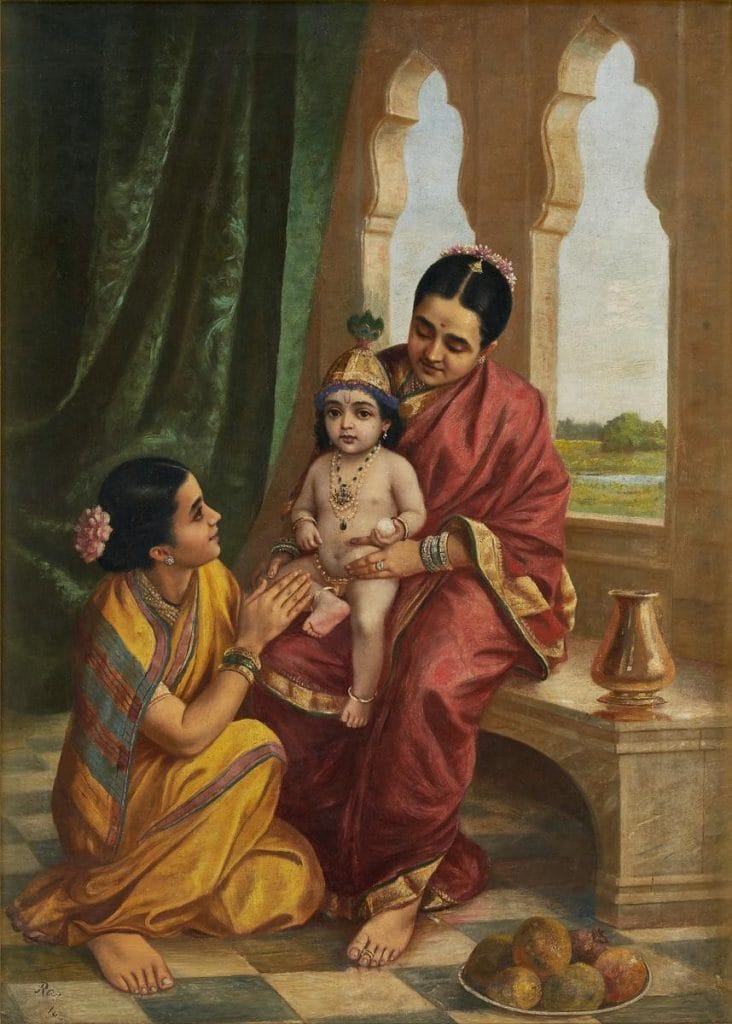
“Now, his paintings are valued at extraordinary scales—sometimes calculated even per square foot,” Kandwal said, adding that Yashoda and Krishna was “valued at Rs 22 crore per square foot.”
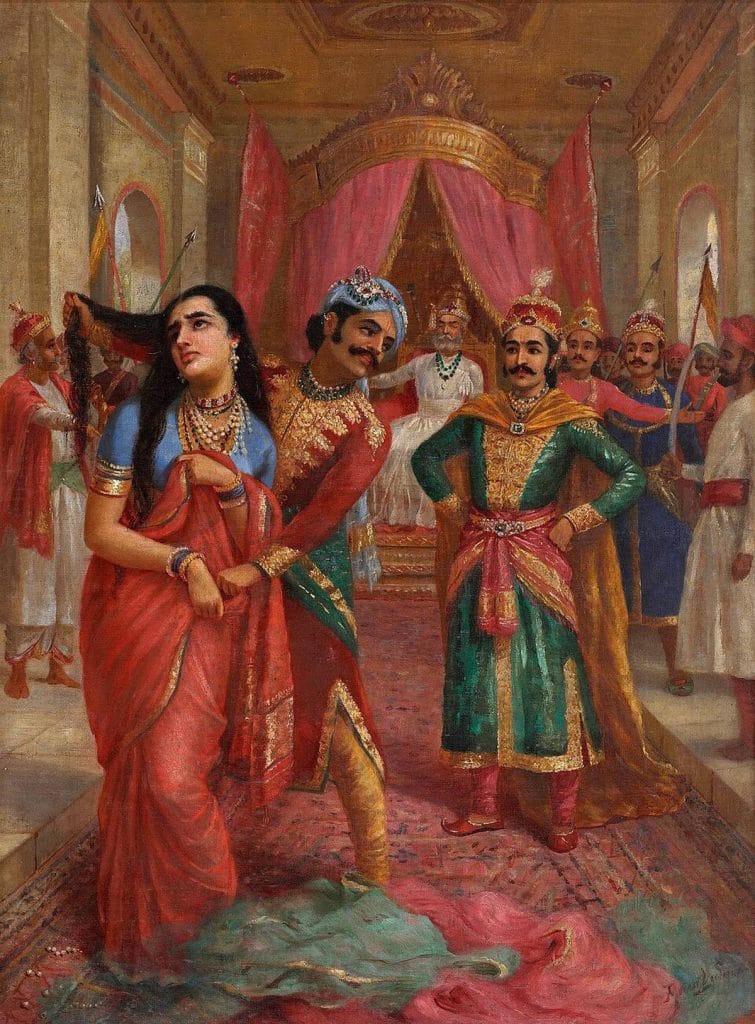
The April 2026 sale was no anomaly. Over the past five years, his works have steadily climbed at auction: Draupadi Vastraharan sold at Saffronart in 2022 for Rs 21.6 crore, and another Yashoda Krishna fetched Rs 38 crore at Pundole’s in 2023. The Pundole’s auction also saw Lord Shiva and Family sold for Rs 16 crore.
Portraits of women
Beyond market value, paintings such as Yashoda and Krishna resonate across generations because of their emotional simplicity and depth. This sensibility began early in his life, with his mother’s nightly readings of the Mahabharata and Ramayana anchoring his imagination and how he visualised Indian mythology.
“Those stories stayed with him,” Kandwal said. “They shaped how he saw and imagined these worlds.”
Varma’s paintings were internalised narratives. He followed a disciplined routine, performing puja every morning and evening. This spiritual rhythm translated into the tone of his work– composed, reverential, and attentive. It also influenced how he portrayed women. Across his canvases, women are central to the emotional and narrative core.
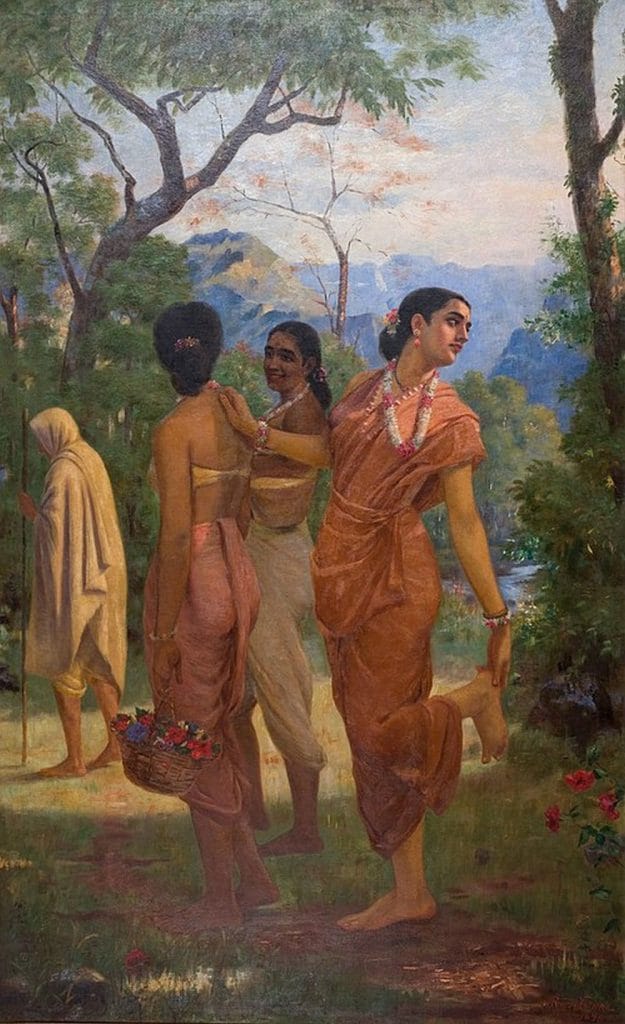
At a time when women’s visibility in public life was constrained, his paintings often represented them with dignity, presence, and power. While some art historians, including Tapati Guha-Thakurta, have argued that works such as Shakuntala and Hamsa-Damayanti organise their subjects around an absent male lover — the ‘male gaze’ defining the feminine image—across his wider work, the women remain unmistakably the centre of gravity.
A powerful example is Sita Vanvas. The painting captures Sita’s second exile near Valmiki’s ashram. Draped in a muted mustard sari, her expression is composed yet pensive, while the stillness of the surrounding forest deepens the sense of isolation. Then there is Galaxy of Musicians, which depicts women from different regions and walks of life—from a Muslim courtesan to a Nair woman playing a veena.
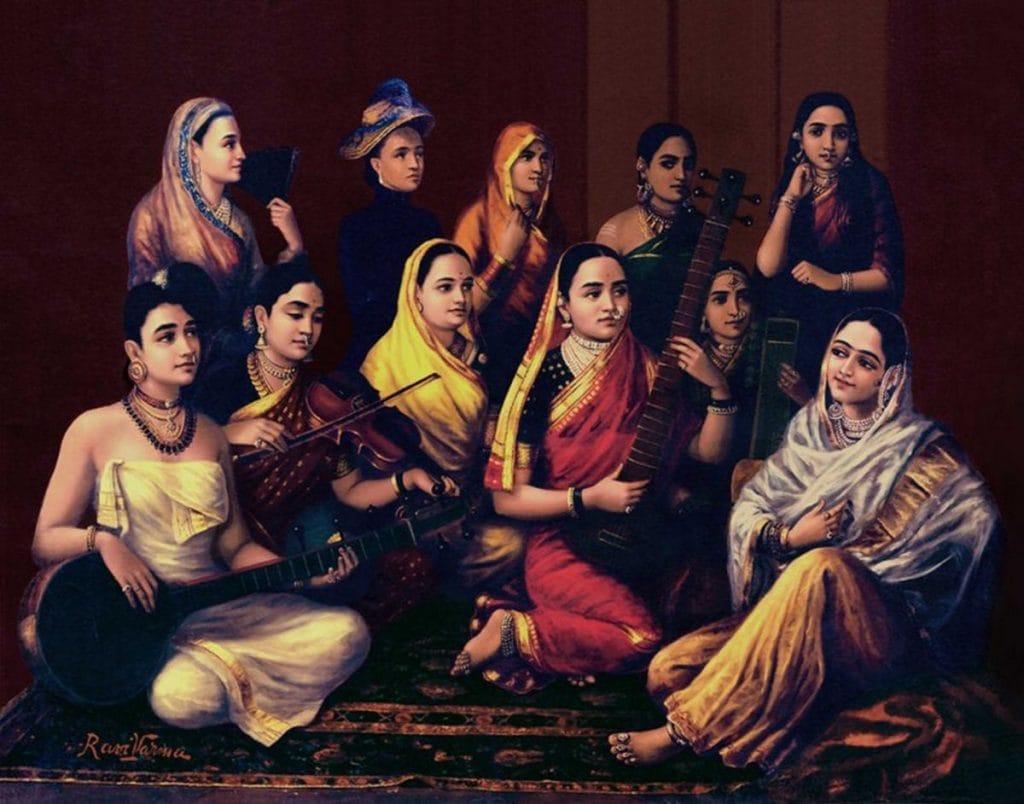
There are subtle tensions in these works—between tradition and modernity, modesty and self-expression. These are not just formal portraits—they reveal changing lifestyles, changing identities
-Kishore Singh
“At a time when most women did not step out for portraits (apart from some Parsi women), this was significant,” Singh said. “There was a clear sense of progressiveness.”
For perhaps the first time, women of elite families were also visible as subjects of study and representation. When Varma painted the women of the Baroda royal family in nine-yard Maratha saris and traditional jewellery, they were, in a sense, stepping out to be seen for the first time.
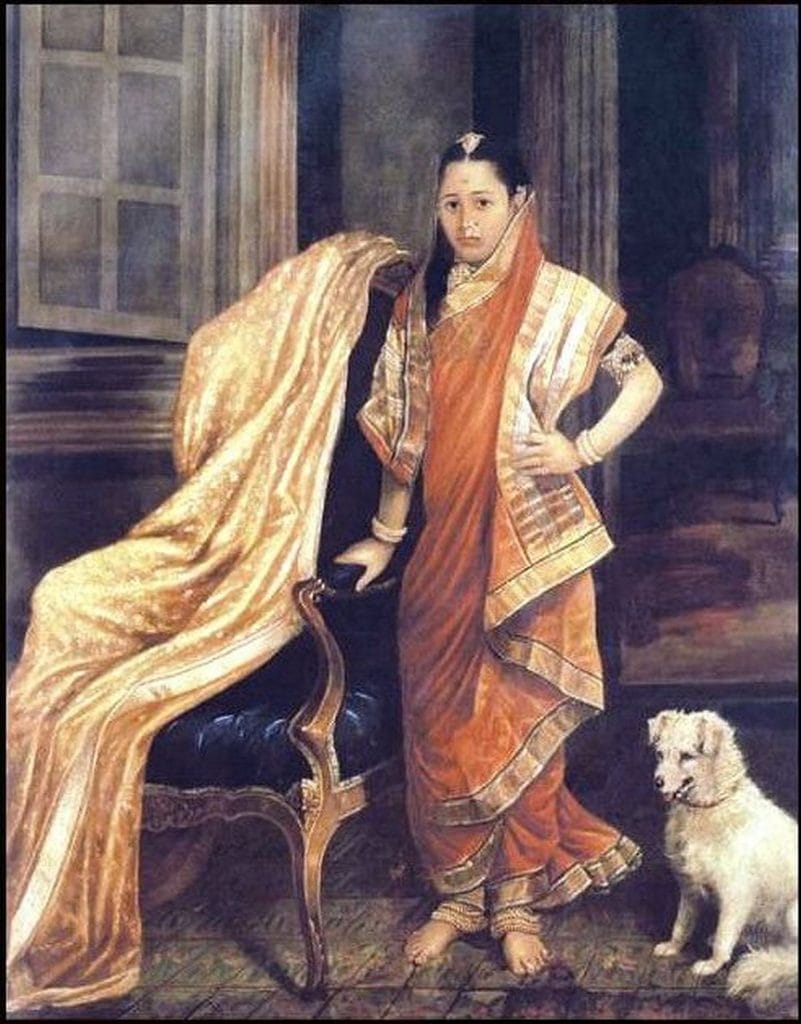
One painting Singh pointed to was Princess Tarabai, a portrait of a daughter of the Baroda royal family. She is shown with her pet dog by her side — “an unusually modern detail” for that era.
“There are subtle tensions in these works—between tradition and modernity, modesty and self-expression,” Singh added. “These are not just formal portraits—they reveal changing lifestyles, changing identities.”
Also Read: Who was VS Gaitonde, the reclusive artist whose canvas fetched Rs 67 crore at auction
Painting cultural selfhood
In an era when colonial artists often framed India through an orientalist gaze, Ravi Varma’s work offered an internal vision. His portraits offered a powerful record of a society in transition.
“They become a kind of historical window,” Singh said. “You begin to see lives that were previously unseen.”
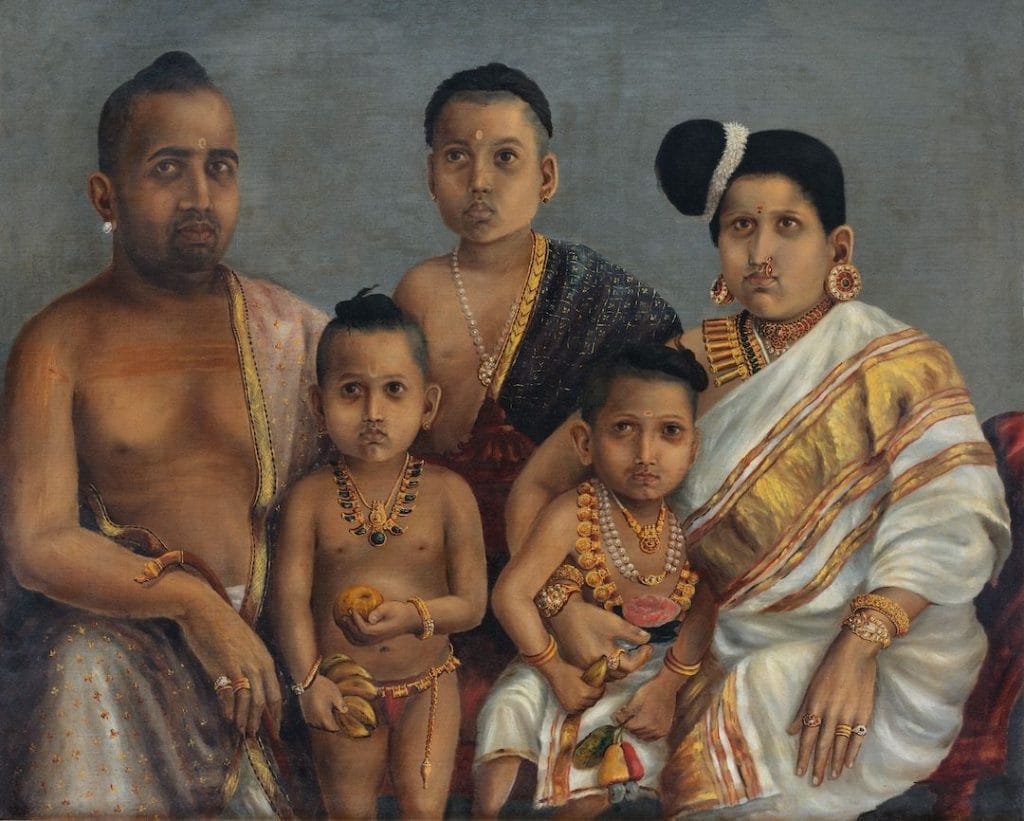
He painted portraits of British officials, prominent businessmen, and influential families. His very first paid commission was a portrait depicting sub-judge Kizhakke Palat Krishna Menon with his wife, two sons, and daughter. The family posed in traditional Kerala attire, not Western dress — a small choice, but a telling one. The middle child, KP Raman Menon, would go on to become one of the founders of the Congress Party in Kerala.
His subjects ranged from mythological figures like Draupadi to ordinary people, including, in Gypsies of South India (Poverty), a tribal woman playing the tanpura on a street. Even his goddesses were painted from live models, in a break with Indian tradition.
In this sense, Ravi Varma’s work becomes more than aesthetic; it becomes archival. A visual record of a society negotiating change under colonial rule.
Unlike Western artists who often depicted India in an imagined, oriental style, Varma portrayed it from within, elevating Indian subjects to a heroic level — from Head Peon, a young boy in a grand turban, to Maharana Pratap Singh, a large oil portrait of the 16th-century Mewar warrior, to Sri Rama Vanquishing the Sea, where Rama draws his bow against the ocean itself.
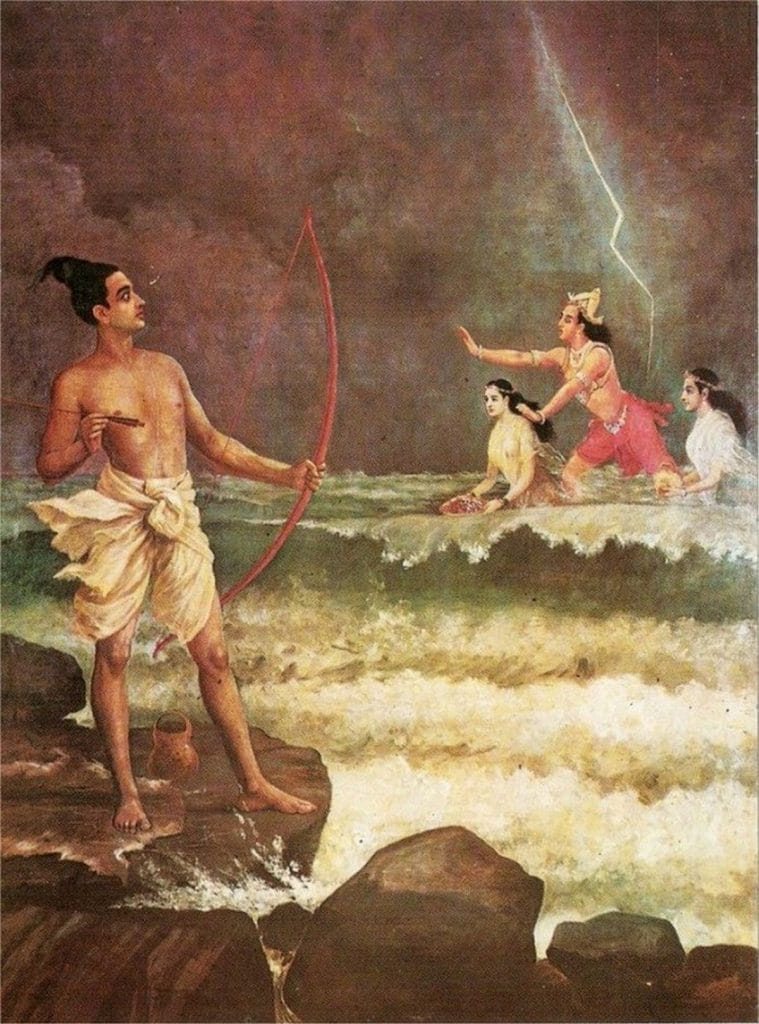
While not overtly political, his work carried a quiet assertion of cultural selfhood. More than a century after his death, hw is still the artist who made India visible at a time of colonial erasure.
“He was painting Indian subjects, from an Indian perspective, for Indian audiences,” Singh said.
Today, his presence spans both the digital and the global. Platforms like Google Arts and Culture host hundreds of his works, while the international art market continues to reaffirm his stature. But to Singh, this “relevance” is a limiting way to look at art.
“We don’t ask whether Ajanta or Khajuraho are relevant—they simply continue as part of our cultural consciousness,” he said. “His work embodies something essential about India: a sense of beauty, of devotion, of identity.”
(Edited by Asavari Singh)