





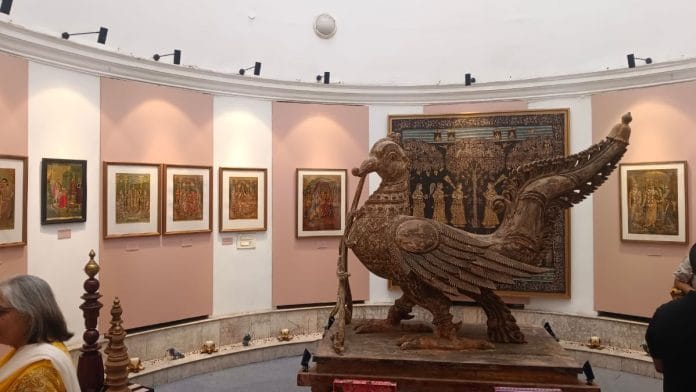


New Delhi: An exhibition in Delhi has brought together the devotional art traditions of North and South India on a single platform. The event, presented by the Raseel Gujral Art Legacy is celebrating India’s rich devotional visual culture through two exhibitions titled Dakhin | Dilli – A Sacred Dialogue and Prints of Divine.
In South India, traditions such as Tanjore and Mysore painting present deities as radiant icons, adorned with gold leaf and intricate ornamentation. In contrast, North Indian devotional traditions, particularly Pichwai painting, feature vibrant natural colors and motifs of cows and lotuses.
Hosted at Arzaani Atelier Privé, Bikaner House, New Delhi, the exhibition was inaugurated on 10 April, and will remain open to visitors until 10 May. Curated by interior designer Raseel Gujral Ansal, the exhibition explores the depth and diversity of sacred imagery across the Indian subcontinent.
“India’s sacred visual culture has always been shaped by journeys of ideas, artists, pilgrims, and patrons. ‘Dakhin | Dilli – A Sacred Dialogue’ and ‘Prints of Divine’ together trace how devotion travelled across regions and centuries, inspiring diverse artistic languages while remaining rooted in a shared spiritual imagination,” said Ansal.
The exhibition unfolds across three rooms, the walls are adorned with depictions of deities such as Ram, Krishna, Ganesha, and Nandi, many executed using the traditional gesso technique and a number of sculptures. At the centre of one room stands a striking 19th-century wooden sculpture from South India of the Annapakshi Vahanam, a mythical bird form.
Among the highlights of Prints of Divine are rare works such as “Mohini” (circa 1905) and “Indira” (circa 1894) by Raja Ravi Varma. They sit alongside devotional prints created using techniques like Burma cloth and silk embellishments, which add texture and luminosity to the imagery.
“The idea behind this exhibition was to show how devotional practices—whether from the North or the South—ultimately bind us together. Even in an age driven by modernism, traditional art and artefacts continue to hold relevance. This exhibition demonstrates how Indian art can be celebrated in contemporary spaces,” Ansal said.
Also read: Mewar-style Mahabharata painted by Muslim—what 2 art enthusiasts found buried in Udaipur fort
Who is the art for?
The exhibition also features works by influential artists including MV Dhurandhar, KS Siddalinga Swami, and GV Venkatesh Rao. Their contributions helped expand the reach of sacred imagery through printmaking.
A devotional iconographic artwork depicting the Shiva family, created in 1927 by KS Siddalinga Swami is displayed on the wall. Beside it hangs Rama Pattabhishekam (circa 1920), a devotional print produced by the Ravi Varma Press using Burmese cloth.
The artworks and artefacts in the exhibition are available for sale, with prices ranging from Rs 30,000 to Rs 80 lakh.
The exhibition is divided into two themes—one exploring the devotional traditions of North and South India, and the other highlighting how lithographic prints brought sacred imagery into everyday life.
Ansal noted that people in their 50s and 60s tend to have a deeper understanding of these traditions, having grown up with them. However, she emphasised that the younger generation needs greater exposure to such art forms.
“These artworks and this exhibition serve as an important exposure for the new generation, showing how relevant these traditions remain and how they offer cultural depth and understanding,” she said.
(Edited by Theres Sudeep)