





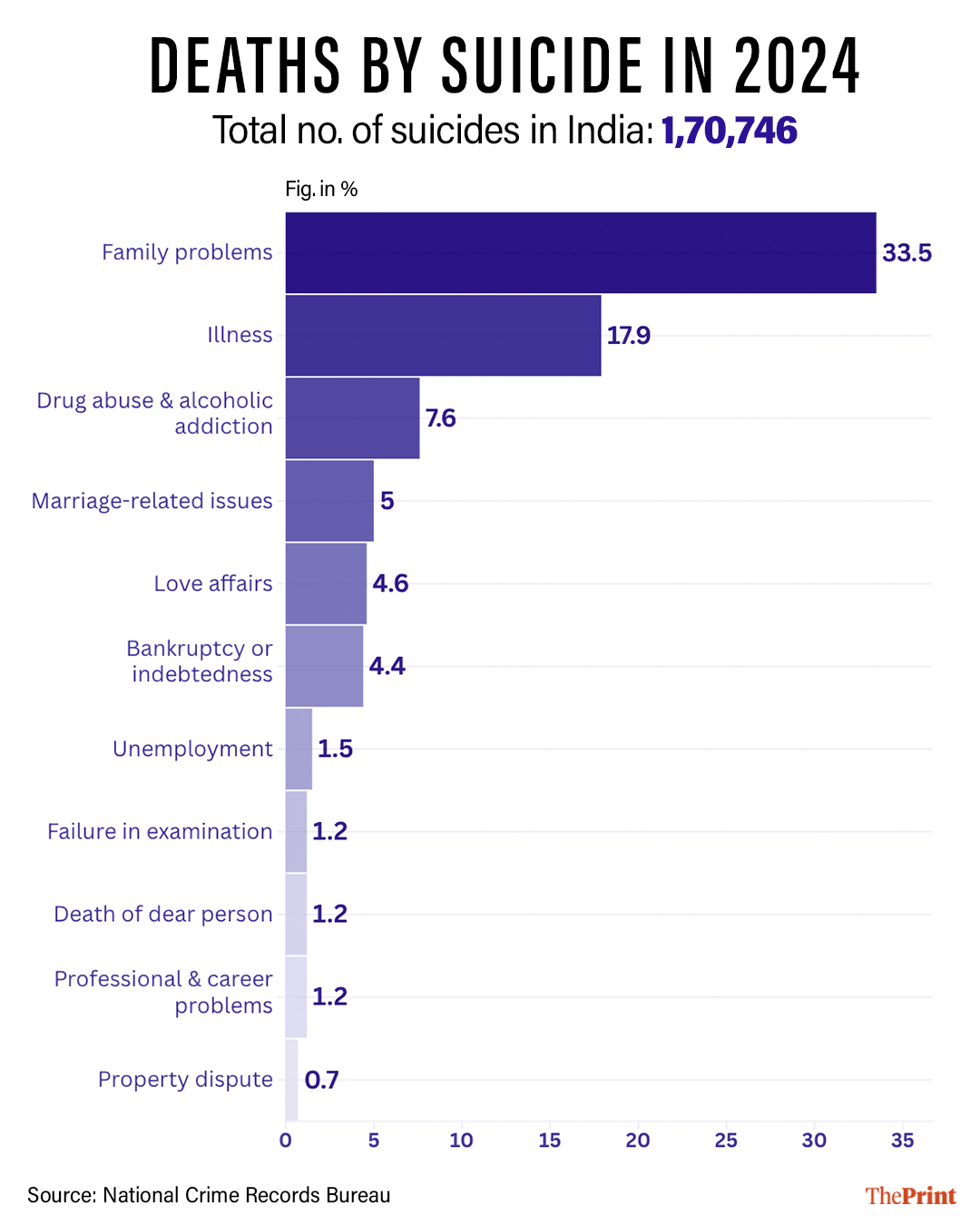
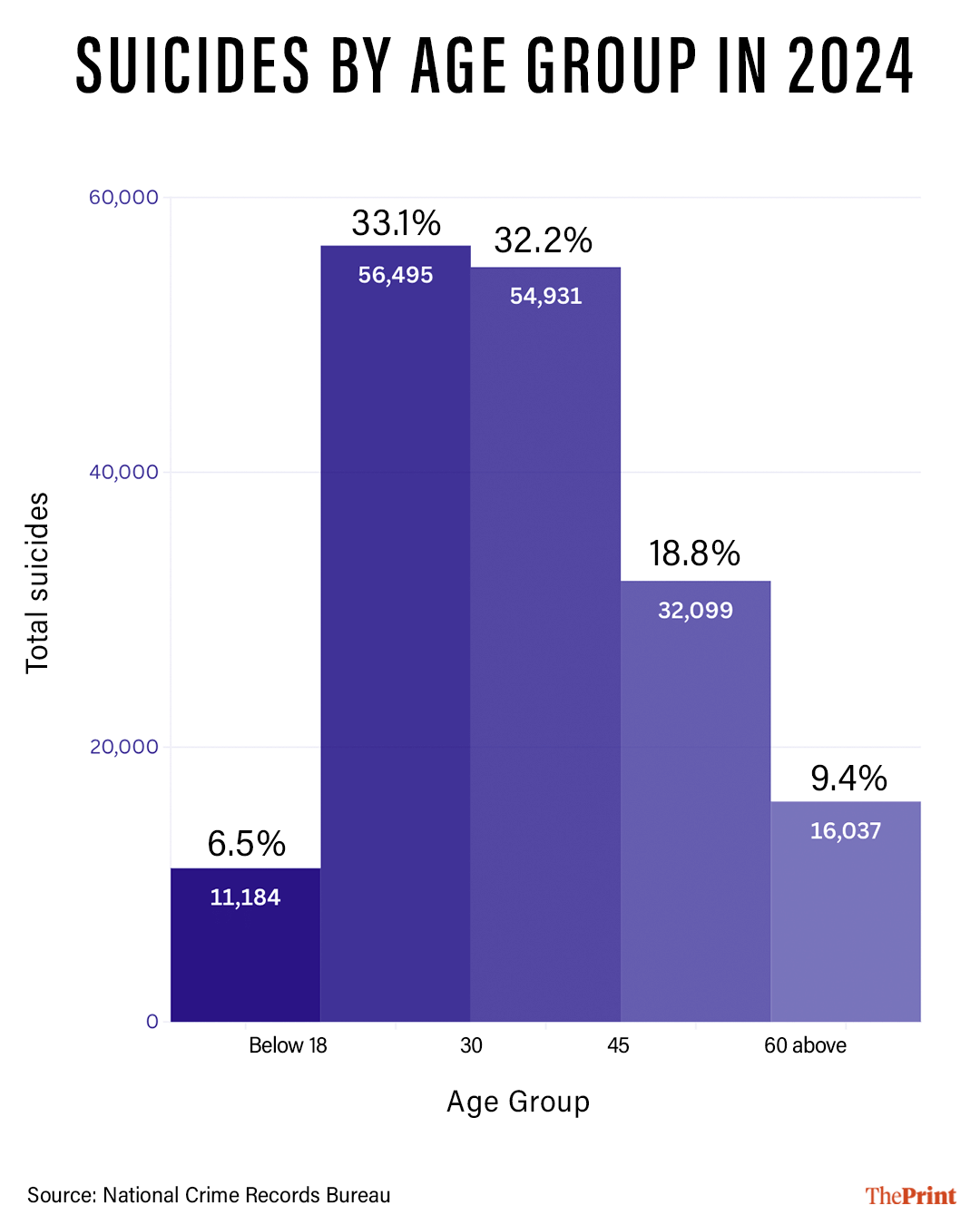
New Delhi: The latest National Crime Records Bureau (NCRB) report revealed that people aged between 18 and 30 years accounted for the highest number of suicide deaths in 2024, followed by those in the 30–45 bracket. The leading causes for the 1,70,746 suicides in 2024 were family problems (33.5 percent) and illness (17.9 percent).
According to the NCRB report, ‘Accidental Deaths & Suicides in India 2024’, released Wednesday, the suicide rate in India dropped marginally from 12.3 percent in 2023 to 12.2 percent in 2024.
The report identified other causes of suicide: drug abuse and alcoholic addiction, marriage related issues, love affairs, bankruptcy or indebtedness, unemployment, failure in examinations, death of a dear person, professional and career problems, and property disputes.
Accidental deaths in 2024, according to the report, climbed to 4,67,857, reflecting an approximately five percent increase from the 4,44,104 cases in 2023. The highest casualties were in the 30-45 age group, followed by the 45-60 bracket.
The report divided accidental deaths into ‘deaths due to forces of nature’ and ‘deaths due to other causes’. It attributed 7,903 deaths to forces of nature, identifying lightning, heat/sun stroke, and exposure to cold as the leading causes. Under ‘other causes’, 4,59,954 deaths were logged. The majority, 43.4 percent, were traffic accident deaths, followed by sudden deaths, drowning, falls, poisoning, and electrocution.
Fire accidents—particularly, during the summer season—have emerged as a concern. In 2024, India recorded 5,971 fire accidents, resulting in 5,888 deaths and injuries to 330 persons.
The report cited some significant fire accidents. In northeast Delhi’s Vivek Vihar, seven babies died in a fire that broke out in a hospital operating without a valid licence. The Delhi Police arrested the hospital owner and the doctor who was on duty. A deeper probe showed that the management had not provided fire extinguishers or an emergency exit. Then, 10 newborns died in a fire at a hospital in Uttar Pradesh’s Jhansi, as the neonatal ward was engulfed by the blaze.
The Ministry of Health and Family Welfare has issued advisories to all states and union territories on ensuring fire safety in hospitals. It highlighted the need for hospitals to review and update fire prevention and response plans, install smoke alarms, fire extinguishers, and sprinklers, and provide equipment, evacuation and protocol training to hospital staff.
Traffic accidents: Roads & railways
At 87.8 percent, the highest share of traffic accident deaths in 2024 was attributable to road accidents, which killed 1,75,142 people in a year. Another 11.2 percent of these deaths—22,413, in total—involved incidents on railway tracks or premises. Railway crossing accidents killed another 1,888 people.
Two-wheelers were involved in 48.3 percent of the road accident deaths, followed by SUVs/cars/jeeps (13.6 percent), trucks/lorries/mini-trucks (7.9 percent), and three-wheelers/auto-rickshaws (four percent).
The highest number of traffic accidents occurred between 6 pm and 9 pm. Month-wise, May (43,640) and March (43,508) witnessed the highest number of traffic accidents.
Moreover, over-speeding caused 61.2 percent of road accidents in 2024, resulting in 101,649 deaths and 283,162 injuries. Dangerous/careless driving, including overtaking, contributed to 26 percent of the road accidents, resulting in 46,132 deaths and 1,12,504 injuries. Roughly 2.1 percent were due to poor weather.
A majority—59.7 percent (2,79,412 cases) of road accidents—were reported from rural areas, while 1,88,555 cases, or 40.3 percent of the road accidents, were logged in urban areas.
Residential areas saw 1,46,232 of the 4,67,967 road accidents, the report further stated.
The report also noted that tractor-trolley deaths remain a growing concern in northern India. In February 2024, 24 people died after a tractor-trolley overturned and fell into a pond in Uttar Pradesh’s Kasganj district. The deceased—much like other villagers—had chosen the tractor-trolley, due to a lack of last-mile connectivity by buses or other public transport facilities.
This, a retired transport commissioner from Uttar Pradesh, speaking on condition of anonymity, told ThePrint, remained a systemic problem in villages.
The government, though, is introducing buses to the villages.
“It will take some time to go deep inside the villages…. there have been multiple such cases reported,” said the former transport commissioner.
Cities & sectors seeing high suicide rates
India recorded 1,70,746 suicides in 2024—slightly lower than the 1,71,418 suicides in 2023. The suicide rate in cities, at 16.3 percent, was higher than the all-India suicide rate of 12.2 percent.
The overall male-to-female ratio of suicide victims was 73.5:26.5. Moreover, nearly 69 percent of the male victims and 63.2 percent of the female victims were married.
The report states that a majority of suicides were logged in Maharashtra (22,174), followed by 19,965 suicides in Tamil Nadu, 15,491 suicides in Madhya Pradesh, 13,151 suicides in Karnataka, and 12,931 suicides in West Bengal, accounting for 13, 11.7, 9.1, 7.7, and 7.6 percentages of total suicides, respectively.
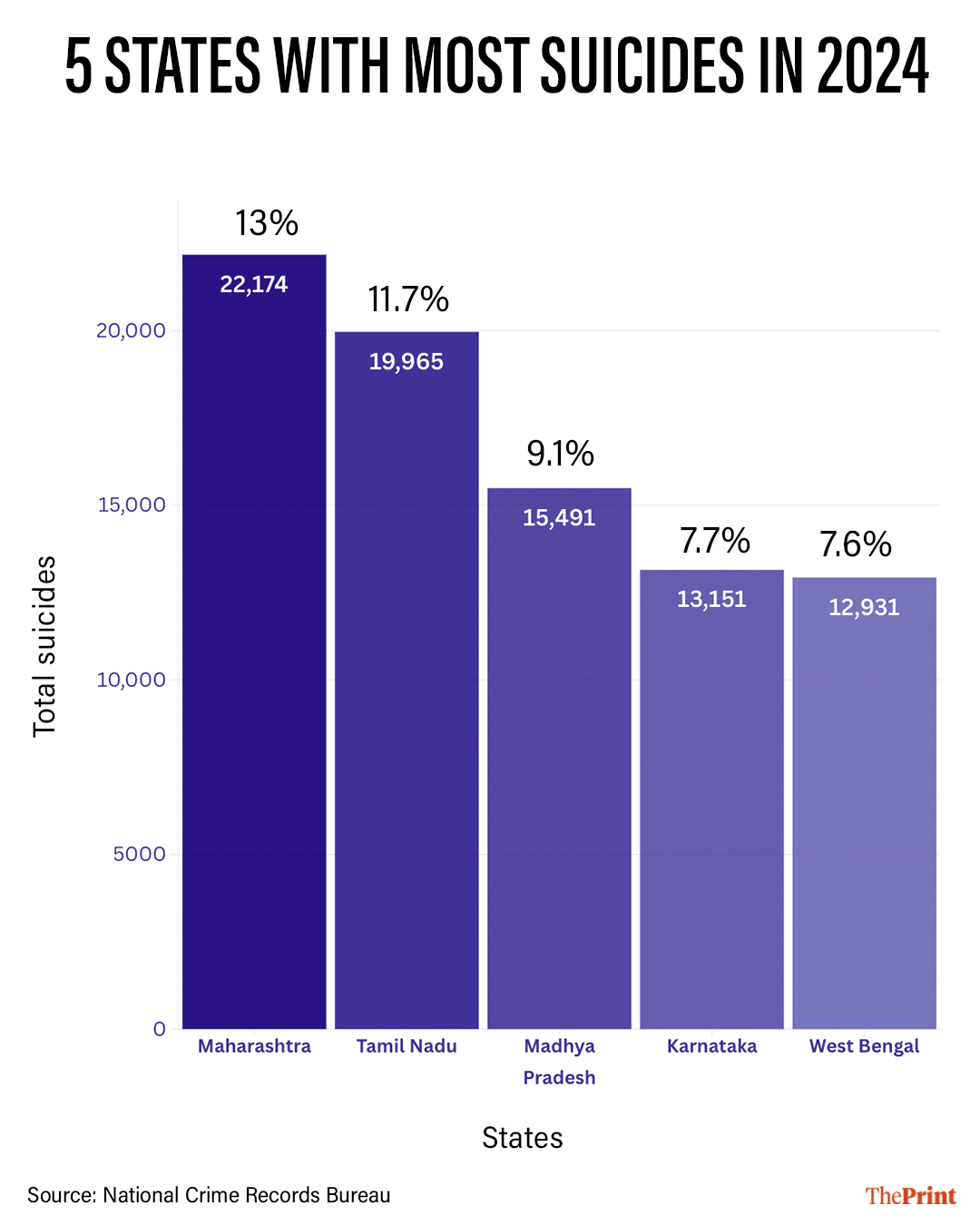
These five states together accounted for 49 percent of the total suicides reported in the country.
Uttar Pradesh, the most populous state with 17 percent of the country’s population, reported a comparatively lower percentage share of suicidal deaths, at 5.4 percent.
The report also threw a light on suicides among farmers and daily wage earners.
A total of 10,546 persons involved in the farming sector, including 4,633 farmers and cultivators and 5,913 agricultural labourers, died by suicide in 2024, accounting for 6.2 percent of suicide victims. Of the 4,633 farmers who died by suicide, 4,481 were males, and 152 were females. Of the 5,913 agricultural labourers, 5,352 were males, and 561 were females.
Debt has been one of the major drivers of suicides in the agricultural sector.
On 9 December 2025, Union Minister of State for Agriculture and Farmers Welfare Ramnath Thakur said in the Lok Sabha that the reasons for suicides were wide-ranging, and that ex gratia or relief in the agricultural sector was provided by state governments, according to state provisions and rules.
“The government is implementing the Modified Interest Subvention Scheme (MISS) to provide concessional loans through the Kisan Credit Card (KCC) scheme. Under this, farmers can avail KCC loans at a subsidised interest rate of seven percent,” he further said in a written reply.
Ramnath Thakur noted that to support the scheme, financial institutions receive a 1.5 percent upfront interest subvention, and farmers who repay loans on time are eligible for a three percent prompt repayment incentive, effectively bringing the interest rate down to four percent per annum.
These benefits are available for loans up to Rs 3 lakh. “As of 30 September 2025, Maharashtra had 69,86,475 operative KCC accounts with Rs 86,100 crore in credit extended under the scheme,” the minister highlighted.
Maharashtra has been implementing the Pradhan Mantri Fasal Bima Yojana since 2016. Over the past nine years, 1,308.09 lakh farmer applications covering more than 796.88 lakh hectares have been insured under the scheme.
“Capacity building for establishing village-level seed banks and community nurseries is being undertaken under the NICRA project to ensure seed availability in adopted villages. Climate-resilient and drought- or flood-tolerant varieties of crops such as rice, wheat, soybean, mustard, chickpea, sorghum, gram, and foxtail millet have also been demonstrated in several NICRA villages,” Ramnath Thakur said.
“Training programmes are also conducted under the Agricultural Technology Management Agency (ATMA) on various agricultural practices, including creating awareness among farmers about the use of quality seeds.”
(Edited by Madhurita Goswami)
Also Read: ‘Harassment, dispute with wife’ at centre of probe into Delhi judicial officer’s suspected suicide