





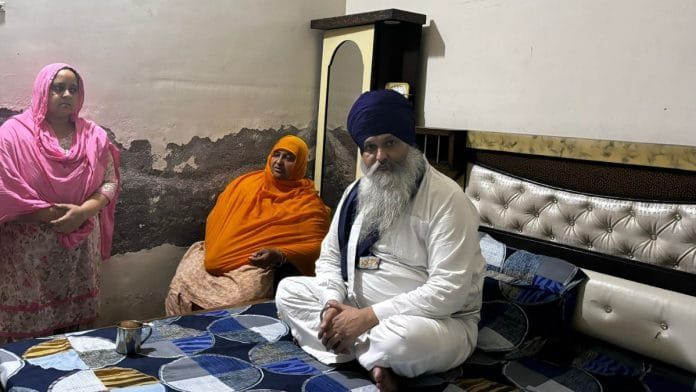

Patiala: For more than a year, a house in Kheri Nagaiyan village in Punjab’s Patiala district stood silent, heavy with absence. But on 22 April, the sky shone with firecrackers, and the house was lit up with strings of light. It was like Diwali night for the family.
They were welcoming their son Gurjeet Singh Khalsa, the 43-year-old Sikh farmer who had climbed a 400-ft tower and stayed there for 560 days, protesting to demand a stricter law against sacrilege in Punjab.
That anti-sacrilege law was passed by CM Bhagwant Mann’s government earlier this month, providing for stricter punishment for the desecration of the Guru Granth Sahib. Under the amendment, those found guilty could face severe penalties, including life imprisonment and fines of up to Rs 25 lakh. It was time for Khalsa to come down now.
“We didn’t light a single diya while he was gone, didn’t celebrate a single festival. How could we celebrate when our son was fighting alone up there?” said Paramjeet Kaur, mother of Gurjeet Singh Khalsa, her voice breaking.
Brother Gurjeet Singh Khalsa was able to do something which many governments failed to do. His sheer will and courage inspired the community to join him and the result is in front of everyone to see
– Surinder Singh, one of Gurjeet Singh Khalsa’s supporters
The demand for a law against the sacrilege of the Guru Granth Sahib has been recurring among Sikhs, especially after the 2015 incidents in Faridkot district that triggered widespread protests, followed by police firing at Behbal Kalan and Kotkapura. Incidents like these began to gradually reshape Punjab’s political landscape.
“I was broken—I had started to feel that we Sikhs would do nothing in the face of disrespect of the Guru Granth Sahib. Would we just keep watching it like a spectacle? That’s when something stirred inside me, and then Guru Sahib showed me the path,” Khalsa told The Print.
Over the last few months, Khalsa has become a sort of a folk hero in the village.
“Brother Gurjeet Singh Khalsa was able to do something which many governments failed to do. His sheer will and courage inspired the community to join him and the result is in front of everyone to see,” said Surinder Singh, one of Khalsa’s supporters who had travelled from Moga, Punjab, on 24 April to catch a glimpse of Khalsa.
He is no longer seen as a mere mortal in the village. Some even see the hand of god in him. His protest has moved from social to the divine realm as stories and whispers get attached to him.
“Through the heat, cold and rain, my brother persisted. It was God Himself who protected him,” said Gurpreet, Khalsa’s elder sister.

A choice
Khalsa’s resolve toward his faith was neither sudden nor surprising, it had been part of him for years.
It was June 2011. A young, 27-year-old Gurjeet Singh Khalsa was undergoing Amrit Sanskar, or Khande di Pahul, a Sikh initiation rite marking the entry into brotherhood, at the Durbar Sahib — the Golden Temple, the holiest shrine for Sikhs. When he stepped out, raising loud jaykare, or victory chants, of Sat Sri Akal, he was brimming with energy and devotion.
Soon after, it was time for him to return to Shri Guru Arjan Dev Ji Niwas, the pilgrim accommodation near the temple. But Khalsa made a choice. He refused to wear shoes and began walking barefoot on the scorching marble.
“The Guru has made me his son — I will walk on this hot floor,” he had said at that time.
By the time he reached the niwas , his feet were covered in blisters. He never regretted it.
“He has always been like this — stubborn, unyielding, and deeply devoted to his Guru,” said Jagdev, who has known Khalsa for over 30 years, and accompanied him on this trip.
At the village Gurudwara Sahib, Sukhwinder Singh, a sevakar at the gurudwara, said suddenly more people started coming to the gurdwara. There is an overall rise in religiosity.
“They would inquire about Khalsa ji, and his health. I would myself, pray for the good health of Gurjeet Singh ji and pray for his win,” said Sukhwinder, a worker at the local gurudwara in the village, who feels proud that his village is home to a legend.
Life on top of the tower
For a man over six feet tall, living in an 8×10-foot, cubicle-like space was no easy feat. Yet, 400 feet in the air, Khalsa turned it into a place where he survived for more than 18 months.
He had climbed up with nothing. What followed was built slowly, with help from those on the ground. A tarpaulin sheet was put up to keep out the rain. Plywood was laid down so he could stand and sleep. Gradually, other essentials were sent up — batteries, clothes, thermal tiffin boxes, Gutka Sahib, and a small portable fan.
Two men, Gurjant Singh and Sahib Singh, took on the daily task of climbing up and down the ladder to assist him, carrying food, batteries, and other daily essentials.
Whenever Sikhs begin a struggle, they do not do it out of fear — it is always a matter of all or nothing. We have a strong legacy, and that is what we learn from. I knew from the start it would not be easy
– Gurjeet Singh Khalsa
Even the basics had to be managed. He relieved himself in plastic bags, which were then carried down by one of the sevaks.
Their role was often questioned, with people asking them to stop. Gurjant Singh told ThePrint that police stationed at the site made them sign papers stating that if anything happened during the climb, only they would be responsible for it.
But the two were never deterred.
“I was never once scared of heights. Every morning, I made those trips because I wanted to help him in whatever way possible. For me, this was a seva I was doing for my guru,” said Gurjant, who stayed on even when only a few others did.
Even with that support, the strain showed. Gurjant recalled finding Khalsa unconscious many times. Each time, he stepped in — checking his pulse, giving him medicines, and sometimes staying with him through the night.
With little movement in that confined space, they also had to massage his legs to keep his muscles from stiffening.
“Whenever Sikhs begin a struggle, they do not do it out of fear — it is always a matter of all or nothing. We have a strong legacy, and that is what we learn from. I knew from the start it would not be easy,” said Khalsa.
Up there, Khalsa settled into a routine. He stayed awake through the night, guarding his position, and slept in the morning around 6 am. He would wake up when one of the sevaks brought him food. Through the day, he remained on calls, took short naps, read Gutka Sahib, and recited Gurbani. Much of his time was spent in touch with the morcha, guiding people and taking part in discussions.
“He did not need much, but in the beginning sometimes I had to climb three to four times a day,” said Gurjant. Each climb took 30 to 45 minutes.
Also read: Arctus Aerospace has one mission—End India’s reliance on foreign players in earth observation
Fear and acceptance
While Khalsa’s faith, according to him, gave him the power to stay on top of the tower, for his family, acceptance came slowly.
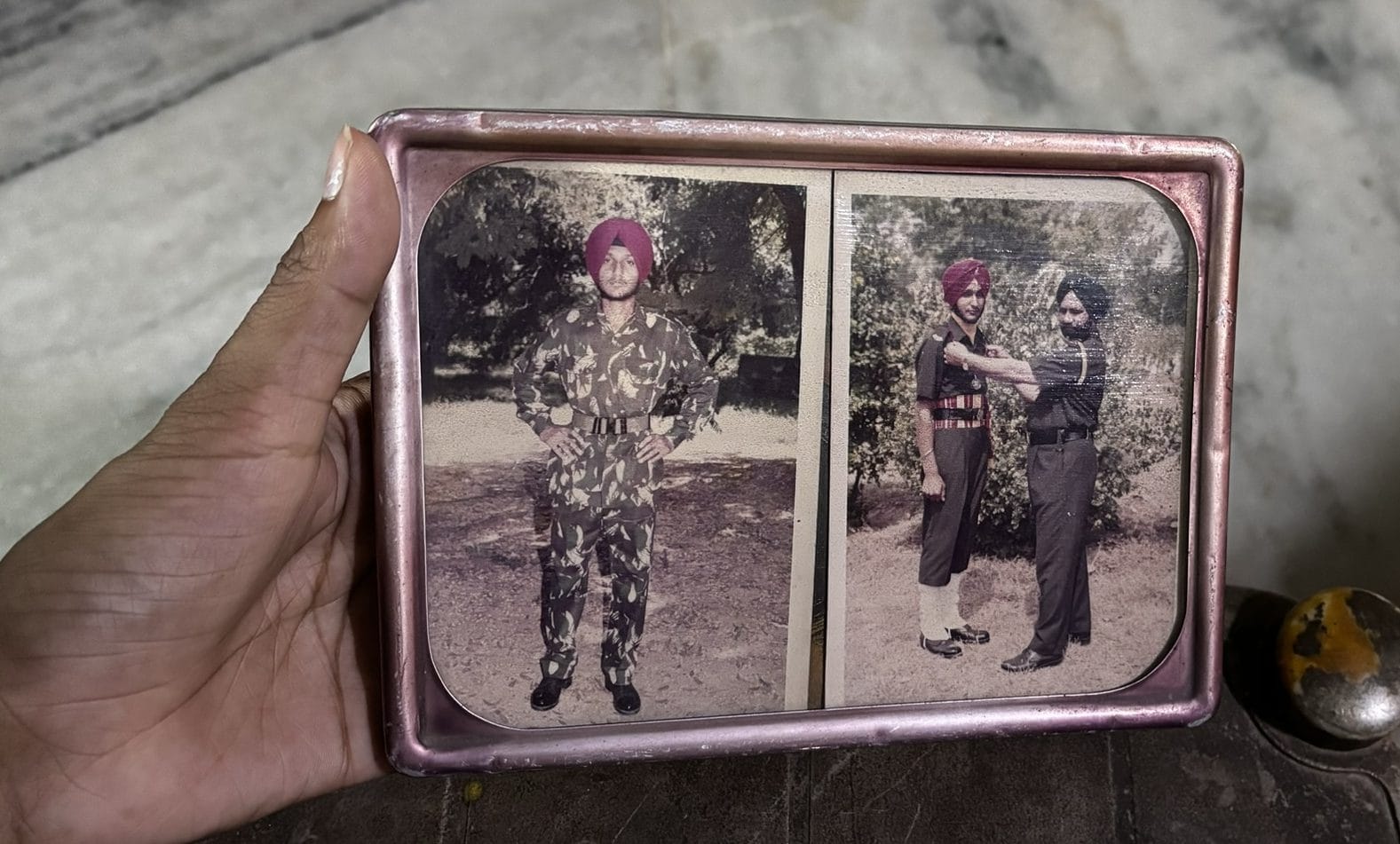
Before this, Khalsa was living an ordinary life with this family in his village. After retiring from the Army following a leg injury, Khalsa was running a dairy business and remained involved in community service at his village.
The only time Gurjeet Singh Khalsa stepped into politics was during the 2024 Lok Sabha election, when he campaigned for Amritpal Singh after being impressed by his work for Punjab’s youth. But he now looks back at that decision with regret. “I consider it a mistake. The time I spent in the Khadoor Sahib constituency was only to support the youth of this state,” he said.
According to his friend, Jagdev Singh, Khalsa spent nearly two months campaigning there at his own expense, but felt that the party’s support for the morcha was limited. The experience, those close to him say, left him disillusioned with politics.
When Khalsa left to stay on top of the tower, the dairy business was taken over by his younger brother Rajpal Singh and his father, Baldev Singh.
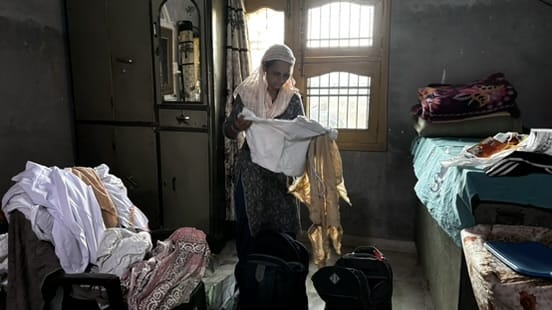
“It was always him I turned to — for the smallest things, from what vegetables to buy to what medicine to take when I was unwell. He liked being the one I asked. When he went away, I felt completely lost at first,” said his wife, Gurpreet.
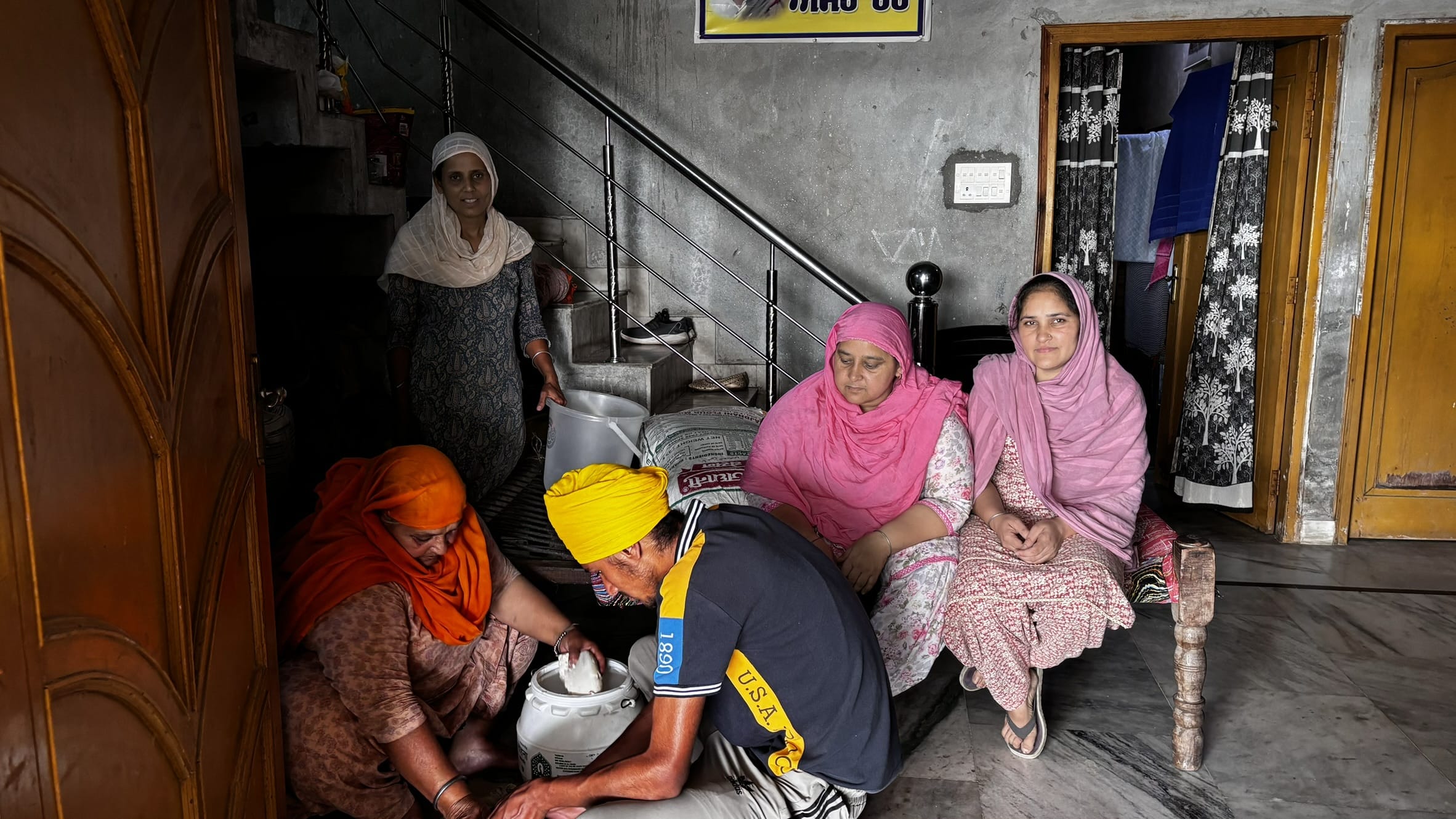
In those months, the family continued to support him, even as fear stayed constant. They stopped celebrating festivals, staying away from gatherings altogether.
“Even the children never complained,” said Khalsa’s mother, Paramjit Kaur.
What next?
Khalsa’s house in the village now resembles a public square. A steady stream of visitors pour in. Relatives, neighbours, local leaders, children. Everybody wants to see him.
Khalsa sits on his bed, laughing with his sister’s daughters over video calls, his phone constantly ringing. He takes each call, unhurried.
Beside him, his mother massages his hand, still not believing that his son has returned.
Days later, the lights are still up. People continue to walk in, hoping to catch a glimpse of the man who spent over a year on a tower. Even as Khalsa enjoys being back on the ground, he is aware that the future is still shaky. Because although the amendment has been passed, there remains the possibility of legal scrutiny of the amendment.
“I am ready to face any hardship again. With the Guru’s blessings, I will follow whatever path he sets for me,” said Khalsa, adding that he will let faith guide what comes next.
Jagdev Singh said Khalsa remains committed to working for the community, especially in tackling Punjab’s drug problem.
He added that Khalsa wants to help the youth of Punjab struggling with the issue of drug addiction and hopes to guide them toward recovery, even encouraging them to take amrit at the gurdwara as a step toward a more disciplined life.
As his growing popularity draws attention, several political parties have approached Khalsa with offers, but he has chosen to stay away. “I don’t want to get into politics. I want to devote my time to the Guru’s seva,” he said.
(Edited by Aamaan Alam Khan)