





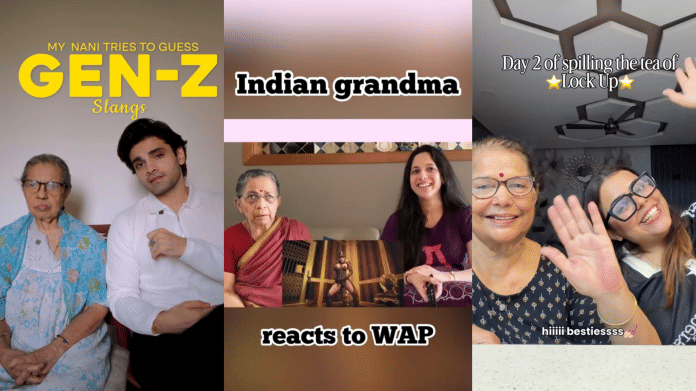


New Delhi:Kumud Nagral, better known on the internet as Avanti ki Aaji, has recently shifted from being a retired doctor to becoming a digital celebrity. Since the onset of her Alzheimer’s disease, her memory and focus has been slowly slipping away. But she snaps into attention as soon as the camera hits record. The grandmother of Instagram creator Avanti Nagral, Kumud takes her new role very seriously.
“The instant I put a camera in front of aaji (grandma), she is on,” Nagral notes. “I think she understands that what she says is being consumed by other people, that she has a responsibility towards them, and it brings her to life in a certain way.”
The 93-year-old influencer has a lot of wisdom and experience to share. She tackles questions a lay person would consider taboo — from sexual pleasure to dating apps, she’s covered it all.
“You’re marrying the person, not the caste,” said aaji, giving her unwavering support to inter-caste marriages.
What began with Avanti posting a casual but fun recording of a memory with her grandmother has slowly grown into a dedicated Instagram account with over 14,000 followers. And she’s not alone. In the past few years, Instagram has seen the rise of “granfluencers,” a word used to describe seniors who share their wisdom, opinion, lifestyle or even fashion on social media.
In India, this phenomenon has taken shape through young influencers featuring interactions with their grandparents on their social media accounts. The result is the creation of inter-generational content.
At a time when solo-living, DINKS (double income, no kids) and nuclear families are becoming the norm in urban India, it almost seems counter-intuitive that young influencers are turning to the good, old extended families to connect with followers – mixing the organic, traditional wisdom with algorithmic hustle.
“There is so much content online, to the point of it being a content clutter. There is, however, a niche for everything, and inter-generational content falls under that umbrella,” says Falguni Vasavada-Oza, Professor and Co-Chair of the Crafting Creative Communication, heading the Social Media Influencer Programme at MICA School of Ideas, Ahmedabad, Gujarat.
Also Read: Haryanvi song ‘Ab Tera Beta Mera Hai’ is Indian women’s new anthem against mama’s boys
Avanti ki Aaji
The story of Kumud Nagral’s online presence began in October 2020, after her husband passed away. For the first time in her adult life, Avanti found herself interacting with her grandmother not merely as part of a collective “grandparental unit,” but as an individual named Kumud. This is when Avanti decided to spend more time with her aaji, both to help her ease the grief and get to know her better.
Kumud would pick films that gravitate toward modern, progressive Marathi narratives, and they’d watch them together.
Avanti has been creating content on platforms like YouTube and Instagram since 2016-17. She started off by posting music covers, performance videos, and vlogs. She is trained in several musical styles, including Indian Classical, Church/Gospel, and Broadway, and has been making original tracks since 2015. With time, her content expanded to include lifestyle, education, and social commentary.
One day, Avanti sensed an opportunity to show her grandmother something entirely out of the box. She set up her phone to record Kumud’s reactions to arguably two of the most scandalous music videos of the time – WAP by Cardi B and Anaconda by Nicki Minaj. The outcome was digital gold.
The seven-minute-long video featured Avanti tenderly translating the lyrics of the tracks for her Maharashtra-born grandmother. But Kumud did not react with the predictable, puritanical shock that internet audiences expected from an Indian elder. Instead, she delivered a nuanced critique.
“I feel as such it is okay, but what’s the need for so much sexuality,” Kumud is seen saying in the video. “I am not backward in my thoughts, but I think too much of anything is not that good.” Kumud then went on to question if similar content has been made about men. “We are only talking about the body – the sexuality – of women,” she said. “Are there such things about men also? Show me.”
The video has garnered over 1.2 million views on YouTube, and 395,000 views on Instagram.
It was shortly after this video went viral that Avanti created a separate Instagram account for Kumud. The camera, logistics, and posting was of course taken care of by Avanti, but the thoughts and ideas were entirely aaji’s.
In her video posts, Kumud challenges the stereotype of conservative passive elders. She has emerged as a reliable ‘trusted adult’ discussing menstruation, sexual education, mental health, and the complexities of bridging the generation divide. Aaji’s followers frequently ask her for advice, and she obliges in her own gentle and sapient way.
While Avanti uses the granfluencer-grandchild dynamic to dive into cultural and progressive dialogue, another creator discovered that the camera could simply capture banter across generations.
Also Read: How India’s pre-wedding shoots have become content factories. Lights, camera, marriage
Kunal Bhan and his Nana: Bridging gaps with pick-up lines
When actor and content creator Kunal Bhan started living with his grandmother Florina Maria Pinto for the first time during the pandemic-induced lockdown, the two could not find any common ground. Oddly, the constant rift between the two paved the way for Pinto to get a massive fan-following online.
“Nana (grandmother) was really rude to me all the time. But when I used to video call my mother, she used to behave nice. I realised that I can trick her into being nicer to me if I put a camera in front of her. That’s exactly what happened,” Bhan recalls.
What began as a playful defence mechanism quickly drew a wide audience, which loved to watch the duo bicker. With a deadpan face, Pinto delivered the most brutal comebacks to everything Bhan said.
“That was not helpful at all,” she said in one of her videos as Bhan tried to explain GenZ slang to her, “just like you.” Although the internet believes it to be a bit that they play, Bhan insisted that it is just their dynamic.
“People are getting confusing. She’s not sassy. She’s trolling me. It’s all very real,” Bhan laughs, as he notes that the sharp-tongued trait runs in the family. “All the ladies in my family are very sassy, including my mother. But this is her mother, so it is tenfold the sass.”
Bhan capitalises on his grandmother’s witty retorts by giving her further openings. In their most beloved series called Pick-up lines with the Grandmother, Bhan tried out pick-up lines on his Nana. She paid no heed and dismissed him instantly. In one of the videos, Bhan uses one of the classic Mumbaikar pick-up lines on her: “Are you an empty auto rickshaw? Because I have been waiting for you all my life.” Without missing a beat, Nana responds, “Yes, and like them, I also will reject you too.”
The comments section under these reels function like digital living rooms, packed with adulation and good-natured ribbing. For creators like Bhan, viewers have dropped comments like “Nani has been breaking hearts for generations.”
Initially, Pinto did not understand the concept of social media, but that changed when a relative called to compliment an outfit she wore in a video. “It’s only then that she started taking me seriously,'” Bhan joked.
Also Read: Return of the matchmaker. Why young Indians are reviving arranged marriage
Simran and the Sehgal family
Another creator who has taken cross-generational content to a new level is Simran Sehgal. The 22-year-old creator invited her entire family into her content, and her followers love it.
For Sehgal, the journey into digital creation began almost by accident when an “outfit check” video featuring her mother, Mona, unexpectedly went viral and got over 6 million views.
This massive success made her realise the untapped potential of content involving family members. Seeking to expand on the dynamic, Sehgal brought her grandmother, Swarna, into her videos. Slowly, the rest of the household followed suit. Sehgal’s father Rajeev and uncle Sanjeev have become recurring characters in her reels. The joint family setup — the Sehgals if you will — delights viewers online.
“Apne ghar me koi jagah dedo, behan banalo apni (Give me space in your house, make me your sister),” one comment read. “Coolest Family awards goes to the Sehgals,” read another.
Sehgal often also posts behind-the-scenes footage, which captures her family members at their most authentic and unassuming selves. It is the family banter that tickles her viewers. Sehgal credits their Punjabi genes for this playfulness.
Now regulars in her content, the Sehgals try out trending dances, participate in viral online challenges, play games, and record candid family moments and conversations. Within the household, Swarna Sehgal has emerged as a fan favorite, popularly known as “baddie dadi” – a role she thoroughly loves playing.
In one of their videos, Sehgal talks to her grandmother about the American TV series Euphoria while dressing her up as Maddie, one of the key characters from the show.
Also Read: Inside India’s manosphere: Rhea Chakraborty sparked it, Siya Goyal is firing it up
Global granfluencers are a brand
Globally, granfluencers are directly challenging the concept of aging out of society. Internationally-recognised icons like the late Iris Apfel, known for her flamboyant style and oversized round glasses, or the late Helen Ruth Elam, better known as Baddiewinkle, were perceived as highly-independent personal brands. Instead of playing a supportive role online too, they chose to play the main character. For instance, Baddiewinkle amassed millions of followers by confidently sporting eccentric, suggestive clothing to promote body positivity and combat ageism. The content created by global granfluencers focusses heavily on self-expression, luxury fashion, fitness routines, or solo global travel. It intentionally subverts stereotypes that equate aging with physical decline and social invisibility.
The Indian granfluencer content is in sharp contrast to its Western counterpart. In India, seniors occupy little digital space as an individual. Their digital presence is a collaborative effort, co-created by their grandchildren. The content doesn’t highlight their separation from the family, but documents their dynamic with family members across generations.
In other words, while the global granfluencer uses social media to say, “Look at how vibrant I am on my own,” the Indian granfluencer says, “Look at how vibrant we are together.”
Bridging the generation gap
By introducing their grandparents to the world of social media, young creators unlocked a space for dialogue that traditional, hierarchical Indian family dynamics only sometimes permit.
For Bhan, creating content with his Nana has reshaped his relationship with her. Earlier, their conversations would be limited to talking about distant relatives or stories from her past. Now, the duo regularly discusses GenZ slang and pop culture — Bhan introduces Nana to his generation’s lingo and then seeks her thoughts.
Avanti and her aaji too have found room to have conversations they otherwise might not have had – perhaps due to time constraints in a fast life, or uncomfortable subjects or choosing (doom)scrolling over actual communication or all of the above.
“The conversations that I may not have had openly with my parents, I can now have with aaji,” Avanti said. “And then that opens up that conversation with my parents too. I think it has a neat trickle effect.”
Engaging with her grandma on social media has led Avanti, and her entire family, to discover Kumud in a new light. The videos have acted as a cultural buffer, where topics like sex education or mental health can be more approachable and less intimidating.
Sehgal, too, believes that content creation has bought the family closer together.
“Sometimes I am filming with my family at 2 am. If it weren’t for reels, we perhaps would not have spent so much time together,” Sehgal said.
“For one of my videos, I talk to my father about what kind of a man he’d want me to marry. It is such a bizarre question. If it weren’t for the camera, we probably wouldn’t have had the conversation,” Sehgal says.
“I will find whoever I want for you,” the father answered.
Creating a digital archive
What began as a casual pastime during a pandemic has transformed family intimacy into a public performance. This shift raises questions about the nature of content creation involving elderly family members. When a video is recorded in the house and posted online, it inadvertently lets the guard rails down. It turns everyday household banter, vulnerabilities, and the realities of ageing into consumable digital content.
For the creators, the process has resulted in encapsulating their grandparents’ personalities, their humor and wisdom.
For Avanti, the videos serve as a beautiful memory exercise for both of them. She wants to create a digital archive of their times together. “My only regret is that I didn’t start sooner,” she reflects. “I only had a couple of years with aaji, before Alzheimer’s started affecting her memory.”
Avanti addresses aaji’s memory loss in some of their conversations. In one such video, she asks aaji how she copes with her memory impairment “You have to connect a particular thing (memory) to another particular thing (object),” aaji answers.
An aspirational parental figure
As these granfluencer accounts have scaled into tens of thousands of views, their followers have inevitably developed parasocial relationships with the protagonist. For a majority of young viewers who grew up geographically distant from their grandparents, or lost them at an early age, figures like Kumud, Florina, and Swarna assume the role of an aspirational parental figure.
Followers are treating these grand-creators not as distant internet celebrities, but as their own flesh and blood — sliding into their DMs to seek personal comfort, validation, and life advice. Avanti beautifully describes this highly-attached following as Kumud’s “collective internet grandchildren.”
“Such content resonates with viewers because so many Indian adults still live with their families. They share a deep bond with their parents and grandparents. The sentiment adds to the appeal of the content,” notes Oza. The tight-knit Indian family dynamic makes reels around intergenerational interaction either relatable or aspirational.
The seniors have adapted to this sudden digital stardom in delightfully unique ways.
Florina Maria Pinto, for instance, has taken to her digital celebrity status with immense confidence. Bhan recalled a moment watching Kaun Banega Crorepati on television with his grandmother, when a question regarding Instagram popped up on the screen.
“She very nonchalantly looks at me and says, ‘Do you think Amitabh Bachchan gets as many views as me?’ And I instantly realised, in her head, she’s that girl now,” laughs Bhan.
(Edited by Aakriti Handa)