



New Delhi: Delhi University student elections are usually a battle waged along party lines: nationalism for the ABVP, social justice for the Left’s AISA-SFI, fee hikes for the NSUI. But this year, the Satya Niketan PG collapse that killed five DU students has shaken up the tried-and-tested formulas. Parties across the ideological spectrum have now put one issue front and centre in their campaigns. Safe and affordable student accommodation.
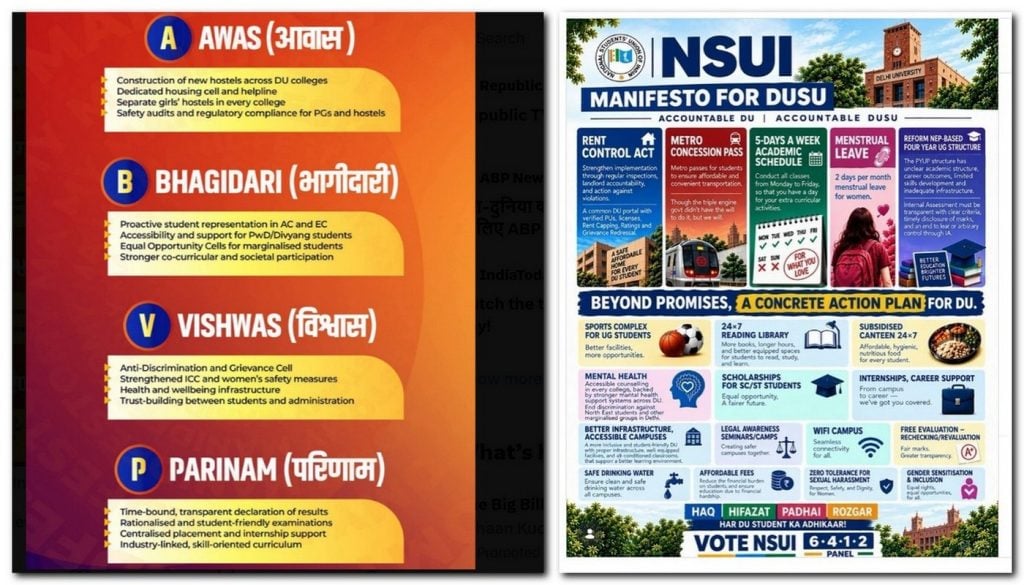
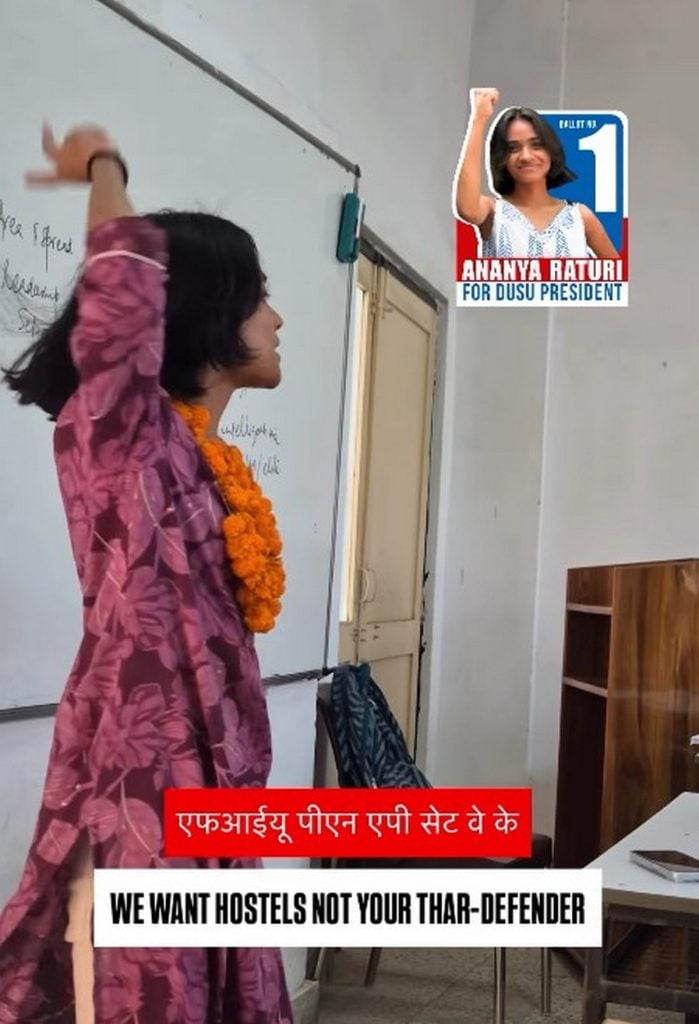
From speeches to manifestos, this is now at the top of the promise list. The ABVP has proclaimed in big, bold letters that the “A” in its name stands for Awas — accommodation. The very first item on the NSUI manifesto is “a safe and affordable home for every DU student” and a vow to ensure “regular inspections, landlord accountability, and action against violations”. AISA-SFI has not released a formal manifesto yet, but housing is all over its Instagram campaign, with a recent reel declaring, “We want hostels, not your Thar Defender” in a dig at money and muscle in politics. It has also promised “rent control and safety audits” for PGs.
The tipping point for the campaign was the collapse of a five-storey building operating as a boys’ paying-guest facility in Satya Niketan on 6 September. Seven people died and six were critically injured, most of them DU students.
The tragedy threw a harsh light on the plight of tens of thousands of outstation DU students. Of DU’s 91 colleges, only 20 have hostel facilities. There are just around 7,000 hostel seats for more than 2.6 lakh students. Even where hostels exist, seats are scarce and infrastructure is often poor. Many students have no choice but to stay in cramped, unregulated PGs in areas such as Malka Ganj, Vijay Nagar, Kamla Nagar, Lajpat Nagar and Satya Niketan.
An alarm that has flashed red for years— from the 2023 Mukherjee Nagar fire where 61 students were injured to the Hauz Rani guesthouse blaze this June—is now at DU’s door. The Satya Niketan building had no sanctioned plan and no Fire NOC, and thousands of DU students are staying in accommodation much like it.
“The main focus for this year’s election is, of course, hostel accommodation,” said B Parijat, the joint secretary candidate from the Left-wing AISA-SFI alliance and a first-year MA English student at Hansraj College. “The horrific incident at Satya Niketan has revealed the disparity in the accommodation setup for DU students. The university must strive to provide hostels for all outstation students.”
A child comes from Tamil Nadu, Kerala, Assam—from so far away, leaving home and family—with their dreams. Delhi University isn’t even able to provide them with a place to stay
– Vijay Meena, NSUI presidential candidate
In this four-cornered fight — the latest entrant being the AAP-backed Association of Students for Alternative Politics (ASAP) — all the parties are giving their own slant to the same burning cause, in the run-up to polling on 18 September, with results due the next day.
NSUI candidates point to the Rajiv Gandhi Hostel, built under an earlier NSUI-led union, as proof of intent. ABVP promises to break what it calls the “flat-PG nexus.” ASAP alleges that ABVP itself built the nexus.
That fight is unfolding in one of the country’s most closely watched campus elections, given that DUSU has long been a launchpad for mainstream politics, with former office-bearers including Arun Jaitley, Ajay Maken, Alka Lamba, Nupur Sharma and Delhi Chief Minister Rekha Gupta.
This time, candidates have repeatedly framed DU’s housing problem as a national issue— one that affects students from every part of India.
“A child comes from Tamil Nadu, Kerala, Assam—from so far away, leaving home and family—with their dreams,” said NSUI presidential candidate Vijay Meena, a law graduate currently enrolled in the Department of Buddhist Studies. “Delhi University isn’t even able to provide them with a place to stay.”
Also Read: MCD’s unsafe buildings list for Delhi. Declared dangerous, still in use
Hostel blame-game
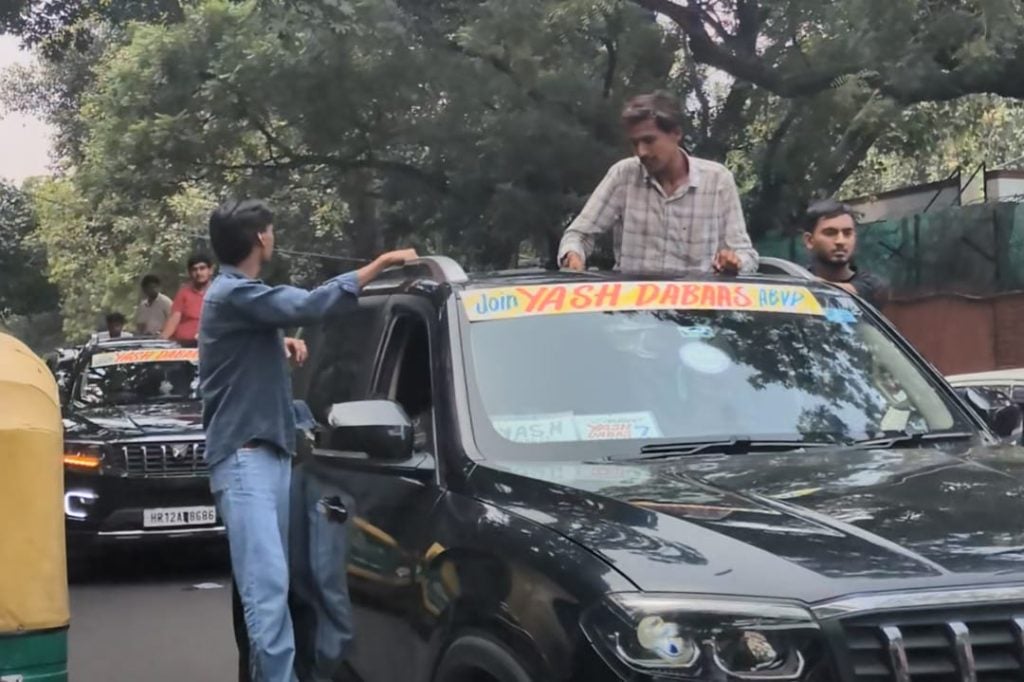
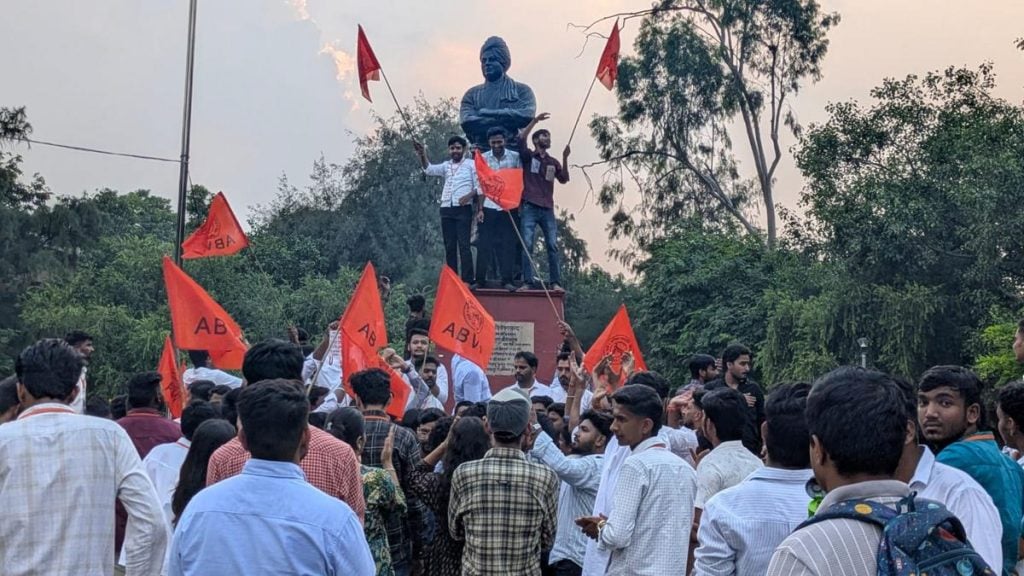
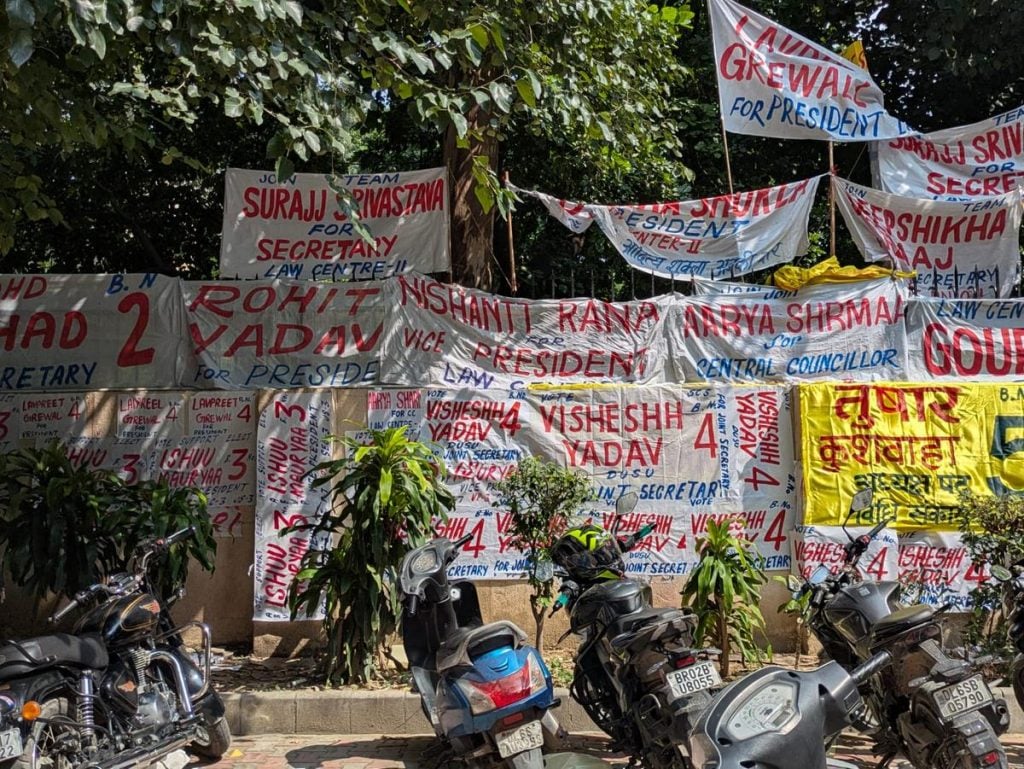
A convoy of black SUVs clogs the road leading to the Faculty of Arts. Campaigners in white shirts stand through open sunroofs, hands raised, their affiliations spelled out in bold red letters across the cars. Posters crowd walls and e-rickshaws. Young men climb college gates and ledges for a better view, waving flags and shouting ballot numbers. The occasional “Jai Shri Ram” rises up.
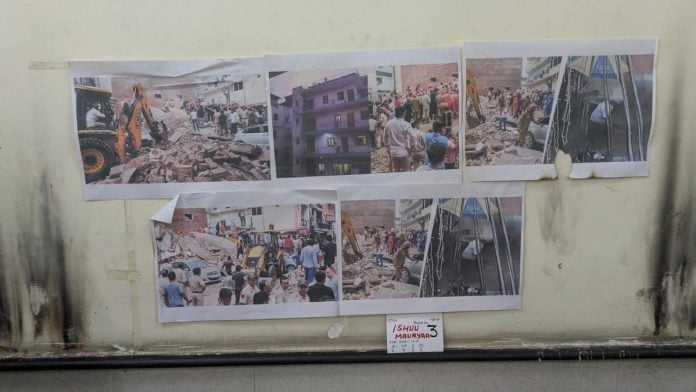
But there’s now a more sombre side to this familiar DUSU election spectacle. At the Campus Law Centre, photographs of the wreckage at Satya Niketan have been taped to a bulletin board: broken masonry, rescue workers, a crushed car. Just below them sits a small handwritten campaign card for ABVP vice-presidential candidate Ishu Maurya, ballot number 3.
“We will work on hostels and PGs at ground zero, and ensure that every migrant student who comes to study at Delhi University gets access to hostel and PG facilities,” Maurya told ThePrint, adding that his union would sit with state government office-bearers to “build a consensus” once elected.
Elsewhere, NSUI flyers also have photographs of the incident and the line “Chhaatra yahaan padhne aaye the. Unhe ek surakshit shahar milna chahiye tha” (Students had come here to study. They should have found a safe city).
The DU victims of the Hostel Daze collapse included Arpit Jaj, from Dewas, MP; Abhishek Kumar, from Chandauli, UP; Yuvraj Soni, from Durg, Chhattisgarh; Pavan Kumar, from Auraiya, UP; and Akshat Singh, from Katni, MP. Two labourers also died.
The blame game this time is over where the failure that led to Satya Niketan lies, and who is the most righteous champion of the housing issue.
The ABVP currently holds DUSU, having won three of the four central posts in 2025, and it’s been getting heat from rivals about not doing enough. But ABVP presidential candidate Yash Dabas, a law graduate currently pursuing his master’s in Buddhist Studies, says his party had been warning about unsafe buildings long before the collapse.
“I had said last year too, in a podcast, that a building would collapse in the times to come, because I could see no safety audit was being conducted,” he said. “We kept raising our voice on this, but because of this negligence, no attention was paid to it.”
The Awas issue has become a campaign refrain for him.
“‘A’ for Aawas. We, brothers from Rajasthan—we migrant students—come to study at Delhi University. If we need something from Delhi University, we need a hostel to live in. Our PGs should be good, our hostels should be good,” he thundered in a campaign speech.
He was careful, however, to frame ABVP’s own dominance of DUSU in the last six years as a story of results rather than failure.
I had said last year too, in a podcast, that a building would collapse in the times to come, because I could see no safety audit was being conducted. We kept raising our voice on this, but because of this negligence, no attention was paid to it
– Yash Dabas, ABVP presidential candidate
“In 2015 Delhi University had 5,700 beds; today that number has more than doubled, to over 12,000 beds,” he said.
The number itself is disputed. Last week, DU officials put the current hostel capacity at 7,210 seats, with plans to raise it to 12,754 over the next five years. NSUI’s Meena gives a lower estimate.
“Every year, 75,000 children get admission in DU, but DU can only provide accommodation for 3,000 or 4,000,” he claimed.
NSUI has also tried to make Satya Niketan proof that its earlier demands were ignored. Meena pointed to a ten-day hunger strike for a system under which DU would certify private PGs as fit to live in.
“If that had happened, if Delhi University had accepted our demand, then perhaps our brothers would be among us today,” he added.
‘Student Tenant Union’ for PGs
The conditions in private PGs are a sore point across the board. NSUI’s former national spokesperson Rajvardhan Thakur described rooms with “barely any space between the two beds” and rampant safety violations.
“Recent data has further shown that 99 per cent of PGs don’t have a Fire NOC,” he added, referring to an MCD survey released after the collapse that found that only 31 of 2,453 PGs surveyed across Delhi had a Fire NOC.
ASAP blames the BJP-led governments for failing to act despite having what it calls “chaaron engine ki sarkaar” — power at the Centre and state, as well as the university and MCD.
“The government doesn’t lack land, but they still don’t allot hostels for it,” said ASAP presidential candidate Ashmit Kumar. “The government should pay the PG rent of children.”
The AISA-SFI alliance, too, pins the blame on ABVP.
We struggle with unhygienic washrooms and water shortages. The drainage is horrible. We are hopeful that the student union might work for our benefit. We are happy that our problems are now being addressed
– Gungun, first-year law student living in a PG
“When freshers join the university, ABVP help stations are the ones to first direct them to these private PGs. They are now trying to wash off from accountability,” alleged Anjali, the 2025 AISA-SFI presidential candidate. She argued that the PG economy was not just an accident of scarcity but something actively maintained.
Parijat pointed to a WhatsApp collective rolled out by SFI called the Student Tenant Union of Delhi as a more durable and immediate answer than manifesto promises.
“If a PG owner is known for not returning security or having bad food, these issues can be brought to public light. Till we can get more perceptible change, at least students can help each other out,” he said.
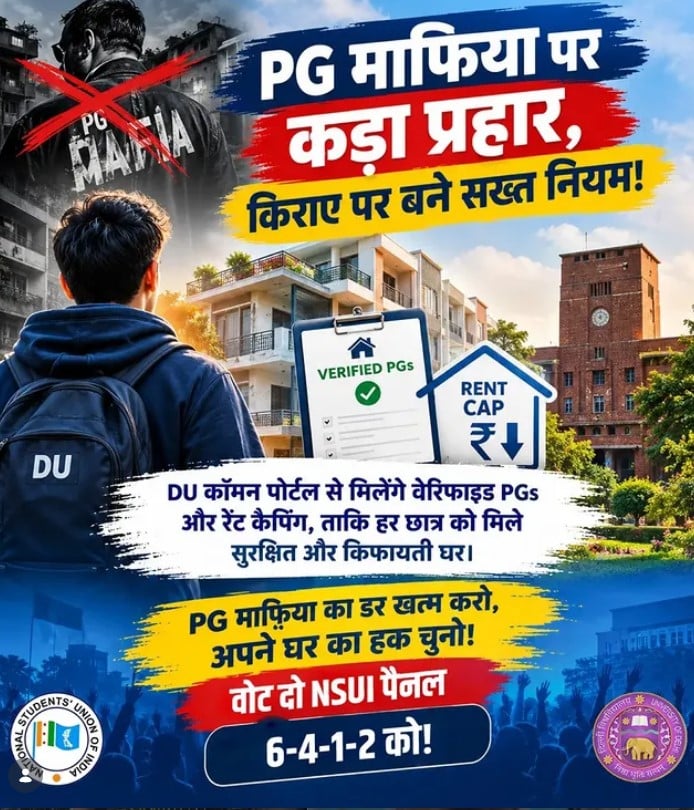
‘PG mafia’ | Photo: Instagram
Other battles on the ballot
Housing may be the biggest issue this year, but the usual DUSU concerns have not disappeared, including women’s safety, connectivity and the metro concession.
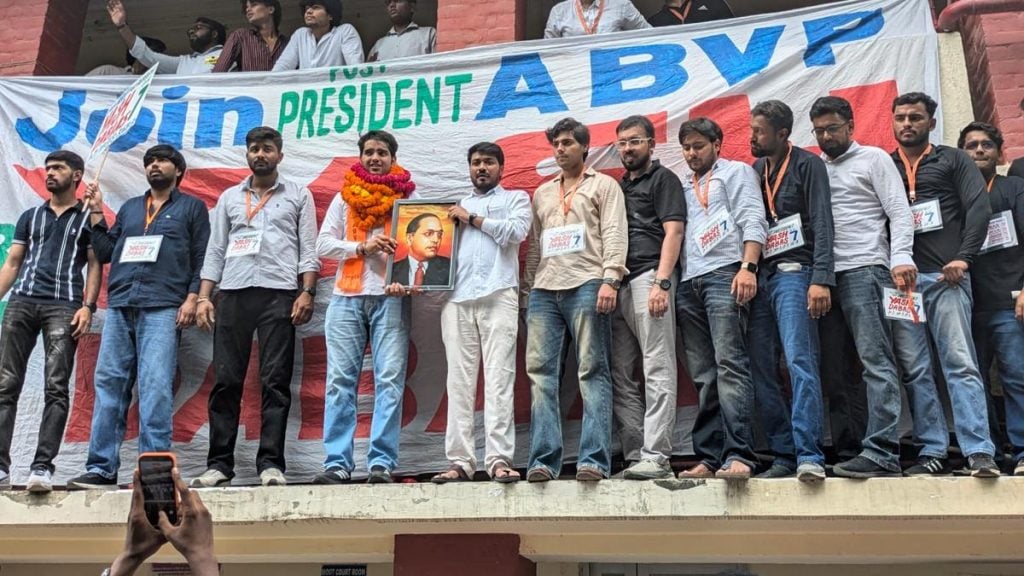
ABVP has made “Awas” its headline pitch, while the B, V and P stand for “Bhagidari, Vishwas, Parinaam” — participation, trust and results. At the Campus Law Centre, presidential candidate Yash Dabas climbed onto a ledge to address supporters, opening with “Bharat Mata Ki Jai” before the crowd broke into chants of his name.
Mansi Sharma, an ABVP campaigner and final-year law student from Patna who lives in a private flat herself, pointed to what she called concrete, delivered outcomes rather than promises.
“We have installed 1,000 plus cameras in the whole of Delhi University,” she said. “We have been protesting, asking, demanding, and requesting the state government for a Pink Booth. We have installed one near Miranda House.”
Rivals, however, dispute the ABVP’s stance on women’s representation.
“Out of 20 women’s colleges, only six have voting rights,” Parijat said. “I think it is a manufactured thing, because if women got voting rights, the goons currently coming to power would never be able to.”
The concession metro pass has also become one of the year’s most contested “original” ideas, with more than one party claiming it as its own initiative.
Meena, NSUI’s presidential candidate, listed it among his top three promises, along with safety and hostels. He positioned it as inseparable from the accommodation fight since commuting PG students need it most.
The Left alliance, meanwhile, insists that they raised the demand well before it became a hot-button issue.
“SFI brought up the issue five years ago. Since then, we’re the only ones who have kept protesting,” Parijat said, noting that the Delhi government had agreed to it but “the Centre disagreed” — a reference to ABVP’s ties to the BJP. For the Left alliance, the housing fight is really a fight about the haves and have-nots.
“These people do not require hostels and they do not require metro passes,” he said. “Even the scale of the cars and campaigns shows that they do not need these concessions.”
Also Read: IIM Sambalpur promised a Delhi campus. After Rs 18 lakh fee, students fight in court now
Hope and hype
While many students seemed weary of the campaign chaos and kept their distance, some saw reason for hope in the sudden focus on housing.
Gungun, a first-year law student who lives in a PG, said conditions were far from ideal and that hostel accommodation would have been preferable.
“We struggle with unhygienic washrooms and water shortages. The drainage is horrible. We are hopeful that the student union might work for our benefit. We are happy that our problems are now being addressed,” she said.
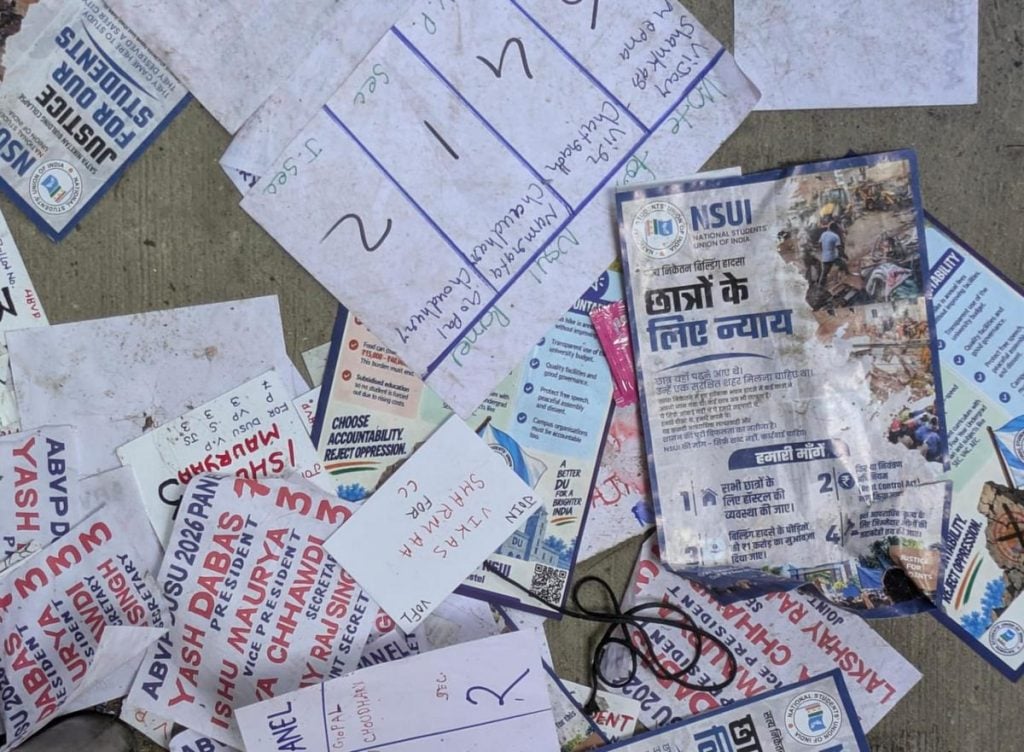
Around North Campus, the campaign was loud and frenetic. “Dabas, Dabas,” someone called. “Yash Dabas!” the crowd answered.
A first-year MA History student from Miranda House was unimpressed. She gestured at the campaign cards and torn posters scattered along the pavement.
“Everyone loves to talk about civic sense, but no one cares about it during DUSU elections,” she said. Among the pile of crumpled and dirty papers lay an NSUI pamphlet with photographs from the Satya Niketan collapse under the words: “Justice for our students.”
(Edited by Asavari Singh)