



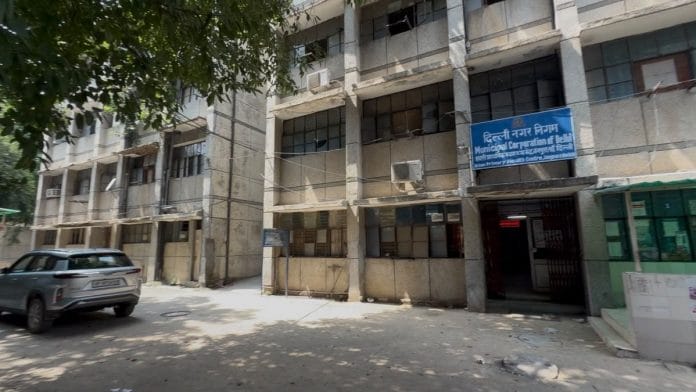

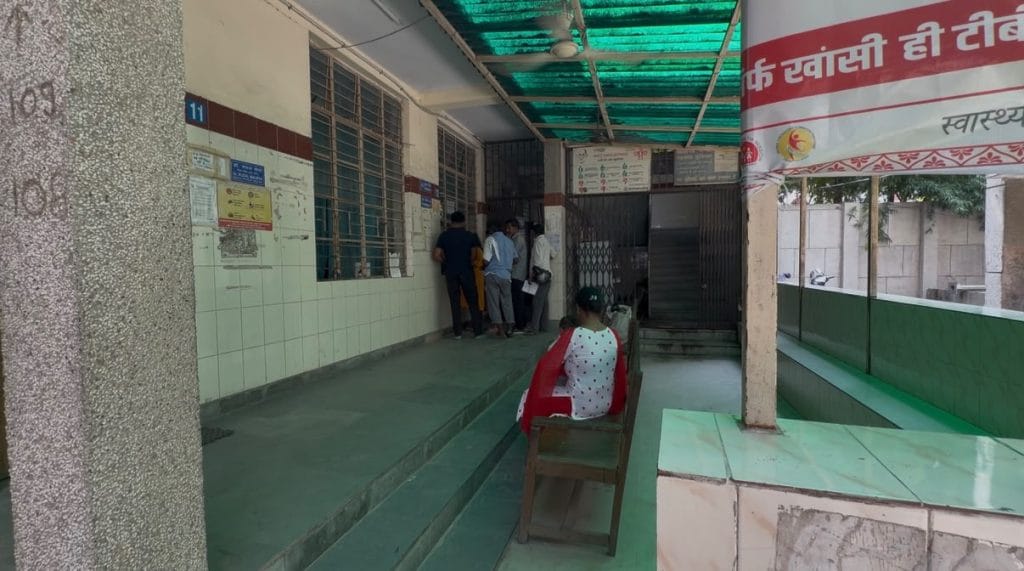
New Delhi: From 8 am every day, pregnant women and new mothers carrying infants queue up in an MCD-run polyclinic in Delhi’s Jangpura. It is so packed that the line spills onto the street.
All this is happening in a building whose structure the MCD had declared dangerous five years ago. The collapse of a five-storey paying guest accommodation in Satya Niketan on Sunday, in which seven students were killed, has once again brought Delhi’s unsafe buildings into focus. In many cases, the warning comes long before a collapse. But even when a building is declared unsafe and marked for action, people continue to live, work and conduct business inside.
The MCD’s annual pre-monsoon survey does not necessarily capture the full extent of the city’s unsafe-building problem. This year, it surveyed roughly 30.7 lakh buildings and declared 62 dangerous, with Karol Bagh recording the highest number. The count was 57 in 2023, 266 in 2022 and 428 in 2021. The list is not available in the public domain.
However, Delhi Fire Services recorded 544 house-collapse calls in 2025 and 464 in 2024, with 46 deaths over those two years. Another 330 calls came between January and September this year, with 30 deaths and 120 injuries between them.
The Satya Niketan building was not on the MCD’s “dangerous” list. But even for buildings that are, action can be glacial.
At the three-storey Jangpura clinic, doctors see patients on the ground floor, which houses a labour room, a child OPD and a general outpatient clinic. On an ordinary day, the facility sees 200 to 300 people.
There is a risk to the women who come here for treatment but the greater concern is for the staff like us who have to report to the building every single day, even after being fully aware of its condition
-Doctor at Jangpura clinic
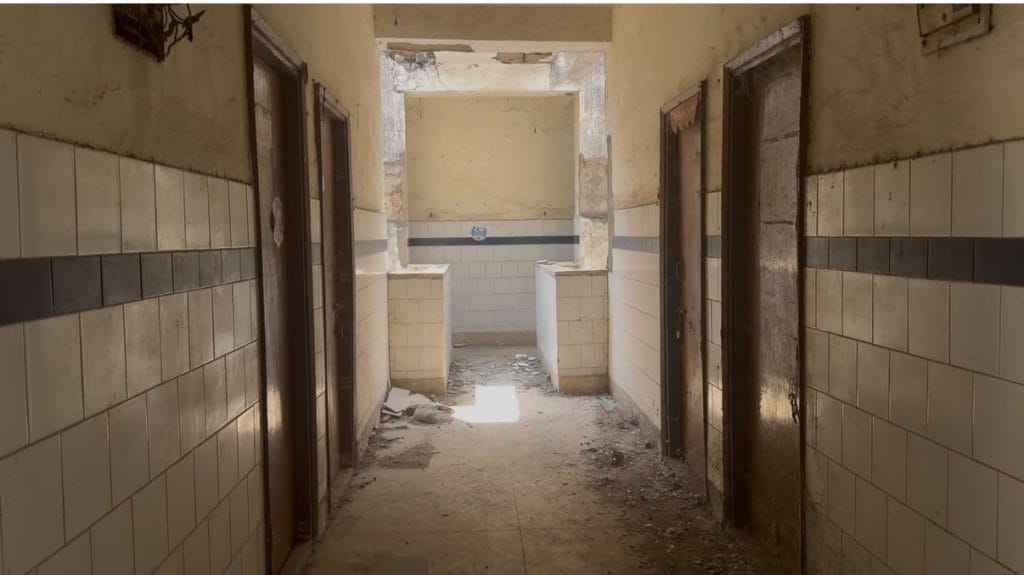
Higher up is where the decay becomes more apparent. Plaster has peeled away from the walls. Ceiling bricks have broken loose. The upper floor, once used as MCD staff quarters, is curtained with cobwebs. Shoes, discarded decorations and other belongings left behind by families who moved out years ago remain scattered alongside the broken plaster on the floor. Three families still occupy these floors. At one doorway, a shoe rack and a few small decorations sit outside a flat.
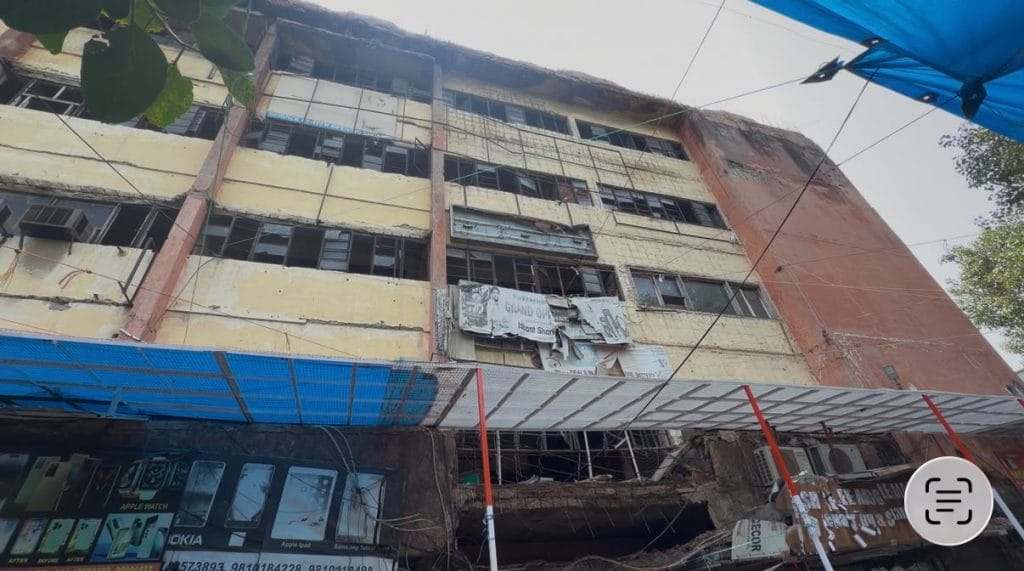
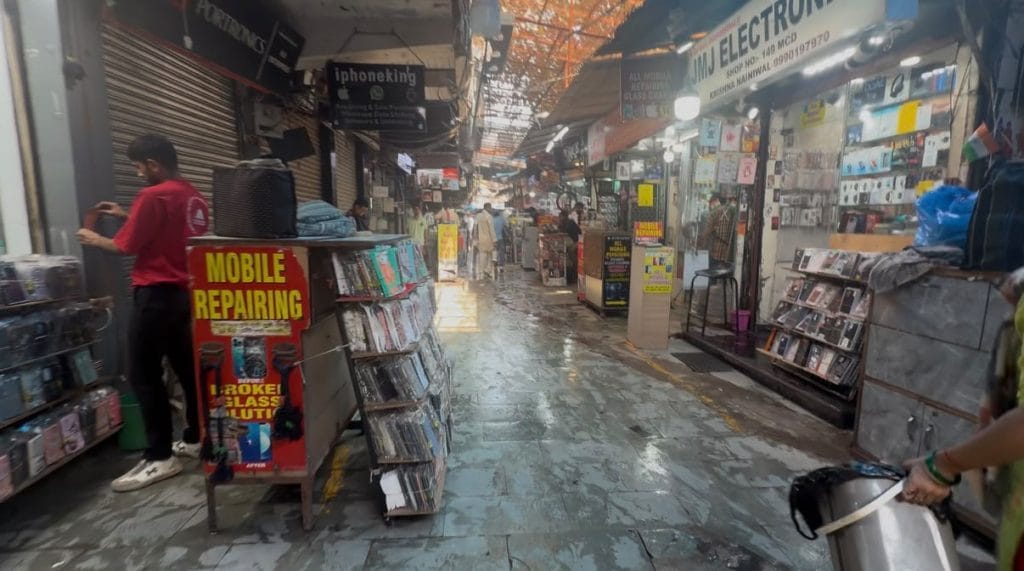
The contradiction is not unique to Jangpura. At Karol Bagh’s Ghaffar Market, Delhi’s first commercial complex for electronic goods, at least 75 traders still conduct their business from a five-storey building whose structural safety has been in question for the past five years. Hundreds of customers visit the ground floor shops every day. Above them, broken windows, exposed rods and crumbling plaster bear the signs of a building that poses a serious safety risk.
In both cases, structural audits and a declaration have generated only proposals, notices, negotiations and files moving between offices — while the buildings remain in use.
That gap between a building being declared dangerous and government action is where Delhi’s unsafe-building crisis continues to play out. A declaration is meant to trigger evacuation, relocation, repair, retrofitting or demolition. Instead, it falls into the black hole of general official and public apathy in a city where public infrastructure is scarce but users are manifold.
Also Read: Two keys, one dilemma—the story of Modi’s slum neighbours evicted to new homes 50 km away
‘Unsafe’ clinic with nowhere to go
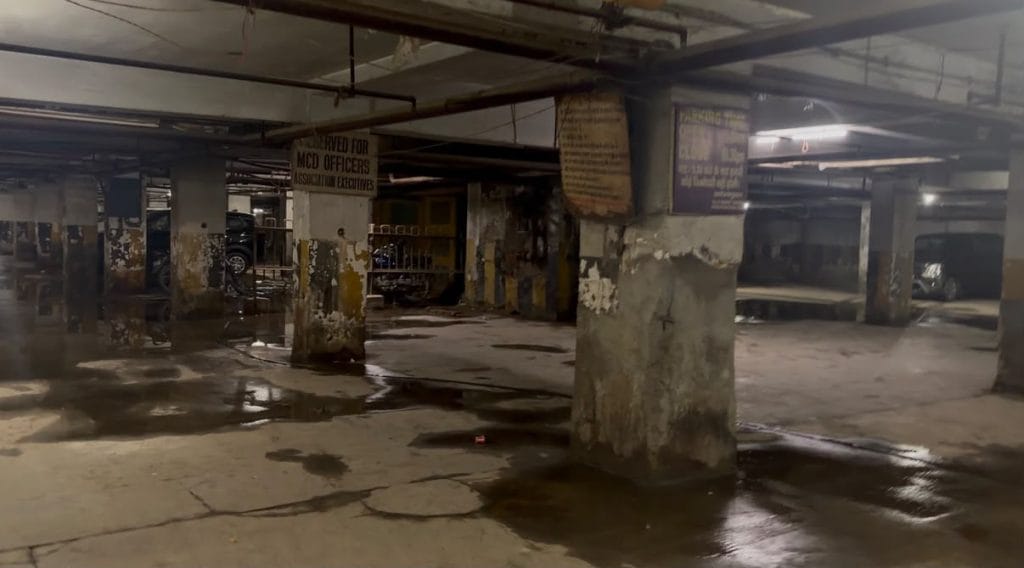
The Jangpura structure’s present precarious condition has been blamed on the MCD building an underground multi-level parking facility beneath part of the premises in 2010. According to Anil Goswami of the Bhogal RWA, the excavation went nearly 100 feet below ground.
“During monsoons, the entire underground car parking started filling up with water. By 2014, thousands of litres had accumulated underground. The excavation and the years of standing water that followed are what weakened the structure above it,” he said.
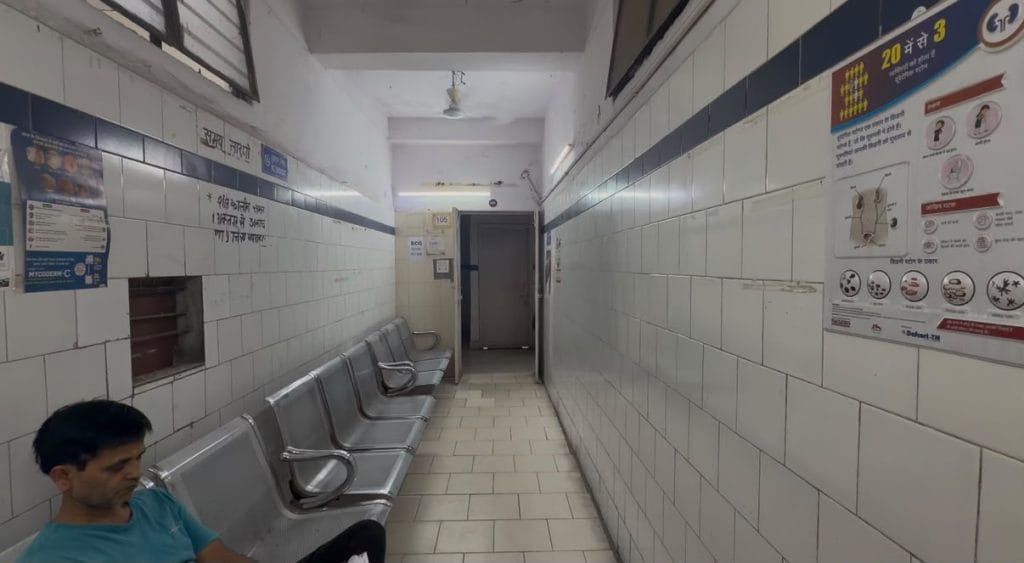
A former resident of the staff quarters, who lived in the building from 1990 until 2021, recalled water from the parking area reaching the building during the monsoon. He said he alerted the MCD in 2012 and asked that residents be evacuated.
“So then the contractor of the parking lot made some temporary adjustments — they ended up filling some cement in the basement. But it has been years since the building was declared dangerous,” he said.
It has been a while since I last visited that hospital, because whenever I go there, everyone has the same complaint, that the hospital is about to fall. So now I feel embarrassed to show my face anymore
-Sarika Chaudhary, AAP councillor
The former resident, whose wife worked as a nurse at the MCD polyclinic, said many residents had long wanted the building converted into a hospital rather than have its basement dug up for parking.
“But at the time, there was political motivation to dig a basement for a multi-level parking, because some residents in the area were convinced that this would increase the price of their land. Those of us living in the staff quarters were aware that deep digging could leave us with no roof over our heads if there was an earthquake of high velocity,” he said, asking to remain anonymous in case his wife’s pension was jeopardised.
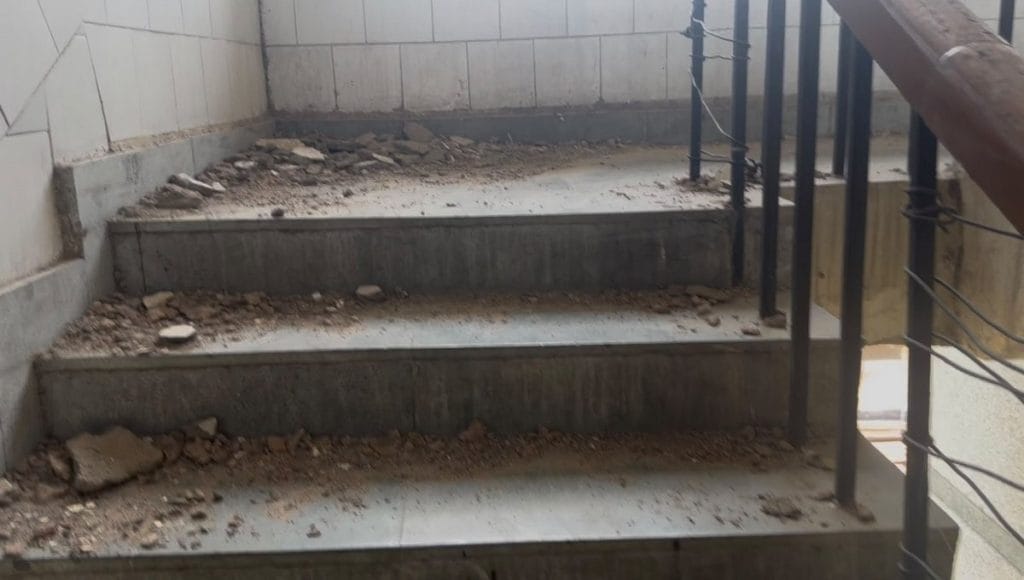
The parking is now unused. So is the Jaccha-Baccha Kendra, where new mothers once stayed overnight after childbirth. The maternity ward was discontinued over concerns about the building, though the clinic continued to function.
A doctor who has worked there for about a year acknowledged the risk for both patients and staff.
“There is a risk to the women who come here for treatment but the greater concern is for the staff like us who have to report to the building every single day, even after being fully aware of its condition,” he said.
The building began in 1920 as a dispensary run by the British-run Raisina Municipal Committee for the new settlement of ‘Youngpura’, so named for an officer called Charles Young who was in charge of relocating villagers from Raisina Hills and Khairpur in the 1900s. It was converted into a maternity home in the early 1970s — a shape the building has held, in name at least, ever since.
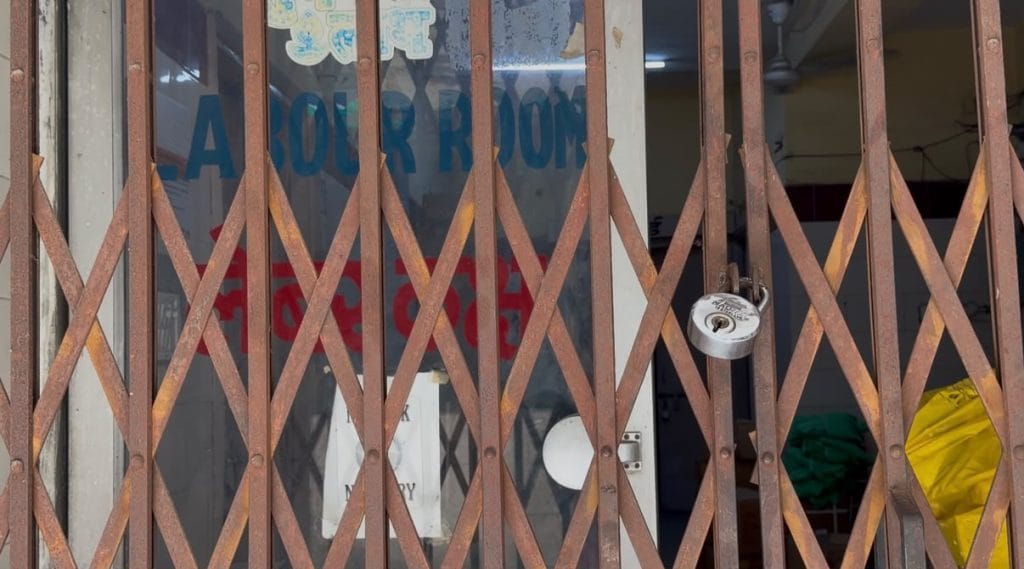
The problem has been finding somewhere for a functioning hospital to go.
Sarika Chaudhary, the AAP councillor for Daryaganj ward, which includes Jangpura, said she has raised the issue in the MCD repeatedly — three times in the civic body’s assembly, and at every zonal meeting since her tenure began in December 2022.
“This building had been declared dangerous some one-and-a-half year before my MCD tenure,” she said.
Chaudhary proposed shifting the clinic to a nearby unused baraat ghar. But a junior engineer estimated that adapting it for medical use would cost around Rs 30 lakh.
“The file was rejected citing paucity of funds,” she said.
She then suggested temporarily moving the clinic there while a new building was constructed. That proposal has stalled too.
Evacuating a functioning hospital is not as simple as moving people out. It requires finding another space, fitting it out for medical use, and moving equipment, staff and patients without anyone losing access to treatment along the way.
Chaudhary said she has now largely stopped visiting the clinic.
“It has been a while since I last visited that hospital, because whenever I go there, everyone has the same complaint, that the hospital is about to fall. So now I feel embarrassed to show my face anymore,” she said.
A question of livelihood
Barely 20 minutes away, a similar policy collapse plays out in Karol Bagh’s Ghaffar Market.
Born as a post-Partition rehabilitation initiative for traders, the complex was later developed into a multi-storey commercial building. The MCD allotted shops on long-term leases — some for as long as 99 years — in the 1970s. Now known as one of Delhi’s “grey” hubs for electronics and mobile phones, its status as a dangerous building is no secret to the shopkeepers.
But asking traders to leave a commercial complex is not as straightforward as shutting an unsafe building. The market is a web of businesses, leases, investments and livelihoods.
Attempts to get it vacated have all ended in failure. In 2021, after a structural audit by IIT Roorkee’s Department of Earthquake Engineering, the North Delhi Municipal Corporation issued an order under Section 349 of the Delhi Municipal Corporation Act directing occupants, owners and consumers to vacate the building within three days.
Traders resisted.
They argued they had been sending reminders to the civic body to carry out repairs for a long time, and that they were willing to pay for retrofitting and other fixes themselves rather than relocate and lose their businesses.
The users have the right to go to court if they want to challenge the decision after the MCD issues notices. A stay was granted after the Ghaffar Market Association approached the court
-MCD official
The MCD then proposed temporary relocation to alternative sites, but traders opposed the move over concerns about footfall and livelihoods. The matter went to court and a stay against eviction was obtained.
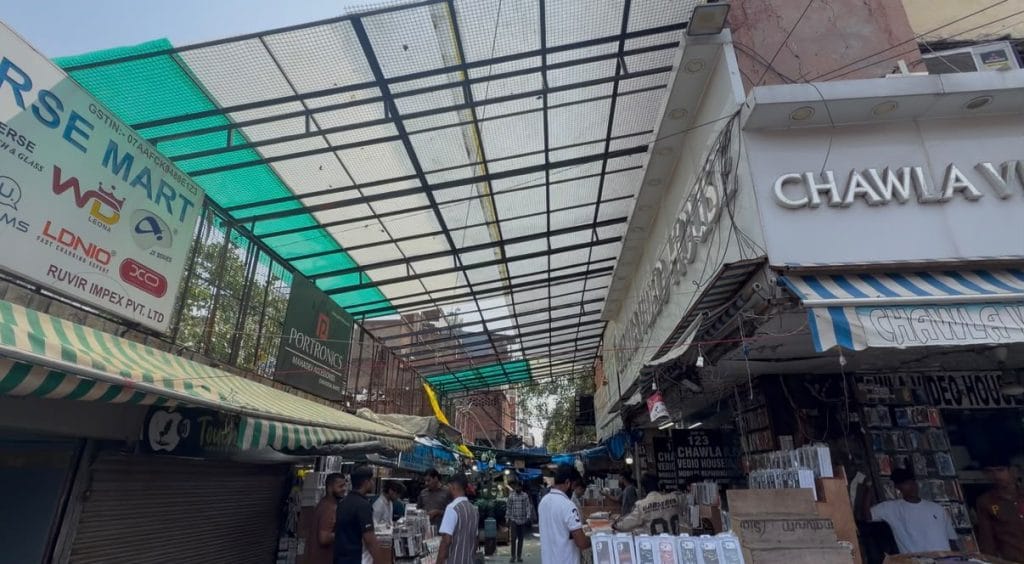
On the face of it, Ghaffar Market can almost pass for an ordinary ageing commercial complex. Shopkeepers on the ground floor have repaired and dressed up their storefronts. The commercial activity on the ground floor almost masks the age of the structure.
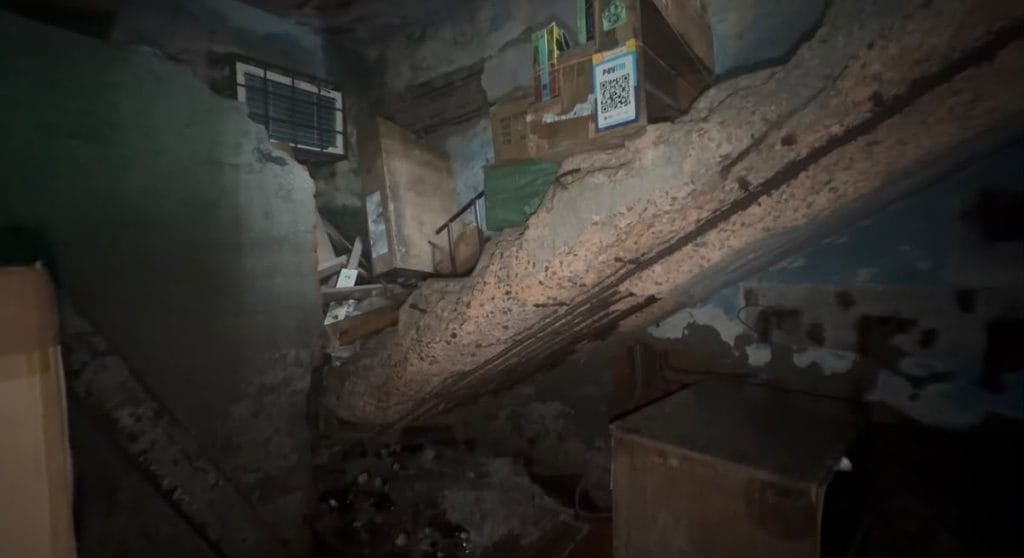
But the upper floors have yellow-stained walls, broken windowpanes and exposed reinforcement rods. Old AC vents protrude from the facade, remnants of offices and commercial establishments that once occupied those levels. As tenants moved out, the upper floors were left to decay.
Harish Chitkara, who has headed the market association for around 25 years, asked: if the building is unsafe, who is responsible for making it safe? He added that the building had not even been painted during his tenure.
Unwilling to accept demolition as the solution, traders say the MCD should either repair the building or permit them to do so themselves.
Meanwhile, falling plaster and bricks have become sufficiently routine for vendors to improvise their own protection. They first covered shops with tarpaulin sheets, and last month, installed metal-mesh sheds over the shopfronts.
For now, the MCD appears to have washed its hands of the matter.
“The users have the right to go to court if they want to challenge the decision after the MCD issues notices. A stay was granted after the Ghaffar Market Association approached the court,” an official said.
An imperfect survey
The MCD’s annual dangerous-building survey is an ambitious exercise. Junior engineers are expected to survey more than 30 lakh buildings spread across 12 zones. One JE is assigned two to three wards. But the survey basically amounts to eyeballing which buildings look dilapidated.
“When someone comes to the zonal DC’s office to complain that there is a crack or a minor collapse somewhere, that is when we make visits.”
The Delhi Municipal Corporation Act 1957 sets a deadline for this survey, though it is rarely met in practice.
“The zonal DCs have to submit reports of their visual survey by 8 June every year, and by 30 June, an ‘action taken’ report has to be published, listing the number of notices served and places where demolitions have taken place,” the official added.
The MCD’s 7 September progress report, accessed by ThePrint, shows that of 62 buildings declared dangerous this year, 16 had been demolished and four sealed or stayed. Of 377 buildings identified as “repairable”, only 27 had been repaired by then.
After the Satya Niketan collapse, the MCD widened the exercise beyond the annual list.
“We are resurveying the entire area. Based on this, whatever little gaps there are, are being surveyed. Yesterday we surveyed more than 1,118 PGs in Delhi, and today too the drive is on. We are categorising all the PGs into five categories — dangerous, vulnerable, needing major repairs, needing minor repairs, or perfectly all right. In the next 24 to 48 hours, we will complete the survey of the entire city,” the official said.
The publicly released annual list covers only residential buildings. Government and commercial buildings are also surveyed, but those results are not publicly disclosed. In 2024 and 2025, the MCD did not announce a final count of buildings found dangerous.
There’s also the fact that the survey can miss dangerous buildings altogether. In April 2025, a four-storey building in Shakti Vihar, Nehru Vihar, collapsed, killing 11 people. It was not on that year’s dangerous-buildings list.
Also Read: Dwarka was Delhi’s middle class dream. Now it’s fighting traffic, garbage, water woes daily
Dangerous homes, hospitals, schools
Even when structural problems are known, the process of repairing, vacating or demolishing a building can drag on.
At Rajan Babu TB Hospital in North Delhi, part of the building was sealed in 2022 after a ceiling fell. Repair work later slowed because of funding constraints, according to reports at the time. The hospital continued functioning even as questions remained over the condition of the building.
In July this year, seven Delhi government school buildings were cleared for demolition after being found structurally unsafe, from a larger list requiring action. Children are shifted between buildings or classes when structures are considered unsafe, according to Kuldeep Singh Khatri, president of Shikshak Nyay Manch, an association of MCD teachers
We are trying to make the best out of whatever that we have been given. The plaster of the building keeps falling everyday but rents are so expensive. I have a daughter to marry off and another who is still in school
– Jangpura resident
And then there are homes. At Signature View Apartments in Mukherjee Nagar, a 12-tower, 336-flat DDA complex, residents began reporting structural problems within years of handover. In 2017, the RWA complained of major cracks and falling concrete, which prompted an inspection by the National Council for Cement and Building Materials. IIT Delhi formally declared all 12 towers unsafe and unfit for habitation in December 2022, recommending demolition. It wasn’t until a year later that the MCD got a formal eviction order from the court.
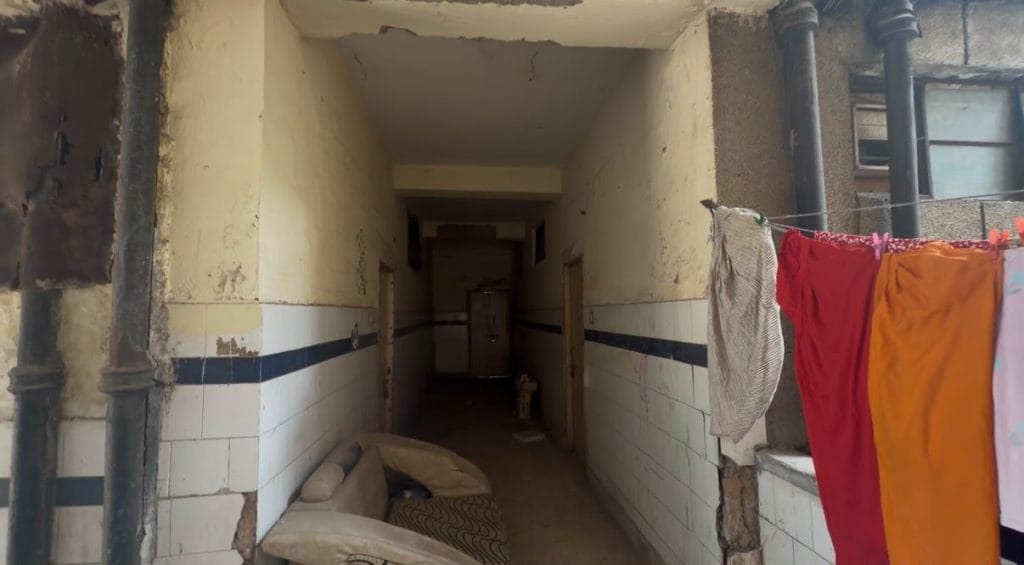
Back at Jangpura, most families in the staff quarters moved out only after retirement, and the flats were not allotted to other employees. But two families with members still employed by the MCD still live there, one on the first floor and another on the second.
“We are trying to make the best out of whatever that we have been given,” said one resident who has stayed there for well over a decade. “The plaster of the building keeps falling every day, but rents are so expensive. I have a daughter to marry off and another who is still in school.”
(Edited by Asavari Singh)