





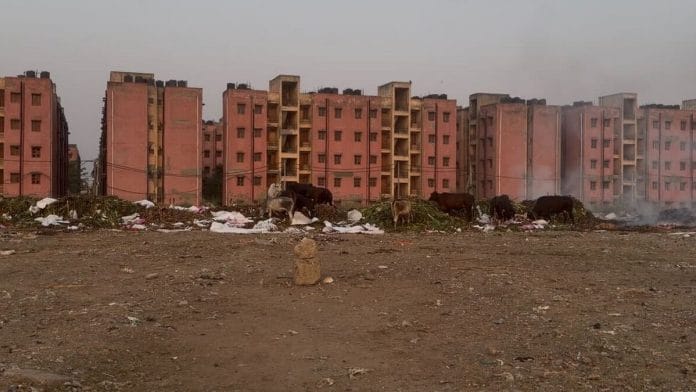


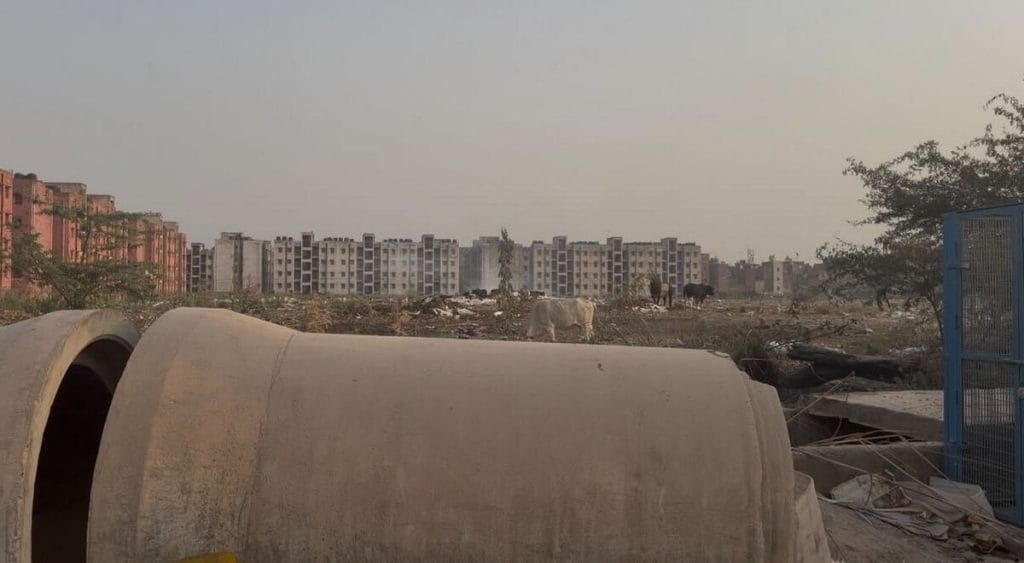
New Delhi: The field in front of DUSIB’s Bhalswa housing complex was once agricultural land. Today, it is a dumping ground where cows graze amid old tyres, broken furniture and construction rubble. The complex was meant as new homes for Delhi’s poorest jhuggi-jhopri communities, who had been relocated to make way for Delhi Metro construction and other infrastructure.
Today, it is a set of ghost buildings, standing as a mute witness to a long court battle between the owners of the farmland and government departments. Those relocated from the slums are still waiting.
This is what nearly two decades of institutional failure looks like in North Delhi — homes built for the city’s poorest families, sitting empty and rotting, on land that has too many legal claimants but no residents. Its story is a microcosm of a larger problem — the dog’s breakfast that well-intended decisions often become in India. And more importantly, India’s perennially doomed and knotty land acquisition project.
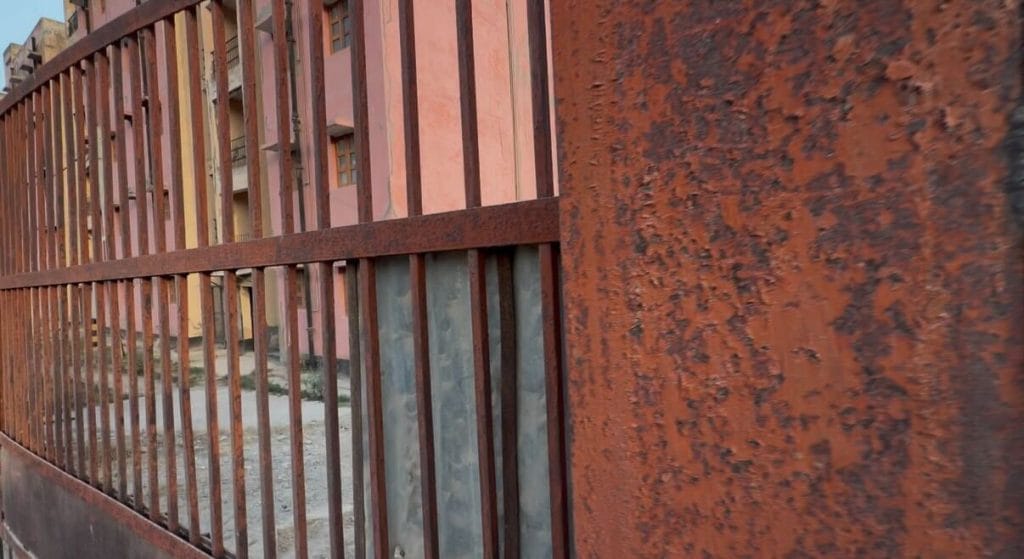
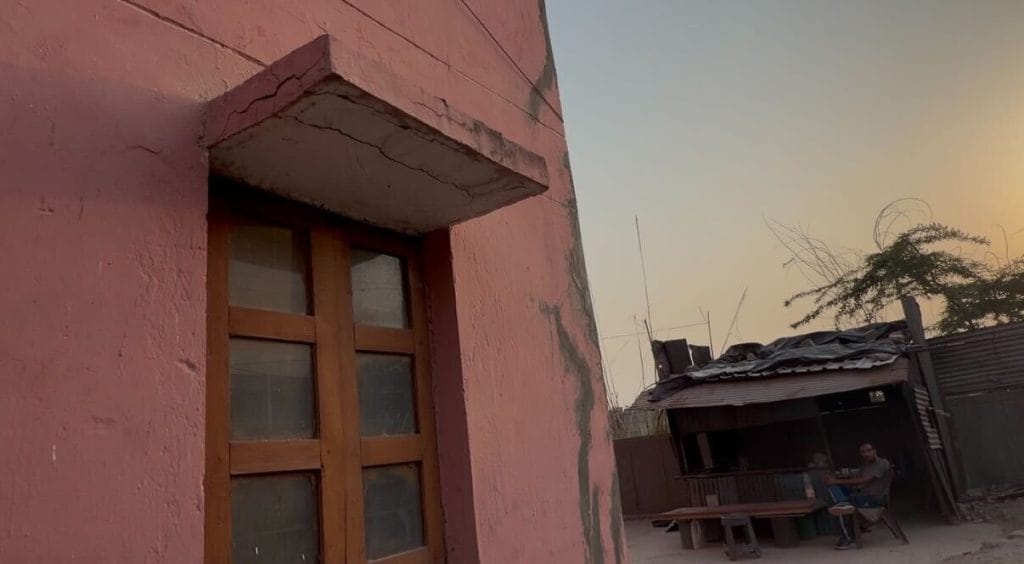
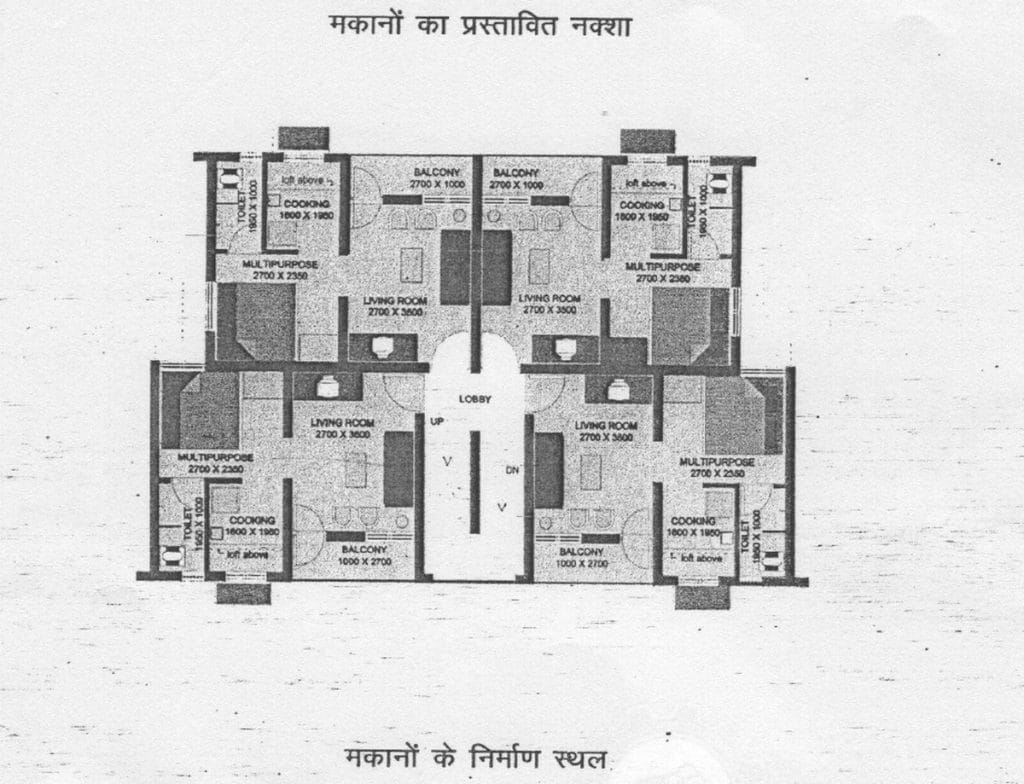
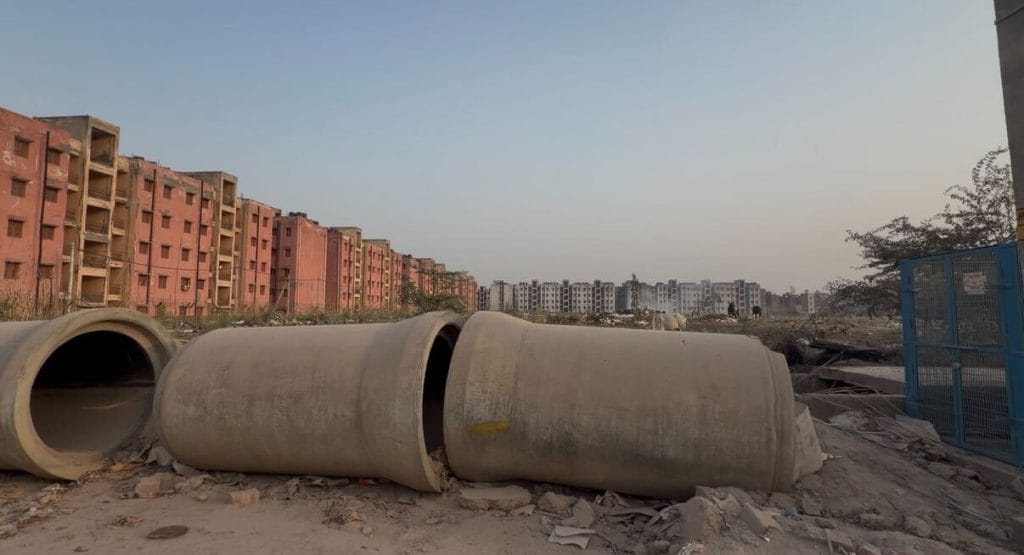
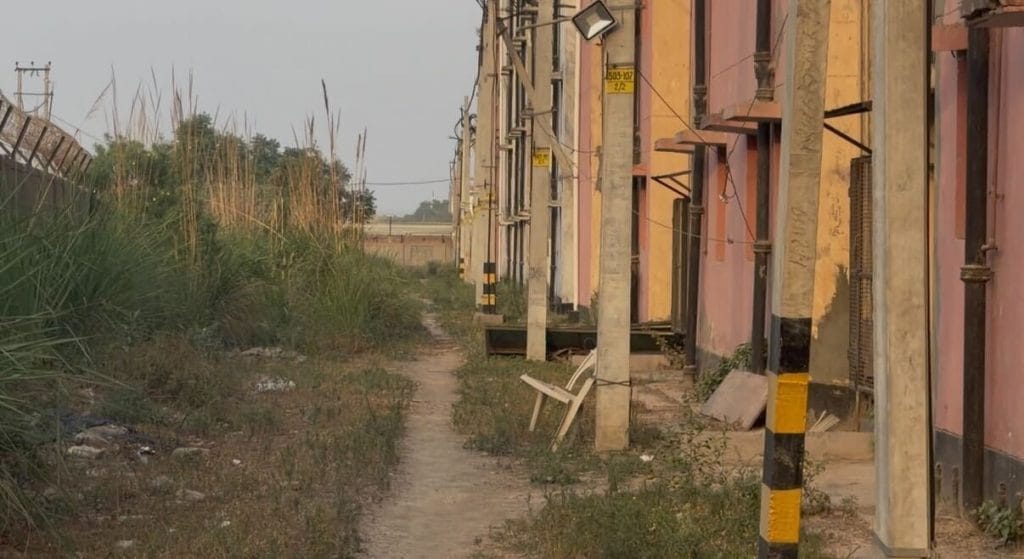
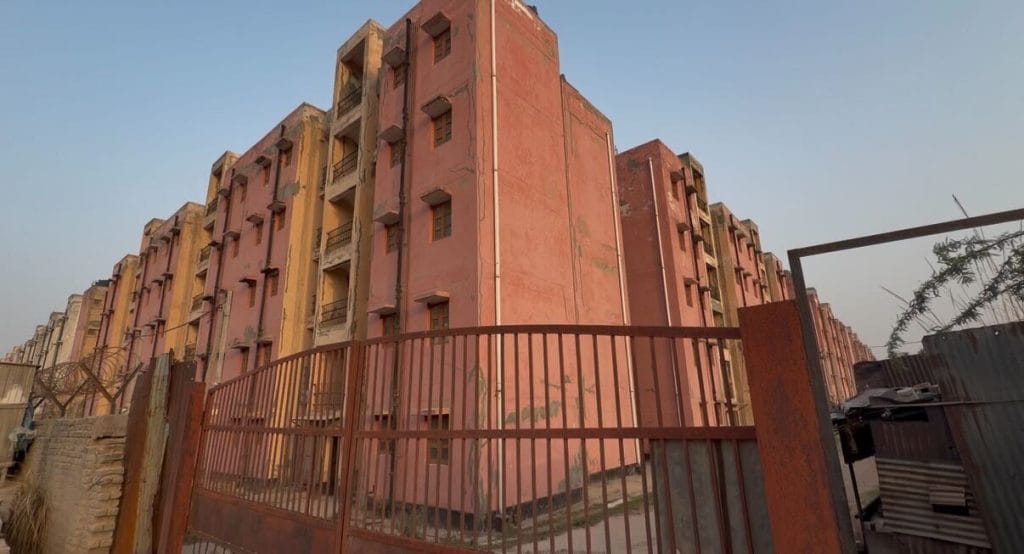
This is the complex that stands on the land that farmers from Bhalswa Jahangirpur village have been fighting to reclaim for over two decades. Behind the mounds of garbage, rows of grey and orange concrete blocks rise against the Delhi sky. The buildings are covered in cracks, each one filled with cement that has dried into a vein-like pattern across the orange facade — the government’s attempt to make the complex presentable before Chief Minister Rekha Gupta’s inspection last December.
She vowed that her government would create a housing model that was “a dream for poor families”, complete with parks and commercial zones. The Delhi Urban Shelter Improvement Board (DUSIB), the authority in charge of the blocks, had started the tender process for repairs.
But new cracks have appeared since. No one has come to fill them. Pipes jut from walls with nothing attached to them. A few water tanks sit on rooftops, which residents have never emptied, but many others have been stolen by thieves.
After a piece of land is acquired and given to DUSIB, our responsibility is to ensure the construction and delivery of EWS flats for slum jhuggi-jhopri rehabilitation. If there is any fault in the acquisition, the responsibility is not with us.”
— DUSIB official
A woman who lives in the settlement adjoining the complex has watched the cycle repeat through multiple governments. Sheila Dikshit’s government built the flats. Nothing happened. The next AAP government promised allotment. Nothing happened. BJP’s Rekha Gupta came and the walls were repainted. Nothing has happened yet.
“It has been at least ten to twelve years since these flats have been lying vacant,” the woman said. “Work often resumes and then it stops. This has become a continuous cycle. Earlier all the fixtures had been placed but now they have all been stolen—the water tanks, everything.”
The Bhalswa complex was constructed under the Jawaharlal Nehru National Urban Renewal Mission (JNNURM), launched in 2005 under the Manmohan Singh government to modernise cities and provide housing and basic services for the urban poor. The scheme was jointly funded by the central and state governments.
In Delhi, 52,584 EWS flats were planned under the scheme in 15 projects through three agencies: DSIIDC, DUSIB, and NDMC. Of these, 24,524 flats have been completed, while 28,060 are at different stages of construction, according to the Economic Survey of Delhi 2025-26.
Only 4,833 homes have been allotted so far, less than 10 per cent of the total planned number. At Bhalswa, 7,400 EWS flats were built and ready for allotment by 2016. The number allotted today is zero.
DUSIB puts the responsibility on the land acquisition process.
“After a piece of land is acquired and given to DUSIB, our responsibility is to ensure the construction and delivery of EWS flats for slum jhuggi-jhopri rehabilitation. If there is any fault in the acquisition, the responsibility is not with us,” a DUSIB official told ThePrint on condition of anonymity.
Also Read: In NCR high rises, EWS residents face daily discrimination—security, sanitation to park access
7,400 flats, home to none
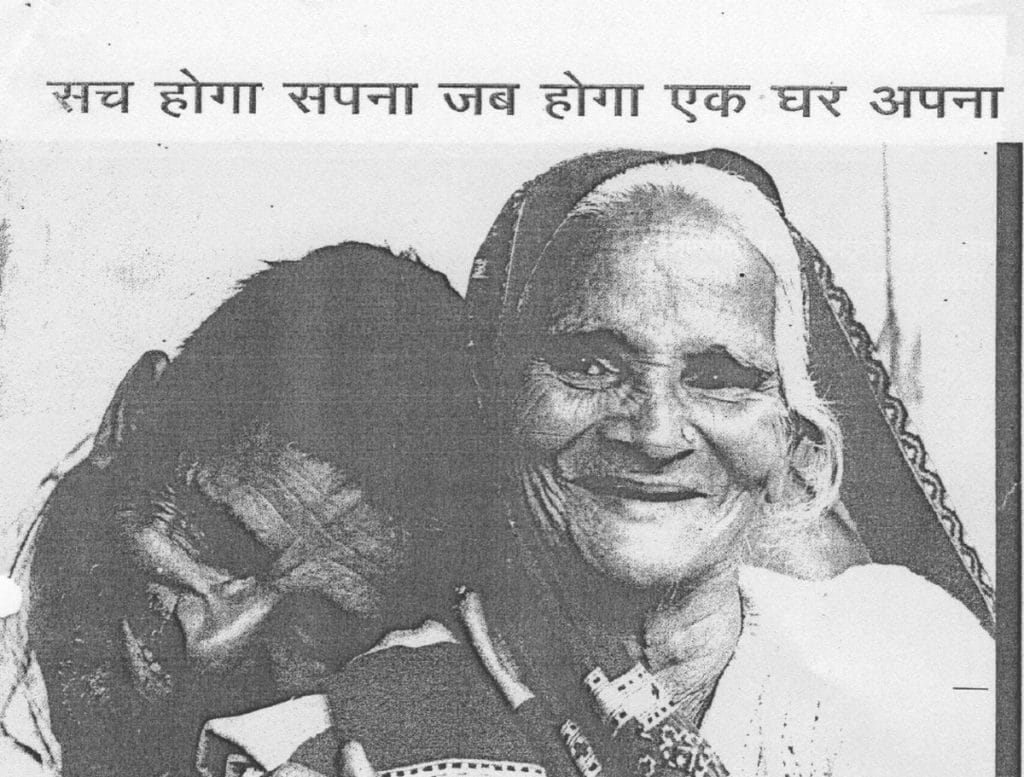
The Bhalswa project was inaugurated in 2007. A year later, registration began for the Rajiv Ratan Awas Yojana, which was meant to allot JNNURM flats for the resettlement of Delhi’s urban poor. The brochure promised a flat worth about Rs 2.5 lakh, for which eligible families would pay only Rs 60,000. The rest would come through government assistance. Bhalswa was among the sites listed. Over three lakh families registered.
The registration brochure, accessed by ThePrint, carried the Chief Minister’s photograph and a slogan: “Sach hoga sapna jab hoga ek ghar apna” — the dream will come true when we have a home of our own.
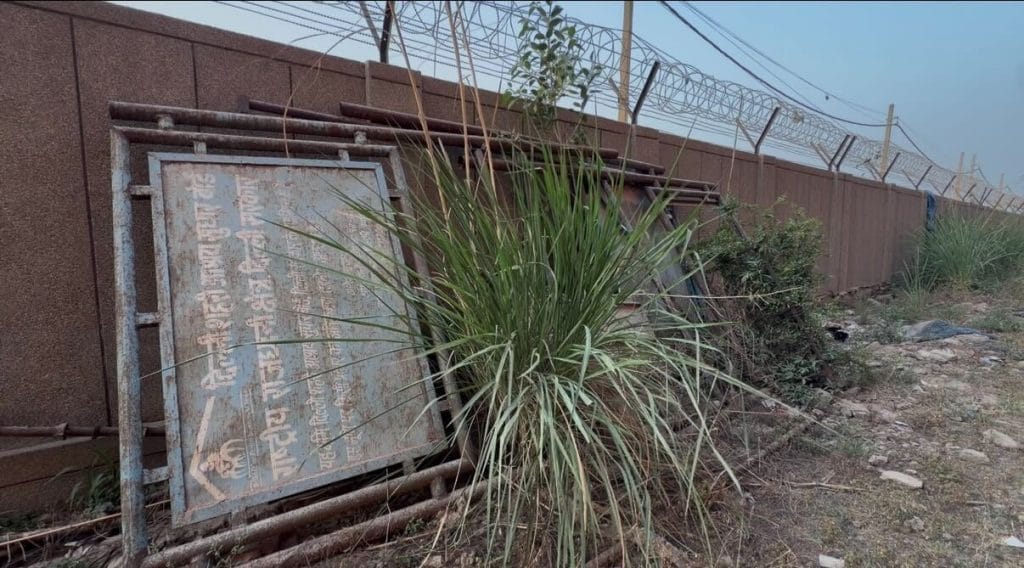
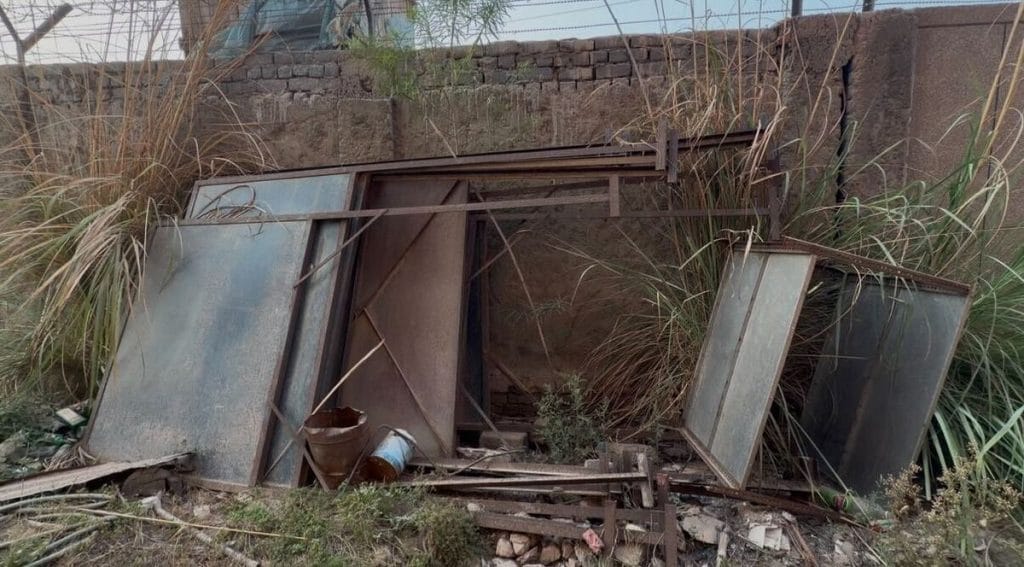
But today, the iron door at the entrance is crusted with rust and dust. Its nameplate, carrying DUSIB’s Hindi name — “Dilli Shahri Aashray Sudhar Board” — in white letters on a blue board, lies on the ground, its paint chipping and portions of the text no longer visible. Several other boards lie scattered nearby, illegible due to corrosion. There are no residents. There have never been any residents.
On a late afternoon, a middle-aged man coasting past on a motorbike slows to look at the complex. He has watched this project from the beginning, he says. He was young when the construction started, when the cranes arrived, when the concrete mixers churned, and when it seemed like the city was finally making good on its promise to its most marginalised residents.
That was nearly two decades ago. The cranes are long gone. What remains are over 7,400 flats across multiple towers —unoccupied, slowly dismantling themselves in the absence of care.
“It is becoming more dilapidated with every passing day,” he said, before riding off.
The reasons are not mysterious. They are documented in government files, court records, RTI responses and minutes of meetings that have been piling up for over 25 years. They come down, at their core, to a single legal catastrophe that the government caused, refused to acknowledge for years, and has still not fully resolved.
The project was constructed partly on land the government did not legally own — a result of India’s labyrinthine, inscrutable, and impenetrable land acquisition system. It set off a long dispute with the farmers whose land was taken. And the jhuggi-jhopri families for whom all of this was built have received nothing.
How six days became two decades
The story began on a hot July morning in 1998, when a letter landed on the desks of officials at Delhi’s Land and Building Department. It was a request to acquire about 200 acres of land in Bhalswa Jahangirpur village, sent by Manjit Singh, then Additional Commissioner of the MCD’s Slum and JJ Department.
The land was part of the agricultural green belt on the city’s northern fringe. The reason listed for the acquisition was the construction of transit camps for jhuggi-jhopri families who needed to be relocated from prime city land to make way for Delhi Metro construction and other infrastructure projects.
What followed was, by the standards of Indian bureaucracy, astonishing in its speed. Court records show that the letter arrived on 24 July. By the same afternoon, the file had moved through five desks. A draft notification under Sections 4, 6, and 17(1) of the Land Acquisition Act was typed out, checked against revenue records, and approved. On 28 July, the LG signed off on it. On 30 July, just six days after the letter arrived, a gazette notification was published.
They [departments] are all playing a safe game, they are blaming each other
— Yaman Yadav, Delhi-based lawyer
There was one crucial detail in that notification: it invoked Section 17 of the Land Acquisition Act, the “urgency clause.” This provision, meant as an extraordinary exception for situations of genuine emergency, had the effect of bypassing Section 5A of the Act—the provision that gives landowners the right to file objections to acquisitions. In a normal acquisition, landowners have 30 days to be heard, but once Section 17 is invoked, that right disappears.
It became a battle that has played out across India for many decades — farmers versus the government over farmland acquisition. Many industrial projects have failed to take off because of these acquisition and compensation battles. It’s what many economists have called one of the most vexing roadblocks holding India back from China-style manufacturing and infrastructure growth.
In Bhalswa, however, the battle has farmers on the one side and the city’s slum dwellers on the other. In the middle, the great Indian bureaucratic quagmire.
An upper hand for the farmers— almost
The land in question was 929 bighas and 15 biswas — the agricultural holdings of dozens of farming families in Bhalswa Jahangirpur, some of whom had farmed it for generations. They were given no hearing. Possession was taken without compensation in many cases. Award No 18, passed in November 2000, formalised the acquisition. While some farmers accepted compensation under it, others moved court to challenge the entire proceeding.
The farmers’ writ petitions, filed in batches in the Delhi High Court through 1998, were clubbed together and heard by a Division Bench presided over by Chief Justice SB Sinha and Justice AK Sikri. On 31 May 2002, the bench delivered its verdict in Praveen Jain & Others v. Union of India & Others.
The judgment was unambiguous. It found that the government had no genuine urgency. This meant that the decision to invoke Section 17 had no legal basis.
“Here a slumbering process, pending for years and suddenly exciting itself into immediate forcible taking, makes a travesty of emergency power,” the bench observed.
The entire notification for the acquisition of 929 bighas was quashed by the court. It was declared illegal and arbitrary. Award No. 18, the instrument through which land had actually been taken and some compensation disbursed, was set aside.
The farmers had won. Or so it seemed.
New acquisition and vanished bighas
In 2003, a year after the judgment, the Lt Governor convened a meeting. The minutes show that all the relevant departments were called: DUSIB (then operating as the Slum and JJ Department), the Land and Building Department, and the Land Acquisition Collector (LAC) of North Delhi. The message was clear: the old acquisition was quashed, but the government still needed the land. Begin again. Do it properly this time.
A fresh notification under Section 4 of the Land Acquisition Act was issued on 4 March 2003, again for 929 bighas. This time, the urgency clause was not invoked. The process proceeded with the required gap of one year before the next step.
But the do-over had a new hole in it.
In February 2004, the Section 6 notification — the formal declaration identifying the land to be acquired — left out 423 bighas from the original 929 bighas. The government had quietly removed a portion of the land from the fresh acquisition.
The most plausible explanation, advanced by those who have studied the case closely, is financial. By 2004, compensation rates had risen. Some landowners whose land had been taken under the now-quashed Award No 18 had already received compensation before the court struck down the acquisition itself. By leaving them out of the fresh notification, the government avoided paying compensation a second time.
Award No 24, the new award for the fresh acquisition, did not cover these 423 bighas. The result was that this land ended up becoming a legal no-man’s-land. It was not covered by the fresh award, and the previous award had been quashed. Today, in the government’s files, this land is nowhere to be found.
The money paid for it, though, is on record. An award of over Rs 15.62 crore was disbursed to the LAC through the Land and Building Department as compensation for acquired land — a sum that left government coffers and now hangs in a legal void.
The question no one will answer
Yaman Yadav, a Delhi-based lawyer whose own family had lost 2 acres to the acquisition, has spent years untangling this case. He describes the bureaucratic evasion that followed as almost surreal.
Between 2023 and 2025, he filed as many as 50 RTI applications.
“I asked a single question, 40-50 times. The land you have withheld — which award is it under? Even the CIC issued a contempt notice. Not even a single question was answered,” he said.
The circumstances are so contradictory that every official claim has an official counter-claim.
For the past seven years, the department has not shown any documents. Because the documents do not exist. The acquisition never happened.”
— Than Singh Yadav, head of Dilli Panchayat Sangh
If officials cite Award No 18, they can be pointed to the High Court judgment quashing it. If they cite the fresh acquisition under Award No 24, the records show that the 423 bighas were never included in the notification. On 3 January 2025, the Central Information Commission issued a contempt notice to the tehsildar for failing to respond to the RTIs. Still, no answer came. Because there is no answer. The government holds land it has no legal title to. It has built on that land, let those buildings fall into disrepair, and has no remedy.
Than Singh Yadav, who heads the Dilli Panchayat Sangh, has been organising mahapanchayats in the villages surrounding Bhalswa. Many of the affected farmers had no idea the original acquisition had been quashed — and therefore no idea they had grounds to fight. The panchayats, he says, exist to tell them their land could still be theirs because it is not in the government’s records.
“For the past seven years, the department has not shown any documents,” he said. “Because the documents do not exist. The acquisition never happened.”
Neither land nor money
The total breakdown between government departments meant that landowners were left fighting in the dark.
Farmer Rajeev Goel was one of them. He owned a single bigha of land in khasra number 72, part of the disputed 423 bighas. In 1998, he filed a reference petition asking for higher compensation to match market rates. The case went through multiple courts. Finally, in 2010, he won the reference case in Rohini court. His compensation was enhanced by Rs 33,781 — a small sum, but his.
At no point during years of proceedings did any of the government departments that appeared in the case — DUSIB, the Land and Building Department, or the LAC, which handles acquisition and compensation — inform the court that the acquisition of his land had been quashed in 2002. Goel had been fighting in total ignorance of the most important legal fact in his own case.
He died before he could collect his enhanced compensation.
In 2018, after his death, Goel’s wife and children filed an execution petition to release the money. In 2019, DUSIB’s counsel appeared in court and, for the first time, disclosed that Award No 18 had been quashed 17 years earlier. This meant the family could not be paid because the award under which the enhancement was granted no longer existed in law.
The LAC then took five more years. It was in 2025 that it finally filed a letter formally confirming this position.
The family now finds itself in a perfect trap. They cannot collect compensation because the award is quashed. They cannot reclaim their land because a building stands on it — built by a government that had no legal right to build there. The CIC has issued contempt notices that were ignored. The courts have heard arguments for decades. And the land, meanwhile, is neither theirs nor legally the government’s.
“Neither the landlord is able to take his land back, nor is he able to take his compensation, nor can these flats be used for relocation of the JJ clusters. It’s all because of this tangled dispute,” Yaman Yadav said with the flat exhaustion of a man who has repeated this reality too many times.
Krishan Singh Yadav, now 90, is fighting a similar battle — one that Yaman Yadav is currently handling. The court has been giving three-month intervals between hearings. At his age, each adjournment is a gamble. If Krishan Singh dies before the case is resolved, it risks falling into the same limbo as Goel’s. His children are scattered across the world, and the practical burden of continuing the litigation may simply be unfeasible.
Paper repairs
The flats built on this contested ground, along with the remaining portion of land where acquisition did proceed legally, have been deteriorating for nearly a decade.
When Chief Minister Rekha Gupta visited the Bhalswa complex in December 2025, she directed officials to expedite repairs under a strict, time-bound plan.
“From 2016 to 2025, these flats deteriorated into a dilapidated condition, yet the previous government did not allot a single flat to a poor family,” she said. “Around 7,400 flats were constructed here, but they have been lying abandoned, turning into ruins, and even the fittings and material have gone missing.”
That same month, DUSIB estimated that it would cost Rs 80 crore to refurbish all 12,880 EWS flats across Delhi that have been sitting vacant. For Bhalswa alone, the figure is Rs 7.8 crore. Of the total, Rs 44.24 crore has been approved.
The Delhi government has also announced an ambitious redevelopment plan to accompany the repairs: e-rickshaw charging stations, secure shops, parking facilities, a primary health centre, a school, anganwadi centres, parks reserved for women and senior citizens, and children’s playgrounds.
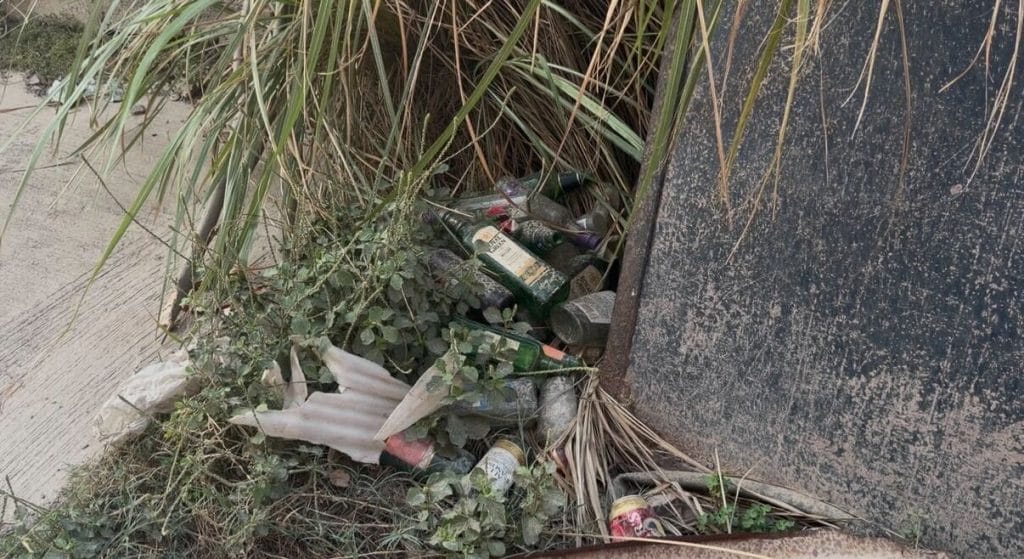
Meanwhile, weeds still push through the concrete walkways, and the roads are lined with the thick dust of a colony that never came to life. Residents of a nearby settlement say that in the evenings, the abandoned compound fills with drug users and drinkers. The evidence is there — crushed foil packets, broken glass, the black streaks left by old fires lit against the cold.
Also Read: Chandni Chowk to Safdarjung Enclave—Delhi’s public toilets are a nightmare
The blame game
The empty flats have been the subject of court directives more than once, but the blame game has been relentless.
In 2024, the Delhi High Court directed DUSIB to make sure the houses were habitable “at the earliest” but nothing came of it. Reports noted that DUSIB officials said allotment fell under the Delhi government’s urban development department. The Delhi government, in turn, blamed the delay on the Centre, saying it had not cleared allotment under the Mukhya Mantri Awas Yojna.
Pressed in court on how it came to build on land whose acquisition had been quashed, DUSIB pointed to the LAC, saying it had handed over possession. In a 2014 case brought by a set of Bhalswa farmers, the LAC (North) defended the acquisition in counter-affidavits, arguing that possession had been taken in 1998, compensation had been paid in 2001, and that quashing would “frustrate the acquisition and cause undue prejudice to the public revenue”. The court dismissed the farmers’ petition in 2019, observing they had been “sleeping over the matter” for more than a decade.
Everyone has a noting to present in court and a file that points blame at another department.
“They are all playing a safe game, they are blaming each other. Who is getting affected? The landlords,” said Yaman Yadav.
The towers grow older every season, slowly decaying, surrounded by garbage and by the silence of departments that have concluded that it is safer to say nothing than to answer a question that has no good answer.
This is the first article in the series, Delhi’s Deserted Projects.
(Edited by Asavari Singh)
Can you work you on the length of text of your articles.