



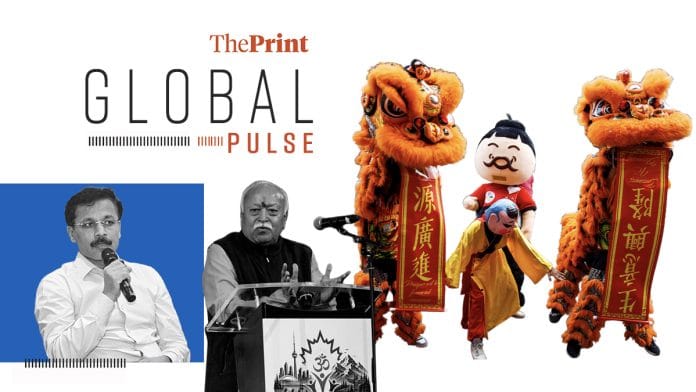

New Delhi: Rashtriya Swayamsevak Sangh (RSS) chief Mohan Bhagwat was in the US in August to celebrate “universal oneness” at a New York City event. Bhagwat’s event and later appearances in Canada have drawn criticism from several quarters in the US.
Multiple human rights groups had called for a ban on the event and asked authorities to declare the RSS a terrorist organisation. New York mayor Zohran Mamdani had called the Sangh’s Hindu nationalist vision “exclusionary” and its rise “incredibly troubling”. He clarified that he had no authority over a private event.
Bill Drexel of The Wall Street Journal, however, argues that the American response to the event harms India-US ties in the long run.
He compares the opposition to anti-Zionism movements, saying that as is the case with the campaign against Israel, “the effort to isolate the RSS damages American interests more than its target”.
For Drexel, this is nowhere more visible than the sheer scale and reach of the Sangh. “Founded in central India in 1925, the RSS runs roughly 83,000 regular neighborhood gatherings across India—an hour of physical drills, songs, games and instruction in its account of Hindu civilization, meant to strengthen the character of young Indian men,” he writes.
He highlights how the five million “Boy Scouts” are not paid, yet they attend the gathering early in the morning due to a shared sense of “patriotism”. “Its influence is even larger than the numbers indicate. The RSS acts as the vanguard of the broader Hindu nationalist movement and has incubated some 2,500 spinoff organizations, including one of Hinduism’s most representative religious councils, India’s largest labor union, and its largest private-school network.”
As the column notes, the RSS is also the parent organisation of the Bharatiya Janata Party (BJP), the world’s largest political party with 14 crore registered members.
“Western disapproval isn’t going to hamper an organization this large and potent. Slamming the door on India’s most influential civil-society organization accomplishes nothing, save empowering the factions of the RSS to which its critics most object, which tend to agree that there is little conversation to be had,” Drexel elaborates.
The criticism is also unhelpful, given the organisation’s ability to evolve in public, the column notes. Most of its outward-facing work is related to charity and social-service work, “many of which are extremely popular”.
The organisation, Drexel writes, is moderating its statements under the responsibility of leading a “social movement that commands political power”.
“One need not endorse the RSS’s views to know that it is imperative the U.S. engage with it and seek to understand it. India is on track to become the world’s third-largest economy, is indispensable to the balance of power in the Indo-Pacific, and is increasingly consequential in a restive Middle East.”
Archana Shukla & Neyaz Farooquee of the BBC document India’s food safety ‘star’ Tukaram Mundhe’s journey and the criticism that his recent actions have brought him.
“Cockroaches scurry across kitchen floors. Spider webs cling to walls. Spoiled vegetables rot in corners, while food counters show signs of pest infestation. One might assume these scenes belong to a struggling restaurant. But the photos are from a members-only club in Mumbai – India’s financial capital and the capital of its richest state Maharashtra,” the report says.
The visuals went viral after the Maharashtra’s Food and Drug Administration (FDA), under Mundhe, began inspections across restaurants and cafes. “Since taking charge in May, Mundhe has overseen thousands of inspections and says food safety laws must be enforced regardless of a business’s size, influence or reputation.”
The FDA has suspended licenses of several quick commerce warehouses and sent notices to Bollywood celebrities for endorsing or indirectly promoting restricted products.
“These actions are taken in public health interest. We will continue to take them against violations,” Mundhe told the BBC. While people online are celebrating Mundhe’s responsiveness, the food industry seems less enthusiastic about his actions.
Restaurant associations accuse him of sidestepping the statutory process, while courts have described some of his actions as “high-handed”, says the report.
Under India’s food safety laws, businesses are generally given time to address violations before their licences are suspended or cancelled. Immediate suspension is allowed only in cases involving an urgent public health risk, and regulators must record the reasons for taking such action.
“While compliance is non-negotiable, high-handed approaches – like public naming-and-shaming, instant suspensions over minor procedural or rectifiable issues and treating administrative oversights with harsh penal measures – create panic rather than reform,” Niranjan Laxman Shetty, legal chairman of Indian Hotel and Restaurant Association, told BBC.
While Mundhe said all his raids have been lawful and suspension only in extreme cases of violation, his style of working has faced some legal challenges. In some cases, courts have overturned licence suspensions, ordered regulators to compensate affected businesses and criticised handling of such cases, says the report.
The Economist looks at Chinese scholarship in India. The column begins with the premise that India baffles China, and it has done so for the last 1,400 years. “In the seventh century a Chinese monk named Xuanzang undertook a journey to the west. His destination was India, which China then held in high regard as the birthplace of Buddhism,” it says.
The column argues that China’s view has not changed since then. “India has long been an important place for China to study. It is a neighbour, a potential rival and the only other member of the billion-plus club.”
India will also host the BRICS Summit this week, and Chinese President Xi Jinping is expected to attend, for the first time since 2019. “As India’s economy, global heft and bilateral relations with China have grown, so have the ranks of researchers dedicated to studying it.”
However, the column notes that much of the research coming from China, on India, is of “poor” quality. “Many of the viewpoints lack sufficient depth, historical perspective and the necessary intellectual grounding,” a Chinese professor in Beijing notes. Indian academics, too, have arrived at the same conclusion.
Raj Verma, a political scientist who spent 11 years in China, told The Economist, that older researchers were “sensible and moderate”, while younger ones are “aggressive and hubristic”.
The column asks, even as China produces more research about India, it seems to understand it less. Why?
Many Chinese scholars point to restricted access as a key problem. India has long been cautious about granting visas to foreign researchers and journalists. But since the deadly 2020 high-altitude clash in Ladakh, Chinese researchers have been barred from entering India, it argues.
Another problem, according to the column, is Chinese attitudes towards India. “Since at least the late Qing era, more than a century ago, China’s elites have looked down on India for allowing itself to be colonised for so long. China’s revolutionary leaders were unimpressed by India’s non-violent freedom struggle. India’s precocious democracy, too, is seen as a weakness that holds it back.”
It is upon this “condescension”, younger researchers are looking at a country that is poorer and less militarily capable, but likes to “talk a big game”.
“India is, admittedly, a baffling place. Not even those who have lived in it their entire lives can claim to understand it. Yet a good way to approach it is with humility. Xuanzang walked thousands of miles to partake in its treasures. Foreign researchers can start the journey simply by opening their minds,” the column adds.
(Edited by Tony Rai)