





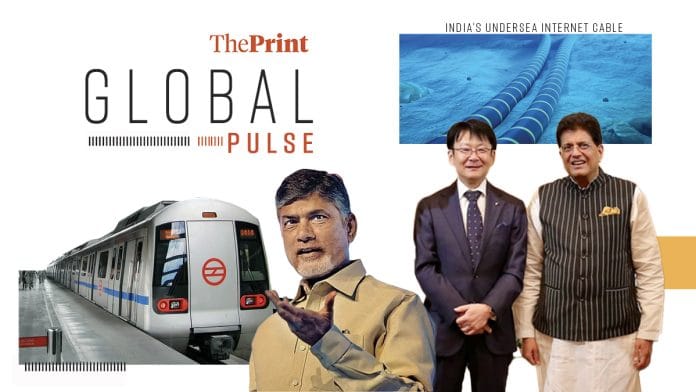

New Delhi: “Has Andhra Pradesh’s tech-savvy chief minister bitten off more than he can chew?” That was The Economist’s leading question for its India column on Thursday. The column takes a look at Chief Minister Chandrababu Naidu’s ambitious project to build the planned capital city of Amaravati.
Naidu’s journey, the column notes, has not been easy. On becoming Andhra Pradesh’s chief minister in 1995, he headed to the US to meet Microsoft founder Bill Gates, as he saw IT as the future. “Gates refused to meet him, but Naidu insisted”.
“He was almost assassinated in 2003 and briefly imprisoned in 2023; twice voters booted him out. Most painful of all, in 2014 his state was cleft in two,” the column adds.
Hyderabad, the bustling tech capital, went with Telangana, and Andhra Pradesh was left with what the column calls, “an agrarian rump without a capital or an economic engine”.
“A dizzying ambition was born. As chief minister of the rump state, Mr Naidu planned a shining new capital called Amaravati, the biggest greenfield city in India’s history, and among the biggest under way anywhere,” the column adds.
Naidu was re-elected in 2024 to continue his project. As the column argues, Amaravati was pitched not as a rival to IT and tech hubs of Hyderabad and Bengaluru, rather as a complementing city that would advance manufacturing, data centres and quantum computing.
Naidu told The Economist that he is building the most beautiful city in India. However, the column says the project is controversial, and the state’s “finances are in bad shape”. Thus, critics have said Amaravati is an “over-ambitious vanity project, and could become a financial millstone” for the state.
“The bulk of the financing for the city is $1.6bn in long-term loans from the World Bank and the Asian Development Bank, which will be paid back by selling off land. The maths relies on land prices soaring, which in turn depends on the city attracting foreign investors, at a time when India as a whole is struggling to do this,” the column says.
Karan Deep Singh of The New York Times reports on how Delhi metro has become a world-class transit system, “for a bargain”.
By the 2000s, Delhi was choking with pollution and traffic congestion, leaving it in dire need for a systematic public transport system. While few used the metro at the time it opened in 2002, today the Delhi metro is a global model, the report says. It has also achieved this stature with costs far cheaper than what other countries have invested.
“In March, the completion of a new line made Delhi’s subway system longer than New York City’s, for a total cost of roughly $10 billion — less than New York spent to build a 3.5-mile tunnel,” adds the report.
“When the Delhi Metro opened, it represented a new dawn of modernity in a country where infrastructure projects were plagued with delays and corruption.”
The project also proved, the report says citing experts, that low and middle income countries could operate complex rail projects at high standards.
The Delhi Metro also became the world’s first railway project to earn carbon credits from the United Nations. About 33 percent of its energy needs are met through solar power, while its trains recover energy generated during braking and store it in batteries. The network also maintained an impressive punctuality record last year, with 99.9 percent of trains running on time, the report says.
Delhi metro, the report highlights, is unique compared to subways in New York, London, and Tokyo. While the metro in other global cities came up alongside the urban development, in Delhi, the metro was built after the city had already taken shape.
The Delhi Metro Rail Corporation didn’t hire foreign consultants, it sent contractors from India to study different subways in the world and bring that knowledge back home.
The Metro enlisted drama troupes to stage street plays that familiarised people with the basics of using the new transport system. For many commuters, concepts such as using escalators and elevators, passing through automated turnstiles, and paying a fare for every ride were entirely new, the report adds.
As the NYT adds, the metro’s success at home has opened up opportunities abroad. It has provided consultancy for metro projects in Dhaka and Jakarta, while also bidding for projects in Bahrain and Vietnam, as well as a proposed 303-km rail link connecting the United Arab Emirates and Oman.
Ni Hao and Wang Tianqing of the Global Times report on why Japanese companies are hesitant to make investments in India. India’s Commerce Minister Piyush Goyal recently led a 200-member delegation to Japan, making investment pitches in Tokyo, Nagoya and Osaka.
However, the two countries are yet to announce any formal agreement or commitment.
“Japanese companies, while expressing interest in the Indian market, remain hesitant about significantly scaling up their investments,” the report says.
Global Times says, citing an expert, that while India has made adjustments in some areas, structural issues such as exchange rate management and capital repatriation are unlikely to undergo major changes anytime soon.
The expert also told Global Times that India remains an attractive destination for Japanese companies, the real challenge, however, is converting that potential into tangible and predictable returns.
A 2025 survey by the Japan Bank for International Cooperation ranked India as the top destination for Japanese manufacturers looking to expand their businesses over the medium term, marking the fourth consecutive year it held the position, says the report.
However, there is a clear gap between the rankings and market entries. “Data from the Japan External Trade Organization showed that as of October 2024, 1,434 Japanese companies were operating in India. Over the same period, Thailand hosted 6,083 Japanese firms, Vietnam 2,543, and Malaysia 1,643.”
Soutik Biswas of the BBC reports about how India’s internet boom is causing an “undersea problem”.
Biswas reports that one of India’s biggest digital vulnerabilities lies along a six-kilometre stretch of Mumbai’s coast, where 13 of the country’s 18 intercontinental submarine cables come ashore. Together, they carry up to 95 percent of India’s internet bandwidth to Europe, Africa and West Asia.
“This network faces a critical vulnerability due to severe geographic concentration,” Anwesha Sen of Takshashila Institution told the BBC. “If several of those cables were cut simultaneously, either accidentally or deliberately, a bulk of India’s westward bandwidth to West Asia, Africa and Europe would be impacted,” she added.
Biswas adds that the vulnerability stems from how much of the world’s digital traffic depends on these cables.
But India’s growing dependence on this invisible infrastructure contrasts sharply with its limited presence in it. While the country accounts for about 20 percent of global data consumption, it is connected to only around 3 percent of the world’s submarine cables, the report further says.
This paradox is at the heart of the problem India is facing. India is becoming a data and internet powerhouse, without controlling enough infrastructure to support this surge.
India has no domestic subsea cable-repair ships to repair any fault-lines in the ocean. “Every cable fault in Indian waters depends on foreign repair ships from Dubai or Singapore. Once a foreign ship is assigned, it must obtain licences to operate in Indian waters, adding weeks to an already lengthy process,” Sen told the BBC.
(Edited by Ajeet Tiwari)
Also read: Global media analyses India’s ‘aloof, but engaged’ SCO comeback in the backdrop of a Xi power flex