





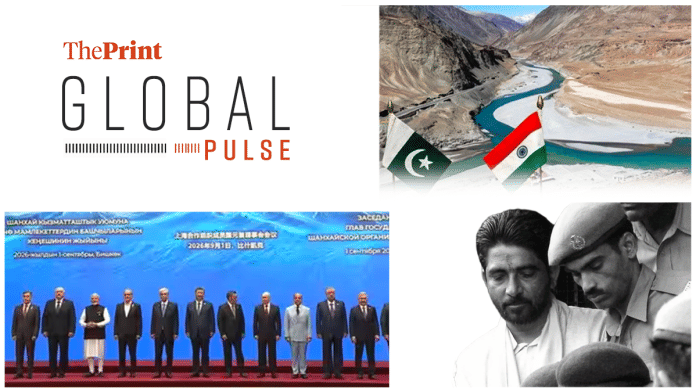

New Delhi: Prime Minister Narendra Modi’s visit to the Kyrgyz capital of Bishkek to attend the two-day SCO Summit continues to draw the global media attention, with India’s “SCO comeback” being viewed through the prism of its evolving ties with Beijing and Washington.
Two years ago, Prime Minister Narendra Modi skipped the SCO summit entirely but returned last year to Tianjin, China.
In a report, Maria Siow of the South China Morning Post talks about why India tried to distance itself from the Shanghai Cooperation Organisation (SCO), and why it is back.
“India’s prime minister stood shoulder to shoulder with China’s Xi Jinping, Russian President Vladimir Putin and the leaders of other SCO member states,” the report says about this year’s Summit.
Maria reports that according to analysts, New Delhi’s renewed engagement with the 10-member bloc reflects both its attempt to hedge against an increasingly unpredictable United States and its efforts to counter China’s influence within the SCO, even though New Delhi is expected to remain a “somewhat aloof member”.
India joined the group in 2017, but the report says it has never been an “entirely comfortable fit”.
“China is widely seen as the bloc’s dominant force, bankrolling regional trade and infrastructure projects at a scale no other member can match, while the presence of Pakistan, Delhi’s arch-rival, serves as a perpetual irritant,” says the report.
“Before last year’s summit in Tianjin, there were signs that Delhi was downgrading its engagement with the bloc,” Chietigj Bajpaee, a senior research fellow for South Asia at British think tank Chatham House told the SCMP.
“This reflects India’s aversion to being part of any organisation that is regarded as overtly anti-Western,” Bajpayee added.
While the aversion has not “disappeared” entirely, improved ties with China and strained relations with the US over punitive tariffs have motivated Modi to attend the Summit.
The report says that India and China, both members of BRICS and the SCO, have been gradually normalising ties after the deadly 2020 border clashes that froze relations for years. Since then, the two sides have opened new military hotlines, resumed direct flights and eased visa restrictions.
It’s time to look at the SCO agenda for the next 25 years.
India’s position is clear…We must transform our shared geography into shared opportunities.
We must work on the three pillars of Security, Connectivity and Opportunity.
— Narendra Modi (@narendramodi) September 1, 2026
Ivan Lidarev, a political scientist and research fellow at the National University of Singapore, told the SCMP that India’s presence keeps China from dominating the block.
However, is any country keeping China’s influence in check? The New York Times says that the Summit with Russia, India and Iran shows the leverage wars have given to Chinese President Xi Jinping.
“Even as President Trump tries to bend the world to revolve around Washington, Xi Jinping of China has his own powerful orbit,” Paul Sonne and David Pierson report for the NYT.
The Chinese leader’s arrival in Bishkek, Kyrgyzstan’s capital, for a meeting of the 10-member SCO highlighted Xi Jinping’s broad ability to maintain ties with countries at odds with Washington, in both peace and wartime, the report says.
The report adds that US President Donald Trump has been distracted by war with Iran. To reaffirm Xi’s “orbit of power”, the report also cites his upcoming visits to India and Egypt.
While Xi Jinping’s influence is growing, the report says that according to analysts, there are limits to his power. Despite the SCO being partly a security grouping, Beijing has been unwilling to use its military to defend members such as Iran, which joined the organisation in 2023, or Russia. Instead, China has formally called for dialogue and an end to the conflicts involving both countries.
Geeta Pandey of the BBC reports on an Indian man who was awarded a life sentence over 25 years ago. On Wednesday, the Supreme Court is set to hear a petition seeking the release of a man convicted of killing Australian Christian missionary Graham Staines and his two young sons in 1999.
“Dara Singh – whose real name is Rabindra Kumar Pal – has been in jail since his arrest in 2000, serving a life sentence for burning alive the Australian missionary and his six and 10-year-old sons in a village in the eastern state of Odisha (formerly Orissa),” Pandey reports.
The report notes that Staines spent 30 years working with leprosy patients, but Singh and his associates “accused him of forcibly converting poor Hindus from disadvantaged castes and tribes to Christianity”.
“The viciousness of the crime sent shockwaves through India’s minority Christian community and caused global outrage. Now reports that Singh may be set free have brought alive memories of the heinous crime,” the report adds.
Staines was burnt alive with his two sons when they were returning from a Christian gathering in Manoharpur. Singh and his men surrounded the vehicle and set it on fire, preventing the family from escaping.
A year-long investigation finally led to a trial and Singh’s conviction. While Singh denied any charges, he said that he is ready to be a martyr for the cause of Hindus, the report adds.
In 2003, a court sentenced him to death, the conviction was commuted to life imprisonment two years later.
“Reports that Singh may walk free if the state government or the court accepts his remission petition have led to some disquiet in India’s 30-million Christian community – some of it because of unease over his earlier statements,” the report says.
The Permanent Court of Arbitration (PCA) in The Hague has delivered its judgment in the Indus Waters Treaty case pending before it, giving the Pakistani media cause for celebration.
“In a setback for India,” the PCA has ordered that the Indus Water Treaty (IWT) will remain fully in force, and India has “no justification for ending or suspending the agreement”, a Dawn report notes.
India suspended the Indus Water Treaty on 23 April 2025, a day after the terror attack in Pahalgam that killed 26 people. Pakistan applied to the PCA in March 2026 to give a ruling on the treaty.
The report says that according to a press release by the PCA, the court “examined the potential grounds upon which India could suspend or terminate the treaty, including the grounds cited by India in its public statements. In a unanimous decision, the court found that none of these grounds could justify suspension or termination of the treaty.”
The Dawn report further mentions that based on the judgement, India “must observe” its obligations under the treaty, including those relating to the design and operation of its hydro-electric projects on the western rivers.
The Dawn also noted India’s response to the judgment. “India, which is officially a member of the intergovernmental court, said it did not recognise the court and categorically rejected the verdict,” the report says.
“This so-called Court of Arbitration has no jurisdiction whatsoever to pronounce on India’s sovereign decisions,” the newspaper records the Ministry of External Affairs’ statement.
The report also addressed India’s claim that “Pakistan had violated the IWT’s cooperative spirit by failing to enter into negotiations to modify the treaty”. The Dawn reported the court saying that “no provision of the treaty obliged Pakistan to enter into such” discussions and therefore, this cannot be a material breach of the IWT.
(Edited by Ajeet Tiwari)
Countering China’s influence within SCO. China’s trade volume with the five Central Asian Republics is $ 106 billion. India’s is about $ 3 billion. Plus, the Belt and Road Initiative, which India alone in SCO does not endorse, because part of CPEC passes through PoK, is widely welcomed by these landlocked countries. It would better to pursue a more constructive engagement with all member states.