





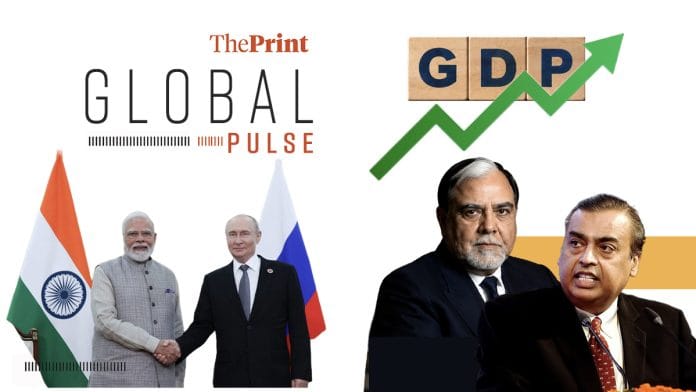

New Delhi: The Indian economy, despite earlier skepticism, has maintained a steady pace with the Gross Domestic Product growing 7.8 percent in the first quarter of FY 2026-27. A report in The Wall Street Journal looks at the “robust” numbers.
Kimberly Rao writes that manufacturing output has risen 9.2 percent from a year earlier, accelerating from 8.3 percent in the same period in FY26. The government expenditure has also grown by 4.3 percent, while construction activity and private consumption growth have strengthened. Exports, too, have grown by 12 percent during the first quarter, from six percent last year.
The figures, Rao argues, suggest that India’s economy has endured geopolitical risks better than economists initially expected, “in line with recent indicators that point to sustained momentum”.
The HSBC Flash India Composite Output Index, which measures activity across the manufacturing and services sectors, climbed to 54.6 in August, indicating that growth continued, the report says.
However, risks to the Indian economy persist. The West Asia war could still push up oil prices, pressuring capital flows and the rupee, and raising risks to growth and inflation.
Rao also points to the risk global shifts pose to India’s economy. “The country remains heavily reliant on external energy sources, with crude-oil imports accounting for more than 88 percent of domestic consumption as of July, government data showed.”
Meanwhile, the Financial Times takes a look at Essel Group chairman Subhash Chandra’s settlement claims and accusations against Mukesh Ambani’s media house, Network18.
Veena Venugopal, in the India Business Briefing newsletter, writes that India’s insolvency tribunal gave Chandra major relief by allowing him to settle claims linked to his personal guarantees for just Rs 6.25 crore, despite his companies defaulting on around Rs 22,000 crore—with creditors having to accept recovery of only a tiny fraction of the amount they have claimed.
This was, of course, before a five-member bench of the National Company Law Tribunal (NCLT) put the repayment plan on hold Tuesday.
The now-stayed decision, as Venugopal notes, raised questions about India’s personal guarantee system, which is meant to allow lenders to recover money from promoters when their companies fail to repay loans. However, the insolvency tribunal believed that declaring Chandra bankrupt could leave creditors with even less money.
Venugopal further writes about a subsequent, “unusually public” feud that has emerged. Chandra released two videos accusing Network18—owned by Ambani’s Reliance Industries—of wrongly presenting the amount of claims against him.
He said that the personal guarantee claims against him totalled Rs 3,990 crore, and not Rs 22,000 crore, which, he argued, was the amount owed by the companies that took the loans—not by him personally.
In another video, Chandra accused Ambani of trying to buy Zee on terms that would have benefited Chandra’s family, but hurt minority shareholders.
While Reliance has denied any such actions and called Chandra’s remarks “baseless”, Venugopal notes how Chandra’s case has left “questions hanging over the personal guarantee framework and no shortage of intrigue”.
On Monday, Prime Minister Narendra Modi met Russian President Vladimir Putin on the sidelines of Shanghai Cooperation Organisation (SCO) Summit in Kyrgyzstan’s Bishkek. As US President Donald Trump announced 100 percent tariffs on countries buying Russian oil, Bloomberg takes a look at the trajectory of India’s trade ties with Russia.
Sudhi Ranjan Sen, Rakesh Sharma and Shruti Srivastava report how India has always tried to maintain ties with both Russia and the US to keep its strategic autonomy. However, Trump’s “erratic” trade and foreign policy is making it increasingly difficult.
India has had strong ties with Russia since Independence. “India’s External Affairs Minister Subrahmanyam Jaishankar has referred to these ties as the one constant in global politics over the last half century,” reads the report.
India and Russia, it notes, have strengthened their relationship over the decades by working together in key areas, such as industry, space, nuclear energy and defence. However, the report adds, in recent years, Modi has tried to maintain this long-standing partnership with Russia, while also building closer ties with the US—which India sees as an important partner in keeping China in check.
India and Russia have been among each other’s top five trading partners since 2022, when India significantly increased its purchases of Russian oil. Bilateral trade stood at nearly $60 billion in India’s FY26, around 13 percent lower than the record level seen in FY25. However, both aim to increase trade to $100 billion by the end of the decade, says the report.
However, India imports much more from Russia than it exports. The imports mainly include oil and petroleum products, while exports include pharmaceuticals, and agricultural goods, like rice and tea.
America, on the other hand, has sought to leverage its position as India’s biggest export market to pressure the country to stop buying Russian oil, the report says.
India also relies heavily on Russia for its defence needs. Russia has been India’s biggest supplier of weapons for decades, Bloomberg notes. The Indian military operates hundreds of Russian-made fighter jets and several S-400 air defence systems, which were used during the four-day conflict with Pakistan in May 2025.
While India has increased its arms purchase from the US, France and Israel, “Modi’s government has made it clear that it will maintain its long-standing defence ties with Russia”.
BBC, on the other hand, looks at how Japan is looking to expand its trade ties with India and why Japanese companies are increasingly betting big on the country. “India’s commerce minister Piyush Goyal led the country’s largest-ever business delegation to Japan last week in a bid to expand trade and investment ties between the two countries,” Nikhil Inamdar reports.
The report notes that several Japanese consumer brands have cropped up in metropolitan cities, like Mumbai, Delhi and Bengaluru. “Apparel giants Uniqlo and Muji and premium sneakers company Onitsuka Tiger have been around for a while, but are rapidly expanding. Niche players are also here—Nitori, a Japanese furniture maker, entered the market recently, while convenience store chain Lawson is on its way, with a plan to reportedly open 10,000 stores by 2050 in India, starting with Mumbai,” the report reads.
Not just consumer brands, Japanese banks are also bidding for Indian financial assets, while foreign investors exit Indian bank portfolios.
MUFG Bank, Japan’s largest bank, acquired a 20 percent stake in Indian shadow lender Shriram Finance for $4.4 billion last year, marking the biggest-ever foreign investment in India’s financial sector.
Japanese companies are now the largest contributors to India’s growing ecosystem of global capability centres, or GCCs, in Asia-Pacific region, the report adds.
Experts argue that it is the growing uncertainty with China that has pushed Japan in India’s direction. “Investment into China has fallen sharply amid geopolitical tensions and changing economic dynamics, the US market is more challenging because of tariffs and domestic competition, and the market size of other Southeast Asian economies is limited,” Vipul Nath Jindal, founder of Next Bharat Ventures, tells the BBC.
There is an official push for investments, too. During Japanese Prime Minister Sanae Takaichi’s first official visit to Delhi in July, Japanese firms announced $12.5 billion in investments.
The two countries signed around 120 agreements across sectors, from semiconductors to green energy. Minister Goyal has also said that Japan could meet its target of investing 10 trillion yen in India ahead of schedule, Inamdar writes.
(Edited by Mannat Chugh)
Also Read: Global media’s take on Modi’s economic diplomacy, ‘middle powers’ & ‘turbulence unleashed by Trump’