



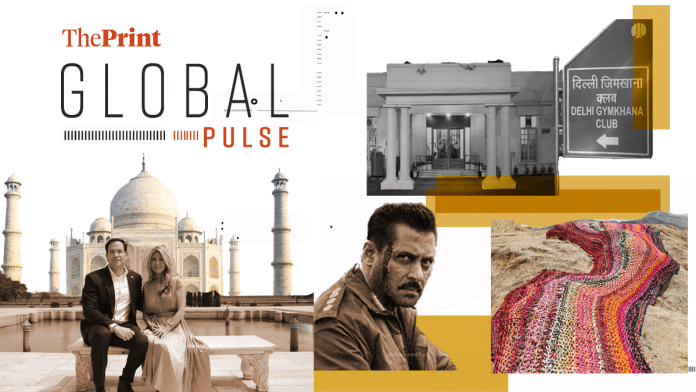

New Delhi: As India and China try to rebuild their ties ruptured by the deadly Galwan clashes of 2020, the Indian government has directed filmmakers to follow a ‘no China-bashing’ rule in their movies, according to a report in the South China Morning Post.
Junaid Kathju reports for the publication that film critics have accused the Indian government of promoting “selective creative freedom”.
“Bollywood heavyweight Salman Khan’s war drama, initially titled Battle of Galwan, was reportedly asked to change its name to Maatrubhumi: May War Rest in Peace, with several scenes requiring reshoots. A separate film, The Lion of Galwan, has been shelved entirely,” the report says.
Chinese State media had heavily criticised the teaser of Khan’s film, accusing it of distorting historical facts, promoting nationalist propaganda and misrepresenting Chinese sovereignty, according to the report.
Citing other media reports, the SCMP says that over 40 percent of the film was reshot, and all direct references to China were replace with “vague euphemisms”.
“Because of the subject’s geopolitical sensitivity, the makers must first obtain clearance from the Indian Army and the Ministry of Defence before applying for CBFC certification,” the report adds.
Onir, an Indian filmmaker and producer, said that selective creative freedom is visible in the Indian government’s response. He said, “How can bashing China not be OK, but bashing Pakistan is? It was China who played an important role in helping Pakistan during India’s Operation Sindoor.”
US Secretary of State Marco Rubio’s recent visit to India has drawn considerable attention from global media, and few saw it as diplomatically productive. Anupreeta Das of The New York Times writes that analysts think the visit was a painkiller, but some “real medicine” is still needed.
“President Trump’s blow-hot, blow-cold approach to India is a stark contrast from that of previous U.S. presidents, who sought to maintain good relations with India,” the report notes.
Last year, US President Donald Trump’s 50 percent punitive tariffs mounted immense pressure on India, especially with the US being India’s biggest export partner. Trump’s tariff threats to India over buying Russian oil has further hurt the country due to the US-Iran war and the closure of the Strait of Hormuz.
“India needs civil and stable ties with the United States, its biggest export market, and doesn’t want to attract the ire of Mr. Trump, which could disrupt its economy or jeopardize its ability to meet its enormous energy needs,” says the report.
Trump has, the report says, upended many of India’s assumptions about the nature of its relationship with the United States. “The bedrock was an economic partnership, with a marginal role for Pakistan and cooperation in the Indo-Pacific region.”
Now, Trump has imposed tariffs, his close relationship with Pakistan’s leaders is not a surprise and the optics of his recent visit to China were not lost on anyone, it says.
Although, during his visit, Rubio asserted that India is one of America’s “most strategic partners in the world”, and Trump backed Rubio by saying, “anything India wants, they get”. But it has done little to dissuade the skeptics, according to the report.
“Many Indians say they are getting the opposite of what they want. Its students and workers have been hurt by the Trump administration’s immigration restrictions. Mr. Rubio defended the policies at a news conference, insisting that they are not a policy targeted at Indians,” the NYT writes.
Michael Stott and Andres Schipani report from the Financial Times about the Indian government’s eviction order to the Delhi Gymkhana Club.
“Despite having survived two world wars, the partition of India and a constitutional commitment to socialism, the 113-year-old Delhi Gymkhana Club now faces sudden eviction as Narendra Modi’s government targets a bastion of the colonial-era establishment.”
The Opposition has described the order as a land takeover by a government intent on crushing what it considers a ‘hub of dissent’, and enforcing traditional Hindu values on a diverse and secular country, the report says.
Supporters, meanwhile, say it is unacceptable for 5,000 elite members to enjoy the privileges of a private club on public land for a nominal rent, the report adds.
“Gymkhana members fought back with a lawsuit in the Delhi High Court this week, but a judge declined to grant a stay order. The next hearing will be at the end of July, after the eviction date, and few are optimistic about winning in courts that often side with the government.”
Seven maharajas were granted lifetime memberships for helping establish the club, though it largely remained inaccessible to ordinary Indians. Built around colonial elite culture, members were expected to adopt British habits and social etiquette. After Independence, the word “Imperial” was removed, but the club continued to serve as a hub for India’s top bureaucrats, diplomats and military officials, with even Jawaharlal Nehru associated with it.
A government official, speaking off the record, told FT that the club’s “reputation for dissent” had made it a target.
Adam Popescu writes in Financial Times about the world’s highest biennale, in Ladakh. A biennale is a contemporary art exhibition held every two years.
Raki Nikahetiya, a Sri Lankan-born artist co-founded the sā Ladakh Biennale with Tenzin Jamyang, a local mountaineer, and Sagar Singh, a New Delhi interior designer.
“Compared with the crowds, pop-ups and activations of the Venice Biennale ,nothing would be on sale in this exhibition, the creators want people to ‘engage slowly’.
“When the organisers say that the event — which features the work of 12 Ladakhi and eight international artists — is conceived as a non-white cube biennale, they aren’t joking,” Popescu writes.
The installations, sculptures and mixed media works will be at eight sites along the 230km road from Kargil to Leh, a route that reaches a high point of 4,108 metres at the Fotu La. Installing the works at such high altitudes would be difficult.
“Visitors are advised to carry sunglasses, sunscreen, raincoats and masks or scarfs to protect themselves from strong winds and dust.”
(Edited by Ajeet Tiwari)
Also Read: Rubio’s visit has global media asking—why is India ‘committing’ to buy $500-bn worth US goods