



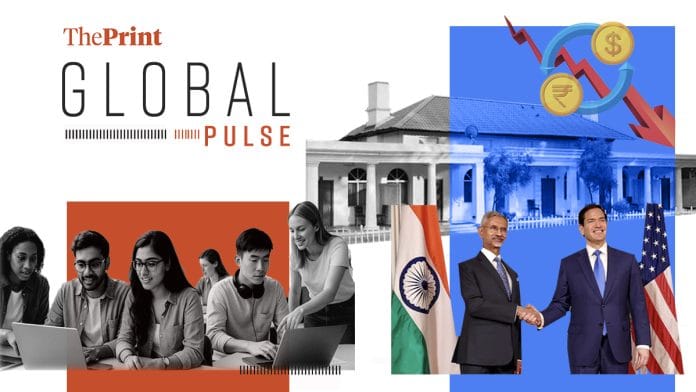

New Delhi: Global media closely tracked US Secretary of State Marco Rubio’s four-day diplomatic visit to India as he departed New Delhi on Tuesday after attending the Quad Foreign Ministers’ Meeting. During the visit, Rubio also extended an invitation to Prime Minister Narendra Modi to visit the United States.
Edward Wong reports for The New York Times that the visit was especially consequential, given the backdrop of President Donald Trump’s “aggressive” actions against India and Indians in America.
Addressing a press conference in New Delhi, Rubio said, “The U.S.-India relationship has not lost any momentum…the relationship continues to be strong.”
On the question of Trump’s 50 percent punitive tariffs on India, Rubio urged India not to take it personally. “There’s a huge imbalance that’s built up and it needs to be addressed. This is not about India,” he added.
EAM S Jaishankar, standing next to Rubio, reaffirmed that the US has an “America first” policy, and India also has an “India first” policy.
But Wong writes that Trump’s tariffs came following India’s refusal to nominate Trump for the Nobel Peace Prize.
“Mr. Trump’s actions have upended more than two decades of U.S. policy toward India. From the early 2000s until now, Republican and Democratic administrations, including Mr. Trump’s first one, sought to forge closer ties with India, the world’s most populous nation,” Wong writes.
Another question that looms large, as the report points out, is Trump’s recent visit to China. “Those two leaders showered each other with flattery at a summit in Beijing last week; Mr. Trump said they would ‘have a fantastic future together’.
“For many Indians, even more troubling is Mr. Trump’s recent praise of Pakistani leaders, who have been mediators in the Iran war.”
When asked about the relation between Washington and Islamabad, Rubio said, “I don’t view our relation with any country in the world as coming at the expense of our strategic alliance with India.”
The report says, “Indians are also concerned over recent anti-immigration moves by Mr. Trump, and in particular new efforts aimed at broadly restricting legal immigration.”
On Friday, the Trump administration announced that most immigrants applying for green cards would be required to leave the US while their applications are processed, the report notes. The move is expected to affect many Indian nationals working in the country on employment visas, particularly in the technology sector, who are seeking permanent residency.
Veena Venugopal, in the Financial Times India newsletter, writes about Rubio’s comments that India has “committed” to purchasing “$500 billion” worth of American goods over the next five years.
“On Sunday in New Delhi, US secretary of state Marco Rubio said that India ‘has committed’ to purchasing $500bn worth of American goods over the next five years, focusing on energy, technology and agriculture. It is puzzling why India would make such a commitment at this stage,” she writes.
The figure had earlier come up during the interim trade deal statement released by the White House. However, since then, the US Supreme Court has scrapped Trump’s tariffs for all countries, standardising 10 percent tariffs globally.
“Under these circumstances, it is rather bizarre that India is not only continuing with the plan to buy $500bn worth of American goods over the next five years, but is also not challenging Rubio’s assertion that this now constitutes a commitment”.
Venugopal asks what India will get in return.
The “commitment” announcement comes at an interesting juncture when India is burning through its foreign reserves due to a weakening currency and rising oil prices from the US-Iran war.
Given the geopolitical circumstances, Venugopal says that it would be rather “foolish” of India to formalise any such agreement.
Zoya Mateen and Abhishek Dey of the BBC report on the looming threat of shutdown at the most elite club of Delhi: the Gymkhana Club.
“In India’s capital Delhi, power has long circulated through ministries, embassies and the parliament – but also through the shaded verandas of the Gymkhana Club.”
For decades, the club has functioned as a discreet world of “retired generals, senior bureaucrats and old business families conducting negotiations over whisky sodas and kebabs.”
The central government, which owns 27.3 acres of land, has ordered the 113-year-old club to vacate by 5 June. In its notice, the government called the area a “highly sensitive and strategic” zone near the prime minister’s residence and said the lease terminated with “immediate effect”.
The order against the club has reignited the debate over elite heritage spaces and how their contentious existence has been since the BJP-led NDA took charge in 2014. Modi has repeatedly slammed the English-speaking elites of New Delhi by using monikers like “Khan market gang” and “Lutyens elite”.
“The Gymkhana is expensive to join, but access has long been controlled more by gatekeeping than price. Applicants must be proposed and seconded by members, after which a managing committee approves them. The process has traditionally favoured senior civil servants and defence officers, with a smaller share for others,” the report notes.
Following inspections in 2016 and 2019, the Ministry of Corporate Affairs approached a government tribunal in 2020, alleging financial irregularities and violations of membership rules at the club.
Two years later, the tribunal dissolved the club’s elected governing committee and allowed the government to appoint administrators in its place.
But the outrage is deeper: “one tied to memory and loss in a city that is constantly changing.”
However, some journalists have criticised the club calling it an “exclusionary institution”.
(Edited by Ajeet Tiwari)
Also Read: As Rubio visits India, global media thinks he is ‘playing cleanup for Mr Trump’