





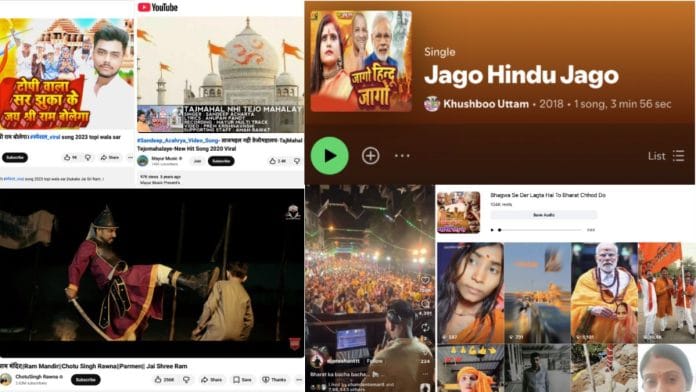


New Delhi: On 22 April 2025, terrorists opened fire on tourists visiting Pahalgam, killing 26 people. Survivors and witnesses claimed the perpetrators checked their victims’ religious identity before shooting. Within hours, Hindutva pop artists had new songs out.
‘Pehle Dharm Pucha’ (‘They First Asked Our Religion’) went up the very next day, by Kavi Singh, a singer with 1.15 million YouTube subscribers. The lyrics make the claim that all Muslims conspire against Hindus, and one of the lines goes: “We made a mistake letting you stay on, you got your own country, why didn’t you leave then?” By May this year, the song had 3.5 lakh views.
‘Jaago Hindu Jaago’ by Gulshan Music, released two days after the attack, tells its listeners that being Hindu “has become a crime” and declares “it is our turn now” to avenge the killings. It has 6.13 lakh views and 13,000 likes. Both are on Spotify and Apple Music as well.
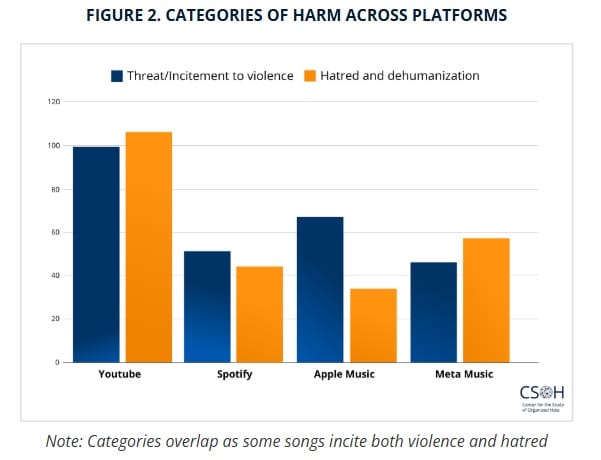
A new report, ‘Profiting from Hate Music’, released this week by the Centre for the Study of Organized Hate (CSOH), a Washington DC based think-tank, documents 523 such songs across four platforms. Authored by journalist Kunal Purohit and CSOH researchers Tavishi and Hamaad Meer, it found songs on YouTube, Spotify, Apple Music and Meta’s Music Library that violate each platform’s own rules.
According to the report, half of the songs call for violence against religious minorities in the country while the rest use “slurs, conspiracy theories and dehumanising language”.

198 million views, 100 channels, 76 million subscribers
The 210 songs on YouTube have been viewed over 198 million times, spread across 100 channels with a combined 76.4 million subscribers—which makes up more than 15 percent of YouTube’s entire Indian user base. On Meta, which owns popular social media platforms Facebook and Instagram, 103 songs were used to make over 5.9 million Instagram reels. Spotify carries 109 songs from 53 artists, Apple Music 101 from 59 artists.
Sangam Dhun, a verified channel with 2.51 lakh subscribers, hosts 46 songs with 15.7 million combined views, including ‘Bhagwa Se Dar Lagta Hai Toh Bharat Chod Do’ (‘If you fear the saffron, leave India’), which has 6.7 million views and has been turned into over 1 lakh Instagram reels.
Mayur Music that showcases a ‘silver play button’, a plaque given by YouTube to pages with at least 100,000 subscribers. Among its videos is a song praising Israel’s actions in Gaza and says that the same treatment be meted out to Indian Muslims.
‘Jaago Hindu Jaago’
‘Hindu Chalisa’ by artist Kalki has been streamed 3.1 million times on Spotify, and has lines like “chop his head off” directed at everyone who places another faith above Hinduism. “Jago Hindu Jago” by Khushboo Uttam calls Muslims “black snakes” and says “shoot them in their chests”.
‘Cheer Ke Rakh Denge Unko’ by Kajal Singh, on Apple Music, threatens to chop Muslims into pieces and feed them to dogs. ‘Bharat Ka Bacha Bacha Jai Shri Ram Bolega” by Pooja Golhani has 43 million views on a single YouTube upload and has been used in 7.3 lakh Instagram reels. One of them, depicting a DJ performing it at an open-air concert, has 5.7 million views.
Nine songs on Apple Music carry “love jihad” in their titles, promoting the claim that Muslim men under false promises trap Hindu women into relationships to convert them to Islam. The report suggests that these songs tend to incite violent behaviour.
Ads aplenty, big brands
The methodology section of the report says that CSOH researchers watched all 210 YouTube songs in April 2026 using two accounts, a guest login and a VPN across three Indian cities. Ads ran on 163 of them (78 percent). For songs that incite violence, the figure was 83 percent. The advertisers include 103 brands, including OpenAI’s ChatGPT, Google’s NotebookLM, Amazon Prime, Adobe, Dell, Levi’s, Kellogg’s, Oreo, Flipkart, BigBasket by Tata Digital, Tanishq, ICICI Bank, ITC Hotels and the Reserve Bank of India, according to the report.
A ChatGPT ad ran on a song glorifying the bulldozer demolition of Muslim homes in Uttar Pradesh. A Levi’s ad played in a song with the lyrics: “We have to bring Muslim daughters as daughters-in-law into our homes.” An RBI ad was on “We will cut/kill those who cut/kill mother cow”. YouTube’s “Super Thanks” tipping feature was active on 55 percent of songs that call for violence. On Meta, 20 of 30 prominent H-Pop singers had monetised Facebook accounts, says the report.
What happens when you report them
Between October and November 2025, CSOH reported 225 of the 523 songs to the platforms. By April 2026, 18 had been taken down, a removal rate of merely 8 percent. At least three of those on YouTube had simply been “unlisted” by the uploaders, meaning anyone with a link can still watch them.
The report alleges that Spotify had no working report button and an online form consistently errored out across the devices and browsers used by them. Researchers eventually reached the platform through live chat and logging a single song took 33 minutes. Not one of 59 songs reported to Spotify was actioned by May 2026. Apple Music required tracking down a separate feedback form and sent no follow-up, the report said. Of 34 songs reported there, 33 remained live.
“Big Tech platforms are not merely offering impunity to the creators of hate music. They are among the most significant sources of financial patronage for these artists,” the CSOH report said.
(Edited by Gitanjali Das)
Also Read: A day with the Dehradun women who sprayed anti-Muslim graffiti. They are also Meerut stars