



New Delhi: The Centre’s decision to temporarily ban Telegram ahead of the 21 June NEET-UG re-exam in a bid to check organised cheating rackets has put the spotlight on how fraudsters have been using the platform to dupe students.
As the probe continues in the main 2026 National Eligibility-cum-Entrance Test (NEET) paper leak case, the Gujarat and Bihar police have busted three scams that were making a killing out of gullible students and parents.
While two involved Telegram channels wherein victims were tricked into shelling out big sums for non-existent question papers, another involved a 19-year-old man who allegedly siphoned off refund amounts of approximately 150 students from the NEET portal into his own bank accounts.
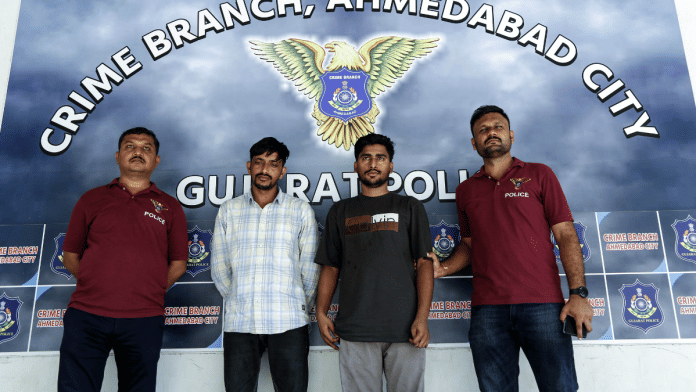
In the first case, the Ahmedabad Police’s cyber crime unit received a tip-off that unknown persons were using the messaging and audio calling cloud-based app to “offer false and misleading assurances related to the RE-NEET examination.” Two suspects—both from Rajasthan—were arrested for orchestrating an inter-state cyber fraud network that duped several medical aspirants of over Rs 1.5 crore.
NEET पोर्टल पर 150 छात्रों के रिफंड लेने की कोशिश करने वाला ठग बिहार से गिरफ्तार! अहमदाबाद साइबर क्राइम की बड़ी कार्रवाई!@dgpgujarat @DrLavina_IPS @sanghaviharsh #CyberCrime #NEET #CyberSecurity #BruteForceAttack #OnlineFraud pic.twitter.com/6MoALOnRWS
— Ahmedabad Cyber Crime (@cybercrimeahd) June 15, 2026
Likewise, a Special Investigation Team (SIT) of Bihar Police swooped into action after learning that a gang deceived NEET aspirants by circulating fake question papers via Telegram. A total of five people have been arrested in the case lodged at the Sikandarpur police station.
The third case, probed by the Ahmedabad cyber crime unit, involved an individual: the teenager had stolen NEET credentials to illegally divert fee refunds.
On Tuesday, the Centre restricted access to Telegram in India until June 22 keeping the NEET re-exam in mind. The National Testing Agency welcomed the Ministry of Electronics and Information Technology’s directions, saying it is “in the interest of students, which will go a long way in helping NTA to conduct safe and secure examinations on 21 June 2026”.
The Rajasthan duo
Jaipur resident Sumer Singh and Kota resident Akash, according to the Ahmedabad City Crime Branch, had allegedly “created Telegram channels and Telegram IDs and circulated posts, messages, and advertisements falsely claiming that they possessed and could provide the RE-NEET examination question paper.”
The Ahmedabad Police acted after receiving 12 complaints from different states. A case was registered under Sections 318(4), 319(2), and 54 of the Bharatiya Nyaya Sanhita (BNS), along with Section 66(D) of the Information Technology Act.
Both Sumer and Akash were arrested on 14 June. Six bank accounts linked to the accused were identified, so far.
“Through deceptive inducements, they misled students and their parents to commit financial fraud through cyber means,” a senior police officer told ThePrint.
Investigation revealed that the accused were using Telegram channels to carry out the fraud activities, the officer said.
During investigation, various Telegram channels and IDs, mobile numbers, IP addresses, and other digital evidence were analysed. It revealed that the accused created a Telegram channel, ‘Raghav_singh_neet’, along with approximately seven other channels and provided them to a Telegram user operating under the pseudonym, ‘Private Mafia’.
The eight Telegram channels, the officer said, were used to spread the word that NEET examination question papers were available for those willing to pay a price.
The NTA will hold the NEET re-test on 21 June.
As for the money, the accused allegedly collected it through online payment modes that included QR codes and bank accounts. Telegram chats revealed that gullible candidates were made to pay Rs 5,000 for ‘booking an appointment’.
“This means, if the RENEET paper is supposed to come, one could book the paper in advance. They (buyers) were to receive password-protected PDFs. To receive the password, candidates paid anywhere between Rs 12,500 and Rs. 50,000. Bargaining was involved as well,” the officer said.
But when the password was provided, all that the buyers encountered was a black PDF. By then, the Telegram account would be blocked.
“By disseminating false information, making fraudulent promises, and engaging in deceptive practices, the accused cheated students, parents, and others, causing financial losses,” Ahmedabad Joint CP (crime branch) Sharad Singhal told ThePrint. “No material related to NEET or any other examination was recovered from their possession.”
As of now, the police have unearthed approximately 1,000 mobile numbers that were contacted within the last one month. The Telegram user, ‘Private Mafia’, remains at large, the police said.
One of the points that came to the notice of investigators was that Sumer and Akash were no novices in the dark world of deceits as they were allegedly involved in milking online gaming users and their accounts to leech off money. What they did was fraudulently obtain money from accounts linked to bank accounts in gaming websites, another police officer said.
“The credited amount was transferred to multiple bank accounts of various individuals through gaming platforms. Using bank accounts of their associates and others, the accused withdrew money and utilised it for their personal financial gain. Transactions worth Rs 1.5 crore were carried out,” this officer said, adding that it is, however, not known how much of it was siphoned off from NEET candidates.
Investigation has revealed that the accused used various third-party services and applications to “artificially increase” the number of members and premium members in Telegram channels.
These inflated numbers were showcased to sell Telegram channels to buyers like ‘Private Mafia’ for making quick money, the police said, adding that ‘Private Mafia’ was found to be using Amazon Gift Cards for buying such channels.
The great refund defraud
In the second case, the Ahmedabad Police reached Bihar after a man lodged a complaint that his daughter was unable to log on to the NTA portal as her password was found altered.
Accordingly, a case was registered at the Ahmedabad cyber crime police station under the relevant provisions of the BNS and the IT Act.
Based on information provided by the NTA’s Chief Information Security Officer (CISO), along with technical analysis of the bank account details and human intelligence inputs, the accused was traced and apprehended from Bihar. The accused was identified as Navinkumar Shankar Prasad Yadav, 19, a resident from Gaya.
Digital footprints generated through the security features of the NTA portal helped the investigators identify Navin and trace his location.
“By illegally using login credentials without the knowledge or consent of candidates, the accused gained unauthorised access to the NEET portal and fraudulently obtained the refund amount by entering his own bank account details,” said the officer probing this case.
The refunds were made to medical aspirants after the cancellation of the NEET-UG. Each successful refund meant Rs 1,700 credited to Navin, who knew the refund process as he was a NEET aspirant himself, the police said.
Navin allegedly targeted approximately 350 candidates who had registered for the NEET examination. From among them, he took advantage of around 150 candidates whose passwords were weak, the police said.
“To gain entry, he would go for the ‘Secret Security Question’ feature as many candidates keep simple options (while registering for NEET). For instance, he would either opt for favourite sport or colour. These options have easy answers that can be guessed easily. Once he gained access, the details would be changed,” the above-mentioned officer explained.
NEET fake certificate fraud
On 14 June, the Bihar Police busted a gang that cheated NEET aspirants and their families by creating fake question papers and distributing them via Telegram. Five suspects, including the alleged kingpin Manish Jha, were arrested in the case lodged at Sikandarpur police station in Muzaffarpur.
Like the case by the Ahmedabad Crime branch, the gang used Telegram to circulate fake NEET papers to unsuspecting candidates. The police received a tip-off that the gang was operating from a rented house near Balughat.
Acting on this information, police conducted a raid and arrested Manish Jha, a resident of the Jajuar police station area, on 2 June. The remaining arrests were made on 13 June.
Harsh, Aman Kumar, Kanhaiya Kumar, Harsh Kanodia—the arrested gang members, admitted to “luring students and parents with the promise of providing NEET question papers via Telegram,” the police said
In exchange, payments were collected online across nine different bank accounts. The proceeds from the fraud were then passed on to Manish. The police have recovered three mobile phones from the arrested accused.
(Edited by Tony Rai)
Also Read: Beijing’s dig at India’s NEET fiasco? Embassy flaunts Chinese equivalent’s ‘smooth’ run