





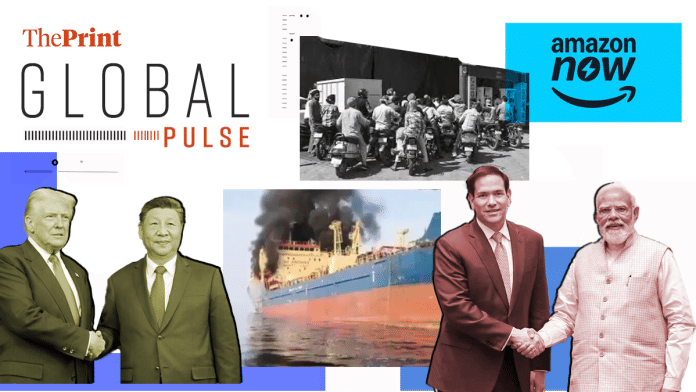


New Delhi: US President Donald Trump’s recent visit to China and what it means for India is being analysed by global media, especially as Secretary of State Marco Rubio landed in New Delhi within days of his president’s meeting with Xi Jinping.
“Secretary of State Marco Rubio has a ‘gargantuan task’ during his visit to Delhi: defuse tensions over President Trump’s anti-India aggression and overtures to China,” Edward Wong writes for The New York Times.
The four-day visit, with plans for closed-door diplomacy and jaunts to historical sites, began on Saturday with a quick stop at Mother Teresa’s charity in Kolkata and a meeting with Prime Minister Narendra Modi in Delhi.
Rubio delivered an invitation on behalf of Trump to PM Modi to visit the White House. The US secretary will also meet top diplomats from Japan and Australia, who are flying to New Delhi for the Quad Foreign Ministers’ meeting Tuesday.
“And Mr. Rubio is in India playing cleanup for Mr. Trump, who tried to cripple the country’s economy with high tariffs last summer after Mr. Modi, the prime minister, refused to nominate the American president for a Nobel Peace Prize,” the report notes.
Trump has repeatedly insisted that he mediated a ceasefire between India and Pakistan last year, a claim denied by New Delhi.
Earlier, Republican and Democratic policymakers “pushed for closer ties with India”, both to secure a partner to counterbalance China and to wean Delhi off its reliance on Russia for security assistance, the report adds.
“Mr. Trump has upended that. And one surprising consequence is that Indian officials are trying harder to improve relations with China, given the sudden erosion of U.S. support.”
Trump, during his visit, also called the meeting “G2”, referring to the US and China—“the two great countries”.
Kayleen Devlin and Phoebe Keane of the BBC report one Indian’s account who witnessed the missile attacks in the Strait of Hormuz, and lost a friend to the war.
“I felt the whole ship shake,” 26-year-old Sunil Puniya told the BBC. “I thought there’d been some fault with the engine. But as soon as I stepped outside of my room, there was another explosion,”
Puniya was on his first job at sea when a missile struck the oil tanker Skylight in the early hours of 1 March. Skylight was the first commercial vessel to be struck after the US-Israel war with Iran erupted in the region. It was a US-sanctioned vessel that was passing through the Strait.
“At the time of the attack, Sunil was asleep in his cabin on the third floor. He woke to find the ship engulfed in chaos. The missile had struck the engine room, sparking a fire that rapidly spread through the vessel,” the report says.
As the flames began to reach the crew, they jumped into the sea. While the Oman Navy launched a rescue operation within an hour of the attack and pulled survivors from the water, not everyone could be accounted for.
Puniya’s close friend, Dalip Rathore, who started working on the ship a day after him, was lost at sea. “India is one of the biggest suppliers of seafarers to the global shipping industry but Dalip and Sunil discovered they were from neighbouring villages in Rajasthan and soon became close friends.”
Puniya and Rathore’s tale of tragedy is part of the larger problem that seafarers passing through the Strait are facing.
“Maritime intelligence firm Kpler told BBC Verify 38 commercial vessels have been hit in and around the Strait since the start of the conflict. Their data shows 24 ships were hit by Iran and four by the US, with the rest unconfirmed.”
As the report notes, according to the International Maritime Organization, more than 20,000 seafarers are currently stuck in the Gulf.
Also Read: Global media takes a dig at BRICS for staying away from controversies
PM Modi’s ‘austerity’ appeal
Meanwhile, The Economist writes on the economic impact of the war on India and PM Modi’s appeals to Indians.
Modi is giving India’s elite the taste of bad old days, it writes.
“On at least one day this month, Delhi’s chief minister rode the metro, a High Court judge in central India cycled to work, a politician in Kashmir hailed a horse-drawn carriage and the leader of Bihar walked the entire 500 or so metres to his office. The elected head of Maharashtra, India’s richest state, made perhaps the biggest sacrifice of all. He flew economy.”
Modi’s austerity call following rising fuel prices from the US-Iran war has drawn criticism and earnest efforts from different quarters of the country. Work from home, he said. Use less fuel. Avoid foreign trips. Buy Indian goods. Defer gold purchases. Consume less edible oil. And of course, avoid using fertilisers, the column notes.
However, it points out that, barring buying gold or using fertilisers, all the efforts are required from the “elite” of the country.
And while the elite are a “patriotic bunch”, they are also fed up, the column says.
This is bad economics and worse politics, The Economist writes. “What do these people get for their money? Not health or education. No one from this class would dream of sending their children to a State school (nor would their cooks and drivers). Not decent public transport, which Mr Modi blithely advises them to use. Not even clean air. They watch as politicians fall over themselves to hand out free money every election season in what has become a cross-party consensus on legalised vote-buying.”
The elite voted for the “achche din”, and the point of the Modi government, the column says, was to leave the old days behind when the foreign exchange was always scarce, having a Toblerone was a symbol of class status, and buying a car or a scooter would require a months-long waiting list.
“The prime minister’s speech was a reminder that the past is never past.”
Shan Li of The Wall Street Journal reports on the expanding quick-commerce sector in India, with Amazon aiming to break new ground with its 1,000 mini-warehouses across 100 cities.
“India has become ground zero for superfast deliveries—often in under 10 minutes—of everything from eggs to electronics, fueling a boom that has attracted billions of dollars from global companies and deep-pocketed investors.”
Called quick-commerce, the sector is expanding rapidly as Amazon.com and Flipkart, a Walmart e-commerce firm, compete with Indian startups.
The model is now spreading beyond India. Amazon this month announced the expansion of 30-minute-or-less delivery to dozens of US cities after pilot projects in Seattle and Philadelphia. The service costs $3.99 an order for Prime customers and $13.99 for others.
(Edited by Ajeet Tiwari)
Also Read: Why PM Modi’s austerity call needs real fiscal teeth