





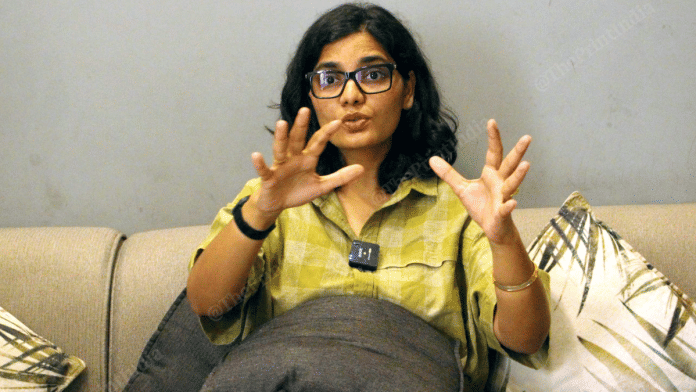


Lucknow: Bhojpuri folk singer and political satirist Neha Rathore has accused the Bharatiya Janata Party (BJP) of promoting Bhojpuri singers associated with what she describes as “ashleel (vulgar) content” by giving electoral tickets to actors and singers like Manoj Tiwari, Nirahua and Pawan Singh.
In an interview with ThePrint, Rathore, who describes herself as “Gen Z”, said that a social movement is needed to preserve the cultural integrity of the Bhojpuri language and create awareness about what she sees as growing vulgarity in the industry.
“Mostly Bhojpuri singers and actors who entered politics and received BJP tickets had earlier promoted ‘ashleel’ (vulgar) content in the music industry. Instead of distancing itself from them, the BJP promoted them in Uttar Pradesh, Bihar and Delhi,” Rathore said.
Manoj Tiwari, Nirahua and Pawan Singh are prominent Bhojpuri entertainment stars who transitioned into Indian politics.
Tiwari has been the Member of Parliament (MP) for North East Delhi since 2014. Dinesh Lal Yadav, or Nirahua, officially joined the BJP and contested from Azamgarh, Uttar Pradesh, in the 2019 general elections. While unsuccessful then, he secured a major victory in the 2022 Azamgarh by-polls.
Pawan Singh was initially named the BJP’s candidate for the Asansol constituency in West Bengal for the 2024 general election but withdrew shortly after.
Referring to Manoj Tiwari’s earlier music career, she questioned whether songs such as ‘Tuhaar Lehanga Uthaa Deb Remote Se‘ could be considered decent. “There are many such songs that were sung and popularised.”
The 29-year-old Rathore rose to national prominence through her satirical and politically charged songs, particularly the ‘UP Mein Ka Ba’ series, which focused on issues such as governance, unemployment, inflation and other public concerns in Uttar Pradesh.
Her political commentary has also drawn controversy, and she has faced police complaints and legal action over some of her social media posts.
Rathore maintains that a broader public awareness campaign is necessary to counter what she describes as the increasing vulgarisation of Bhojpuri music and to encourage a cultural revival of the language among younger generations.
‘CJP protest a reaction’
Rathore said that she supported the Gen Z protest at Delhi’s Jantar Mantar and believed the Cockroach Janta Party (CJP) was a reaction to what many young people feel is a dismissal of their concerns. But she didn’t have an opinion on the CJP yet.
“I can understand the anger of young people. If we talk about the so-called Cockroach Janta Party, it appears to be a reaction to what many youths feel is a public humiliation of their aspirations and concerns. Young people tend to react more strongly because they are less willing to tolerate disrespect,” she said.
“At the same time, I believe enthusiasm is both the greatest strength and the greatest weakness of youth. My concern is that their anger should not be misdirected or manipulated. Any movement can lose its direction if people with vested interests begin influencing it.”
Rathore said she had always stood with people who raised their voices for justice and rights and believed that young people have every right to demand accountability.
“We are seeing accidents, stampedes, paper leaks and various administrative failures. In such situations, citizens naturally ask who is responsible,” she told ThePrint. “If people are protesting through constitutional, democratic and non-violent means, that is completely legitimate in a democracy. As for newer youth-led movements, only time will reveal where they eventually lead, but I wish them well.”
Also Read: Questioning govt can’t be treason, says folk singer Neha Singh Rathore
‘Trolls target me’
Rathore claimed that she has long been a target of online trolls whom she alleges are supportive of the government.
“Whenever I raise issues such as unemployment, inflation, paper leaks, power cuts, or government accountability, I receive a flood of abusive comments. Women are particularly vulnerable to such attacks because it is often easier to target them personally,” she said.
She further alleged that a well-organised ecosystem operates on social media to discredit critics.
“New technologies, including AI, can be used to create misleading content and spread misinformation about individuals. The objective is often to damage a person’s credibility and discourage them from speaking out, but I won’t stop,” she said.
“Sometimes it feels as though important public issues do not receive the attention they deserve. Many protests and public concerns remain underreported, particularly in mainstream television coverage, which I feel is ‘Godi media’. Social media has, therefore, become an important space for raising such questions,” she added.
Songs inspired by village life
Rathore said she was born and raised in a village in Bihar and comes from a farming family. She recalled that during her childhood, she had little exposure to social media or political commentary. “My parents were quite strict, and for a long time I did not even own a mobile phone.”
After graduating in 2018 from Kanpur University, Rathore created her first Facebook account. While her family wanted her to pursue a B.Ed degree, she felt her interests lay elsewhere. She moved to Kolkata with plans to learn music.
“It was there that I realised I was less interested in becoming a classical singer and more interested in writing my own songs and expressing my views through them.”
According to Rathore, the inspiration for her songwriting came from the realities of village life. She cited a stretch of road, barely 100 metres long, in her village in Kaimur district that remained unhygienic despite the availability of toilets in many households.
“People continued to use the roadside for open defecation. Around the time the Swachh Bharat campaign was being promoted, I felt compelled to address the issue and wrote a Bhojpuri song, ‘Sauchalay banaaiye de piya na’, in 2019 to spread awareness about cleanliness,” she said.
“Unfortunately, not much changed. But I believe the responsibility does not rest solely with the government. Public awareness is equally important. People must also take ownership of their surroundings and fulfil their civic responsibilities.”
She added that in 2020, she wrote a song on the coronavirus that also got some traction on social media, but her song before the 2022 Uttar Pradesh polls, ‘UP Mein Ka Ba‘, made her viral on social media.
In 2020, she wrote ‘Bihar Mein Ka Ba’ exposing corruption and unemployment issues in Bihar, but says the UP song became more popular.
Rathore rejected the claim that most of her songs appeared to target the National Democratic Alliance (NDA)-ruled governments, saying she has also written songs critical of the earlier Mamata Banerjee-led government in West Bengal, though they received far less attention.
“I made songs against the West Bengal government during the 2021 elections as well, but they did not attract the same level of public attention. Wherever the BJP is in power, such songs tend to go viral,” she said.
Rathore said she focused on issues that affect ordinary people.
“Governments already spend enormous resources publicising their achievements. My role is different. I focus on issues that affect ordinary people and on areas where I believe accountability is lacking. If roads are damaged, prices are rising, or public services are failing, those issues deserve attention as well.”
She maintained that her objective was neither to blindly praise nor indiscriminately criticise any government.
“My intention is not to support or oppose any political party. As I see it, my job is to ask questions and highlight problems that require solutions,” she said. “I have always written folk songs rooted in people’s everyday concerns.”
The artiste said she was currently working on songs related to the power crisis, inflation and fuel prices, which she plans to record professionally in a studio and release soon.
Rathore is connected to Uttar Pradesh through marriage. Her husband, Himanshu Singh, is from Ambedkar Nagar district in Uttar Pradesh. Himanshu Singh is a professional writer and previously worked with the social media team of Drishti IAS in Delhi. Rathore has often acknowledged his support in her creative and professional journey.
Open to entering politics
Ahead of the 2024 Lok Sabha elections, there was speculation that Rathore might be fielded by an opposition party from either Uttar Pradesh or Bihar. She revealed that she was indeed approached by a political party, but the discussions did not ultimately materialise.
Rathore said that, at present, she had no political ambitions, as she lacked both grassroots political experience and an organisational base.
However, she clarified that she has not completely ruled out the possibility of entering politics in the future. “Perhaps that day may come later, but not now.”
For the time being, Rathore said her primary focus remains on using her platform to raise awareness about citizens’ rights and issues affecting ordinary people, rather than pursuing an electoral career.
Neha argued that criticising a government should not be equated with criticising the country itself. According to her, questioning those in power is an essential part of a healthy democracy.
“Citizens should be free to ask questions and hold governments accountable without being intimidated into silence. Raising public issues should not be seen as being against the nation.”
She added that criticism, trolling or even legal action can sometimes be a consequence of speaking out in public life. “If raising concerns leads to criticism or legal challenges, that is part of the reality of public discourse. However, fear should not stop people from speaking about issues that affect society and the lives of ordinary citizens.”
(Edited by Sugita Katyal)
Also Read: Neha Singh Rathore: How ‘not-so-confident’ poet began singing truth to power with Bhojpuri rap