







New Delhi: ‘India’s diplomats are hosting the world,’ but what is getting done, asks The Economist, referring to the many diplomatic meetings that India has held or is about to hold.
“India’s determination to stay on good terms with all major powers often proves awkward. A traffic jam of meetings in Delhi this month is making its acrobatics look especially complex,” it opines.
On 14 May, India held a BRICS meeting with the foreign affairs ministers of 11 countries. On 26 May, it will hold a meeting with the Quad representatives—America, Australia, and Japan.
BRICS, however, as the column points out, has refrained from discussing or taking a stand on controversial issues. With Iran and the United Arab Emirates opposing each other in the war, the talks concluded without a joint statement, which the column terms as a “relief” for India.
India would not have approved a language that condemns America for the “violence”. It much prefers that BRICS focus on things no one can dislike, the column says.
“One of its priorities as its chair in 2026 is to promote a mission for healthy lifestyles.”
“If core members of BRICS find India disappointingly cautious, the country has sometimes also been seen as a nervy partner for the Quad.”
US President Donald Trump “appears to have lost interest” in the grouping in his chase of Chinese business deals. While India has hopes from the Quad meeting, The Economist says that the best outcome of the meeting “might be to approve plans for another meeting”.
“For years the country’s prime minister, Narendra Modi, sold India as a vishwaguru, or teacher to the world. Yet India very often seems reluctant to divulge what, precisely, it wants the world to learn.”
Meanwhile, The Economist says that India’s cities, both rich and poor, are struggling.
A podcast on Indian cities says that it is a “miracle” they are functioning at all. And the 40 percent of Indians who live there produce 60 percent of the country’s GDP.
“Imagine what they might be capable of, if their cities were made liveable”.
It highlights the problem of inadequate self-governance.
“City councils are decorative, mayors are figureheads, it’s the state that has the real power.”
Moreover, in both state and national elections, rural voters have “much more influence” than the urban ones. Citing its own data analysis, the podcast makes a case that India’s cities are underrepresented in Parliament.
“On average, metropolitan MPs represent 10 times more voters than those in the countryside.”
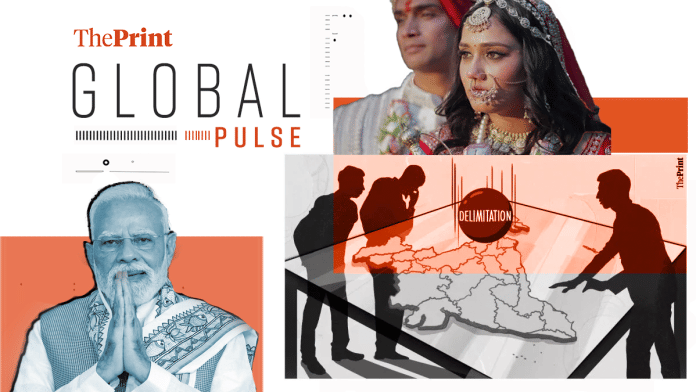
The podcast then argues that a city-based delimitation would have helped balance representation. Even the Modi government’s delimitation bill would have “inadvertently” addressed this representational imbalance. The bill was voted down.
“India cannot ignore this imbalance in representation forever. In 2027, a fresh census would be held across the country, making it all the more obvious.”
Geeta Pandey and Vishnukant Tiwari of the BBC reports on Twisha Sharma’s death in Bhopal—a case that has drawn considerable public anger, with Twisha’s in-laws calling it a suicide, and the deceased’s family accusing her in-laws of murder.
“The 33-year-old model and actor had been married for just five months to lawyer Samarth Singh when she was found dead in her matrimonial home. Twisha’s parents and siblings have alleged that she was tortured by Singh and his mother—retired judge Giribala Singh—over dowry demands and that she was murdered.”
Giribala, on her part, has alleged that Twisha had “mental health issues” and she committed suicide. Tisha’s husband, Samarth Singh, is absconding. A cash reward has been announced for any information leading to his whereabouts, and a lookout notice has been issued to ensure he does not leave the country.
“Our lawyer advised him to stay away. He told him you’ll be lynched if you came out. There’s a tirade against him; people are calling for his hanging,” Giribala said.
(Edited by Madhurita Goswami)
Also Read: Global media terms India fuel price hike ‘modest, but symbolic’, spotlights food safety ‘distrust’