





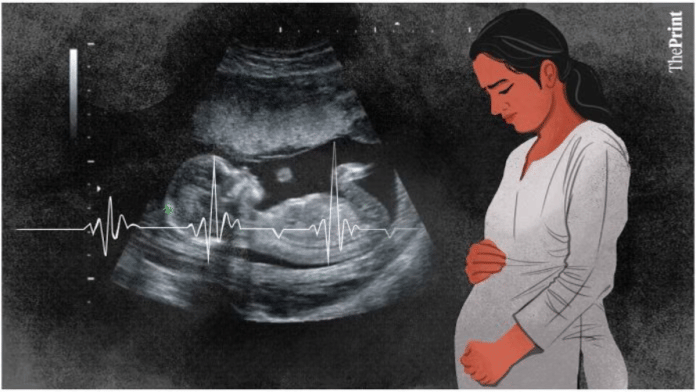

New Delhi: The Supreme Court has dismissed a doctor’s challenge to criminal proceedings under the Pre-Conception and Pre-Natal Diagnostic Techniques (Prohibition of Sex Selection) Act, 1994, or the PCPNDT Act, while reiterating that female foeticide is a grave social evil rooted in discrimination against women and the girl child.
The case arose from proceedings against Dr Ramesh for alleged violations of the record-keeping requirements under the PCPNDT Act.The bench held irregularities in Form F–the prescribed record for ultrasound examinations–are not merely trivial clerical oversights, but substantive violations of the Act.
Opening with a Hindi poem and a Sanskrit ‘shloka’ (verse) about the “beautiful joy” of daughters, a division bench of Justices Sanjay Karol and Prashant Kumar Mishra said the purpose of the PCPNDT Act is to preserve the dignity of women and ensure that a girl child can be welcomed with joy.
The accused had challenged a trial court order taking cognizance of violations of the PCPNDT Act, including improper maintenance of Form F. He contended that inadvertent and unintentional errors in record-keeping were technical mistakes, and not deliberate criminal violations.
The court did not agree, holding that complete and accurate records are central to the enforcement of the Act because they are often the only means of identifying sex determination practices at clinics. “The importance and essentiality of the form to the proper functioning of the Act is no longer up for debate,” it said.
Prescribed under the PCPNDT Act, Form F is to be filled for every pre-natal diagnostic procedure. It covers patient details and the doctor’s name, but most importantly includes a signed declaration by both the patient and the doctor affirming that the sex of the foetus was not disclosed.
The 1994 Act bars sex selection before or after conception, prohibits communication of the sex of the foetus while requiring strict compliance with record-keeping rules. According to the statute, a person conducting ultrasonography on a pregnant woman must maintain complete records in the prescribed form, and any deficiency or inaccuracy can amount to a contravention of the Act.
Section 4 of the PCPNDT Act deals with the “regulation of pre-natal diagnostic techniques”, and the proviso to Section 4(3) carries a reverse burden of proof.
Any deficiency or inaccuracy in the records maintained by the person conducting an ultrasound, unless proved to the contrary by the accused, shall amount to a contravention of Sections 5 and 6 of the Act which are the core prohibitions on sex determination.
The apex court’s engagement in the battle against female foeticide spans decades. The judgment cited Federation of Obstetrics and Gynaecological Societies of India v. Union of India (2019), to reiterate that the contents of Form F are mandatory in nature.
In that case, the court had said that documentary records are “often the only source to ensure that an establishment is not engaged in sex determination” and warned that dilution of the Act’s provisions “would only defeat the purpose of the Act to prevent female foeticide, and relegate the right to life of the girl child under Article 21 of the Constitution, to a mere formality”.
The top court also referred to its earlier judgment in Voluntary Health Association of Punjab v. Union of India (2013) whereby female foeticide was observed to be rooted in “erroneous notions, egocentric traditions, perverted perception of societal norms and obsession with ideas which are totally individualistic sans the collective good”.
In the present case, the court concurred with its previous observation that destroying a female foetus amounts to crucifying a woman of the future, saying that “even after more than a decade our sentiment is similar.”
It also cited extensive data on the national sex ratio and gender parity scenario, observing that while the country had made progress, the data does not allow for complacency.
The National Family Health Survey-5 (2019–21) records a sex ratio of 1,020 females per 1,000 males, an improvement over the previous survey. But the sex ratio at birth–a sensitive indicator of sex selection practices–stands at 929 females per 1,000 males. This is below the biologically expected level of 950.
“The keeping of records is essential to the Act and its avowed purpose. It is true that in general terms, the declining sex ratio issue is better and has shown considerable improvement but, however, diluting the provisions of law, or letting infractions thereof slide cannot be countenanced,” the bench said.
It noted the “deep-seated patriarchal preference” for male children and “the ‘behind the curtains’ prevalence of sex selection practices”, with several states such as Punjab and Haryana still reporting sex ratios at birth below the national average.
Further, India’s overall gender parity ranking in the World Economic Forum’s Global Gender Gap Report 2025 has fallen to 131 amongst 148 countries, it added.
Referring to welfare schemes such as Beti Bachao Beti Padhao, the court highlighted that such schemes can succeed only if the law against sex selection is enforced in both letter and spirit.
“These schemes are indicative of continued efforts to eradicate the systemic bias suffered by the girl child in an inherently patriarchal system. Much progress has been made, and yet, much is left to be desired. In sum, while the situation is markedly better than it was in the mid-1990s, the data does not support complacency.”
The integrity and strict enforcement of the PCPNDT Act remain essential till the time that “there is a widespread change in mentality and what till now, is perceived as the ‘inherent weakness’ of the woman, is replaced by true equality, when there will dawn a realization that efforts such as these are no longer required,” it said, dismissing the appeal.
Saumya Sharma is an alum of ThePrint School of Journalism, currently interning with ThePrint.
(Edited by Tony Rai)
Also Read: How Indian courts built a constitutional case for menstrual health infra, one judgment at a time