



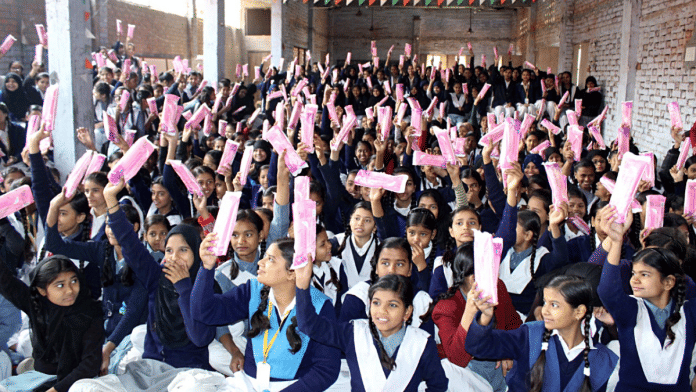
New Delhi: The Supreme Court reiterated Monday that the education of young girls should not suffer due to a lack of menstrual hygiene facilities in schools, as it directed the central government to submit progress reports every three months on steps taken to implement a January ruling that recognised menstrual hygiene as a fundamental right.
The court was monitoring compliance with the January Dr Jaya Thakur v. Government of India ruling that held menstrual hygiene to be a part of the fundamental rights to equality and life under Articles 14 and 21 of the Constitution.
The 30 January judgment was in response to a PIL filed in 2022 by social worker Jaya Thakur seeking directions to the central and state governments to provide free sanitary napkins to female students between Classes 6 and 12 and ensure separate toilet facilities for girl students in all government, government-aided and residential schools.
The petition said that the lack of menstrual hygiene facilities in schools contributed to absenteeism and a higher dropout rate among girls. The court then issued comprehensive directives ensuring the availability of sanitary napkins and gender-segregated toilets in schools across the country. Further, holding menstruation to “not be a topic that is only shared in hushed whispers,” the court mandated awareness campaigns to counter stigma.
On Monday, the court began its judgment with a quote from American educator Melissa Berton: “A period should end a sentence—not a girl’s education.”
“Make good use of it. It is for the good of women and girls of this country. Girls should not give up education and sit at home and do some domestic work only for this reason,” a bench of Justices J.B. Pardiwala and R. Mahadevan said, pressing the central government to ensure its directions on menstrual hygiene were being implemented across the country.
Emphasising a girl child’s right to dignity and education, the court said: “The absence of safe and hygienic menstrual management measures undermines dignified existence by compelling the adolescent female students to either resort to absenteeism or adopt unsafe practices, or both, which violates the bodily autonomy of the menstruating girl children.”
Also Read: From virtue to autonomy, SC just redefined Victorian concept of chastity for the digital age
Fundamental right
The judicial journey to the right to menstrual health did not begin by speaking about sanitary napkins but with broader readings of fundamental rights themselves.
In 2017, privacy and decisional autonomy were recognised as fundamental rights in K.S. Puttaswamy v. Union of India. A year later, in 2018 Common Cause v. Union of India, the court treated dignity as central to constitutional life.
Puttaswamy and Common Cause are important because they provide the constitutional language the menstrual health ruling uses. Together, they let the court treat menstrual hygiene as a question of the right to privacy, dignity and autonomy rather than just public health or a welfare measure.
One of the significant judgments on menstruation and women’s dignity was the 2018 Indian Young Lawyers Association v. State of Kerala, known as the Sabarimala judgment. The court rejected exclusion of women of menstruating age from the temple as discriminatory and inconsistent with constitutional morality.
While the Sabarimala judgment is under reference and review, the case has provided women’s health jurisprudence with precedent over the years. The majority ruling held menstruation to be a biological feature and an intrinsic part of a woman’s personhood, which cannot be grounds for exclusion from religious practice.
The then Chief Justice of India D.Y. Chandrachud invoked Article 17, the constitutional prohibition on untouchability, to argue that exclusion of women on the basis of menstruation could not be constitutionally sustained. The sole dissenting opinion in the Sabarimala judgment was that of Justice Indu Malhotra, the only woman on the bench, who objected to judicial involvement in denominational religious matters.
However, the first major judicial engagement with menstrual products was, perhaps surprisingly, a tax dispute. When the Goods and Services Tax (GST) came into force in 2017, sanitary napkins were placed in the 12 percent slab, alongside mobile phones and leather goods. A petition filed in the Delhi High Court argued that the tax was discriminatory to a woman’s fundamental right to live with dignity.
A parallel petition was filed in the Bombay High Court. The Supreme Court stayed proceedings in both high courts, on a transfer petition by the central government.
The litigation was eventually overtaken by events. In 2018, the GST Council exempted sanitary napkins entirely, reducing the rate to zero.
The court petitions were rendered infructuous, but it had allowed an initial judicial reckoning of whether menstrual products are a health necessity or a taxable commodity.
The court has, however, drawn a different line on menstrual leave. In a March 2026 public interest litigation (PIL), a bench of Chief Justice Surya Kant and Justice Joymalya Bagchi declined to make menstrual leave mandatory in workplaces across the country.
The court said such a compulsory rule could hurt women’s employment prospects by encouraging employers to view women as a liability, and it left the matter to policymakers rather than issuing a nationwide judicial mandate.
The judicial arc shows the Supreme Court moving from confronting menstrual stigma to recognising menstrual health as part of the right to life and education.
At the same time, the court’s refusal to mandate menstrual leave shows the limits of judicial intervention in a policy area that requires legislative and executive design.
Before menstrual health reached the Supreme Court as a constitutional question, a PIL filed in 2020 before the Gujarat High Court forced the judiciary to confront the continuing stigma of menstruation in religion and society.
In this case, more than 60 girl students of Shree Sahajanand Girls Institute in Bhuj, run by a trust of the Swaminarayan temple, were allegedly made to remove their undergarments to prove they were not menstruating after a blood-soaked sanitary napkin was found on the premises.
The incident was linked to hostel rules that barred menstruating students from the dining hall, their beds, the kitchen and places of worship, and required them to stay separately for three days.
Justice Pardiwala authored the Gujarat High Court division bench order in the matter. He is now part of the Supreme Court bench that delivered the judgment and continues to monitor compliance in the Dr Jaya Thakur case in 2026.
The 2020 Gujarat High Court order proposed sweeping directions prohibiting social exclusion of women on menstrual grounds at private and public places, including educational institutions and hostels, while also calling for awareness campaigns, sensitisation of frontline health workers, and funding for implementation.
The court’s monitoring of compliance in the current case is significant in the face of the broader challenge of implementation. While the apex court has recognised menstrual health as a fundamental right, the protection depends on implementation by schools so that girls can receive an education without disruption.
Saumya Sharma is an alum of ThePrint School of Journalism, currently interning with ThePrint.
(Edited by Sugita Katyal)
Also Read: Shared groceries & dreams, no legal protection. Extra-marital live-ins are uncharted territory