





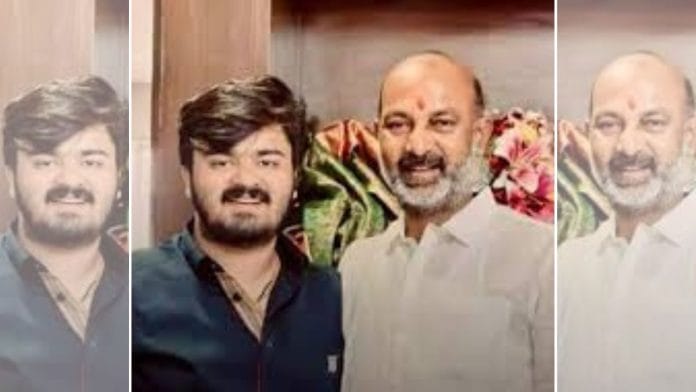


New Delhi: The Telangana High Court’s decision to grant bail to Bandi Sai Bhageerath, son of Union Minister of State for Home Affairs Bandi Sanjay Kumar, in a case registered under the Protection of Children from Sexual Offences (POCSO) Act has sparked debate among legal experts. Some are calling it a departure from the cautious approach typically adopted in child sexual abuse cases, while others say the court attempted to balance the accused’s right to liberty with the need to protect the victim.
In an order passed Thursday, Justice K. Sujana granted regular bail to Bhageerath, who has been in judicial custody since May, observing that the investigation was “almost complete”, with only the filing of the chargesheet remaining. The high court (HC) held that the complainant’s apprehensions about witness intimidation and interference with the investigation could be addressed through stringent bail conditions rather than continued incarceration.
On 8 May, the mother of the victim filed a police complaint claiming that Bhageerath’s friends befriended her minor daughter, aged 17, on social media. Then, she further alleged, Bhageerath, promising marriage, entered into a relationship with her and subjected her to repeated sexual assault on different occasions.
According to the court order, she also alleged that her daughter was made to consume alcohol, and private photos of her were circulated in the “social circle”.
In court, Bhageerath’s lawyers argued that he is innocent and has been falsely implicated. They told the bench that he had been in judicial custody since 16 May and had cooperated with the police during the investigation.
The lawyers also said that although the victim and material witnesses had already been examined by the police, the chargesheet was yet to be filed. The lawyers also told the court that between 22 and 24 June, Bhageerath was out on interim bail to take his BBA exams, and there was no allegation against him relating to misuse of liberty.
Bail conditions prohibit Bhageerath from contacting the victim, complainant or prosecution witnesses, visiting places frequented by them, making public statements about the case, or posting any content relating to the victim or the proceedings on social media. The accused has also been barred from giving interviews, podcasts or media briefings until the trial concludes.
One of the conditions also said that Bhageerath has to appear before the police every Monday “for a period of 8 weeks or till filing of chargesheet, whichever is earlier, for the purpose of investigation”.
Lawyers debate
While the HC viewed these safeguards as sufficient, several lawyers who spoke to ThePrint debated whether such conditions can adequately protect a minor complainant in a case involving allegations against the son of a serving Union minister.
Advocate Soumya Dubey, who practises in the Delhi High Court, said the order appears to underplay the imbalance of power between the parties. “In granting bail, the HC appears to have overlooked the profound power imbalance at play. The accused is the son of a Union minister. Releasing an individual with that level of systemic influence in a case of this magnitude creates an immediate risk. It not only jeopardises the integrity of a pending investigation by opening the door to witness tampering, but it also carries a severe risk of intimidating a young, vulnerable victim.”
While opposing Bhageerath’s bail plea in court, the complainant’s lawyers had argued that the investigation was incomplete and crucial witnesses identified by the victim were yet to be examined.
The State informed the HC that the investigation was substantially complete except for the filing of the chargesheet, and produced the victim’s statement and forensic science laboratory report in a sealed cover. However, it opposed the bail plea, arguing the allegations were grave and involved a minor.
Delhi advocate Ayush Tanwar said the HC’s decision stands out because courts generally avoid granting regular bail at such an early stage in prosecution under the POCSO Act.
“Given the gravity of the allegations in this case, courts are traditionally very reluctant to grant bail at such an early stage. However, by enlarging the accused on bail while the formal investigation remains pending, the HC has deviated from the standard judicial approach. The course adopted by the Court here is distinctly an exception, not the norm,” Tanwar added.
The HC reasoned that once it is satisfied an accused is unlikely to abscond, influence witnesses or obstruct justice, and that those concerns can be addressed through stringent conditions, continued incarceration would ordinarily be unwarranted.
According to Pallavi Garg, an advocate practising before the Delhi HC, that reasoning reflects an attempt to strike a constitutional balance.
“While the Telangana HC has consciously addressed the principal concerns that ordinarily weigh against the grant of bail, namely, the possibility of the accused influencing the victim or prosecution witnesses during the course of the investigation, it has sought to mitigate these risks by imposing an extensive set of stringent bail conditions,” she said. “The court’s reasoning reflects an attempt to balance the accused’s fundamental right to personal liberty with the need to ensure a fair investigation and protect the interests of the victim.”
However, Garg said the order also raises larger questions about how courts should approach bail under a special legislation such as the POCSO Act.
She noted that unlike the Bharatiya Nyaya Sanhita, the POCSO Act is a welfare statute enacted specifically to protect children from sexual offences and has consistently been interpreted by courts through a victim-centric lens.
“In practice, courts are generally slow to grant regular bail in serious POCSO prosecutions before the victim’s testimony is recorded, primarily to eliminate any possibility of intimidation, inducement, or interference with the prosecution’s case. Against this backdrop, the order marks a departure from the more cautious approach typically adopted in cases involving child victims,” Garg said.
She added that although the HC has imposed comprehensive restrictions on the accused, concerns remain about whether such conditions are sufficient where allegations involve someone from an influential family. “The decision is therefore likely to generate discussion on the evolving contours of bail jurisprudence in special statutes, where the competing interests of personal liberty and victim protection must be reconciled with exceptional care.”
Offering a sharper criticism, Seema Misra, a lawyer specialising in POCSO litigation, described the order as extraordinary.
“Fifty-five days in custody for an adult accused facing allegations under Section 6 of the POCSO Act is virtually unheard of. Bail is generally considered only after the victim’s statement is recorded in court (during trial). The consent of a minor has no legal recognition under the law. This is not the normal course. It is an extraordinary and unfortunate order,” Misra said.
She also questioned what she described as an emerging tendency to attach significance to alleged consensual relationships involving victims close to the age of majority despite the statutory position that a child’s consent is legally irrelevant under the POCSO Act.
Before his arrest in May, Bhageerath had moved the HC seeking protection from arrest, contending that the relationship was consensual and disputing the applicability of the POCSO Act. The HC refused to grant him interim protection. He later surrendered before the police and was granted interim bail last month to appear for his BBA supplementary examinations, a factor that his counsel relied upon while seeking regular bail.
(Edited by Gitanjali Das)