





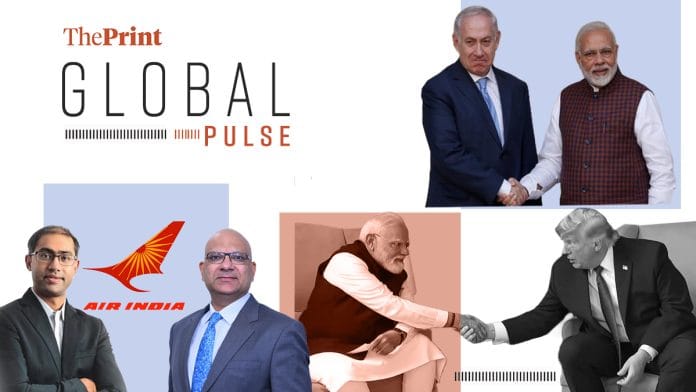


New Delhi: At a time when US President Donald Trump and Israeli Prime Minister Benjamin Netanyahu’s friendship is under considerable strain in the backdrop of the West Asia war, a Financial Times report has turned the spotlight on a far more enduring, yet “unlikely alliance”.
Narendra Modi has maintained close ties with Netanyahu since becoming the first Indian Prime Minister to visit Israel in 2017. FT’s Michael Stott, Andres Schipani and James Shotter write that the two leaders are in a “shared fight against terrorism”.
“When Hamas militants attacked Israel in October 2023, killing about 1,200 people, the first call to Israeli Prime Minister Benjamin Netanyahu came not from Washington or Europe, but New Delhi,” the report reads, adding that Modi used the call to express his support for Israel. Modi’s gesture highlighted the “strong bond” between the two countries, and their common vision of “their nations as homelands for their religious majorities”.
The report further notes how critics say that Modi and Netanyahu also share “authoritarian traits”.
“Both have fostered an environment, they say, in which hostility to Muslim and Christian minorities has intensified, the power of independent institutions has been eroded and the activities of foreign NGOs restricted,” it says.
FT also mentions how diplomats say that the two leaders speak regularly on the phone and “understand each other well”. Modi’s gesture highlighted the “strong bond” between the two countries and their common vision of “their nations as homelands for their religious majorities”.
Reuven Azar, Israel’s ambassador to India, also said—as FT notes—that in a world that is moving towards universalism and post national institutions, Modi and Netanyahu are “not just embracing nationalism, but also identity”.
The ties between India and Israel span intelligence sharing, surveillance, arms sales, joint weapons development, trade, agricultural technology and cultural ties, the report notes.
However, it adds that the closeness between the PMs “contrasts with Israel’s increasing isolation on the world stage, including among some of its closest western allies, amid outrage over its devastating offensive in Gaza, which has caused a humanitarian catastrophe in the Palestinian enclave, and its conduct in the occupied West Bank”.
Also Read: Can Modi-Trump G7 meet reset India-US ties? Indian PM has his work cut out, writes global media
Modi-Trump meet in France
Modi and US President Donald Trump met Wednesday on the sidelines of the G7 Summit in France. Other than Trump calling Modi “beautiful like an angel”, he remarked that the two countries are close to a trade deal, report Sharanya Hrishikesh and Anna Lamche for BBC.
The US President also promised to visit India “sometime in the future”.
“Indian Prime Minister Narendra Modi raised the safety of Indian sailors working in the Strait of Hormuz with Trump during their meeting at the G7 summit,” the report adds. Earlier this month, US strikes on a ship in the Gulf of Oman had killed three Indian sailors on board.
Trump has been expected to visit India for several months now, potentially as part of a Quad meeting with Japan and Australia, the report says. “Officials are set to meet in Delhi next week to negotiate what India’s commerce secretary has described as the ‘final touches’ to the US-India trade deal.”
The future of Air India
Top-tier tensions in Tata Group over succession are delaying the appointment of Air India’s next CEO. Krishn Kaushik and Chris Kay of the Financial Times report about the airline’s future after Campbell Wilson. “His tenure has been marred by a fatal crash that killed 260 people last year, a conflict in the Middle East that has raised fuel costs and a record annual loss of close to $3bn,” they write.
According to the report, Air India has identified two leading candidates: Nipun Aggarwal, the current chief commercial officer, and Vinod Kannan, former chief executive of Tata-owned Vistara, which merged with Air India in 2024.
People in the know tell FT that Aggarwal was favoured by Tata Sons chair N. Chandrasekaran, but he is “reluctant to make a final decision because his own future at the group hangs in the balance”. Noel Tata, the scion who chairs Tata Trusts, has objected to giving Chandrasekaran another term, even though most other directors are in favour, the report says.
It adds, “Whoever succeeds Wilson—who was expected to stay until September, said one of the people—will take over an airline going through what Chandrasekaran has called a perfect storm.”
The carrier has also been forced to curtail its operations by 20 percent since the war in the Gulf began. “Adding to its troubles, Pakistan has blocked Indian access to its airspace since the two countries fought a brief conflict last year. Air India told the Indian government this year the Pakistan air closure would cost it $600 mn in losses annually, as it had the largest international presence from India.”
While Aggarwal seems to be the most promising candidate, the board remains unsure. The report cites how internal meetings revealed that Air India needs cost-cutting and Aggarwal is being seen as a “cost-cutter”. However, others on the board are of the opinion that a CEO needs more skills than simply cost-cutting.
(Edited by Mannat Chugh)