





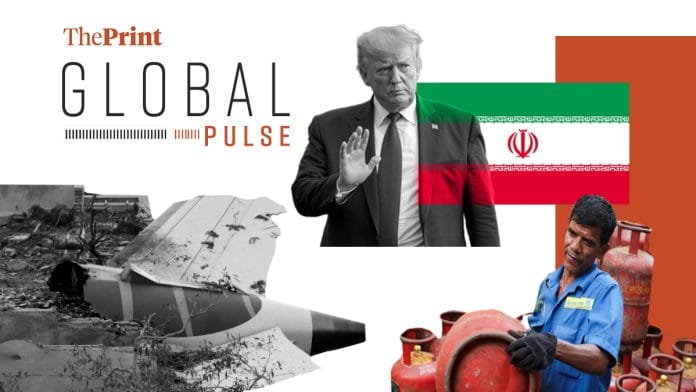


New Delhi: India has witnessed gas shortages, rising fuel prices and a tumbling rupee since the US-Iran war began in March this year. The two countries have finally reached a preliminary agreement to end the war in the Gulf, even though details are yet to be made public, while a permanent truce remains to be negotiated.
There is now hope that India’s fuel and gas import situation will likely stabilise after the prolonged closure of the Strait of Hormuz. Michael Stott of Financial Times looks at the Indian government’s report card amid the crisis.
In the India Business Briefing newsletter, Stott highlights what stood out with respect to the Modi government’s response so far. It responded quickly. “Within days, top officials identified where India’s economy was most vulnerable to the war’s impact and drew up plans to mitigate the effects. New sources of supply were sought and domestic refiners were ordered to give priority to the production of bottled gas for cooking and fertilisers,” he writes.
Second, the population was “shielded from the brunt of the crisis”, he notes. Despite world prices for some fertilisers almost doubling and the price of oil and gas rising, India held prices and increased subsidies.
Also, the Reserve Bank of India “intervened to limit falls in the rupee and the government helped to ease pressure on the currency by incentivising foreign investors”.
However, Stott says, the response was “not perfect”. “Prime Minister Narendra Modi’s exhortation to Indians to work from home, use public transport and avoid foreign trips and gold purchases did not go down well. There were some shortages of cooking gas early on before supplies normalised. The incentives to foreign investors could have been announced last year, rather than waiting for a crisis,” he writes.
The deal with Iran also speaks to Donald Trump’s competence in landing peace agreements. Walter Russell Mead writes in The Wall Street Journal about the US president’s unique approach to foreign policy.
“The underlying issue—Iran’s drive for regional hegemony and the American determination to block it—remains unresolved. If anything Tehran appears more eager than before to assert control over its neighbors and the flow of oil from the Middle East. Moreover, Israel, which has its own war proceeding in Lebanon, wasn’t part of the negotiations,” the opinion piece reads.
Mead notes how the unusual interval between the announcement of a deal and its scheduled formal signing gives Trump the option of “walking away from the agreement if political blowback is too severe”.
This agreement is symbolic of Trump’s second term in office, he argues. “He is driving world events with an agreement that hasn’t been formally signed, whose specifics are unknown and whose prospects are at best murky.”
Mead adds that Trump’s “greatest strength is also his greatest weakness”.
He explains, “The president is a cynic. Unencumbered by deep convictions and free from the constraints imposed by conventional morality or codes of honour, he can alter his tactics to the exigencies of the moment without hesitation or scruple. Cynicism has its uses. No statesman can succeed without a healthy dose of it. But like most potent drugs, it works best in small doses.”
Soutik Biswas reports for the BBC on the status of the Air India crash investigation and the questions that remain unanswered a year later. He points out how the update released by India’s Aircraft Accident Investigation Bureau (AAIB) on the first anniversary of the disaster on 12 June offered “few new clues”.
The delay in the outcomes of the probe has drawn much global scrutiny. However, Biswas looks at how air crash probes are generally allowed to take longer. John Cox, a former airline pilot and aviation safety consultant, tells BBC that India’s AAIB was “entitled under International Civil Aviation Organisation (ICAO) rules to take more time if necessary”.
Shawn Pruchnicki, former accident investigator and aviation expert at Ohio State University, is quoted as saying that the continuing delay points to competing hypotheses, unresolved leads and “possible mechanical issues that have yet to be fully explained”.
However, sceptics think the complexity alone is not responsible, Biswas adds. A veteran Canada-based air accident investigator tells BBC that final reports are sometimes delayed because “their conclusions are politically or institutionally sensitive”.
Highlighting the possible mechanical issues over human action, Captain C.S. Randhawa, head of Federation of Indian Pilots, argues that investigators should pay closer attention to the aircraft’s technical condition, including encrypted health-monitoring messages transmitted before and during the flight.
Another interesting find suggests that the Ram Air Turbine (RAT) might have malfunctioned. “According to the preliminary report, the RAT was providing hydraulic power within about five seconds of the fuel switches being cut off. But simulator tests cited by the BBC reportedly suggest the process should take 14-18 seconds from fuel cut-off to power delivery,” the report notes.
Another theory put forth by some safety campaigners is that a major electrical fault triggered a reboot of the aircraft’s flight computers seconds after take-off. “Under this scenario, the cockpit fuel switches were never physically moved. Instead, the flight data recorder may have captured an electronic fuel-cutoff command rather than a mechanical switch movement.”
(Edited by Mannat Chugh)