





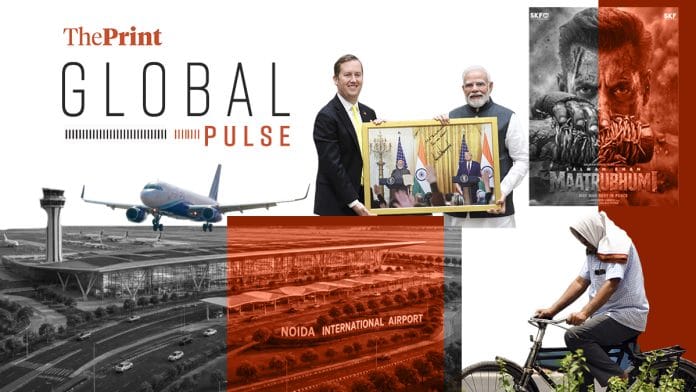


New Delhi: After a long wait, Noida International Airport began commercial flight operations Monday and is expected to reduce and redirect traffic from Delhi’s Indira Gandhi International Airport. The Economist, in a piece titled ‘The real problem with Narendra Modi’s airport-building frenzy’, takes a look at the Modi government’s airport-building push, examining its mixed record and where credit is due.
It notes that in his 12 years in office, PM Modi has more than doubled the number of operational airports, and while some have since shut down, others have thrived and expanded significantly.
The report further states that the Opposition’s criticism of Modi’s airport “optics” is largely misplaced. While it acknowledges that several of the airports inaugurated with much fanfare have seen limited traffic or struggled after opening, it argues that many were never intended to operate at the scale of major aviation hubs.
“It was always an act of extreme optimism to think Saharanpur, an overgrown town of mostly poor people, could support an airport,” says the report, adding: “Not all airports are created equal. Many of those that failed were no-frills sheds designed to handle only one or two flights a day.”
Since Modi became PM, the number of operational airports in India has risen from 74 to 164. Calling this an “impressive achievement”, the report nevertheless raises questions about connectivity, arguing that building airports is only one part of the challenge.
Noida’s new airport is 80 km from Delhi, it notes. A government press release promised a multimodal transport hub with seamless integration across road, rail, metro and regional transit systems. “In reality there are two modes at the new airport: you can drive. Or you can walk,” it adds.
The same can be said for the new Mumbai airport inaugurated last year at Christmas.
“Passengers complain that they have to wait up to an hour to get a taxi—the only way in and out. And even that is a challenge. For months after the terminal opened there was no phone reception with which to summon an Uber, and the airport Wifi was buggy. Build it and they will come, the government believes. But how will they leave?” asks the report.
PM Modi and US President Donald Trump are expected to meet on the sidelines of the G7 Summit in France Wednesday, in what will be their first face-to-face meeting since the India-Pakistan conflict last year strained ties between New Delhi and Washington over claims of mediation. Against the backdrop of the hot-and-cold relationship, one figure has emerged as key in maintaining the fragile ties: Sergio Gor, reports The New York Times.
Gor, the US ambassador to India, has wielded considerable influence within the Trump administration and over Washington’s policy towards India and South Asia more broadly. Perhaps the clearest demonstration of that influence was the fate of a $850 million construction project at the US Embassy in New Delhi.
Gor neither proposed the project nor oversaw it. Instead, he cancelled it after “crews had dug a 200-foot-long pit for the project’s centerpiece”.
“The reversal has stunned diplomats who see it as a long-term blow to America’s ability to operate in the world’s most populous country. It has stung some intelligence officials who wanted more modern classified facilities in a volatile region,” says the report.
Gor has taken an unconventional approach to diplomacy: focusing on short-term gains over long-term diplomatic relations. And Trump seems happy, it notes.
“In both India and Central Asia, Mr. Gor has pleased officials with his ability to secure direct access to US cabinet members. He has satisfied them by emphasizing commerce and staying silent about the rollback of democracy and human rights in much of the region.”
BBC takes its coverage of Delhi’s summer heat a step further. It asks: “Delhi’s temperature showed 43.5C. Why did it feel hotter?”
“On Tuesday, the Indian Meteorological Department (IMD) recorded the maximum day temperature at 43.5C in the capital. But we spent the day out on the city streets with a thermal camera deployed by Greenpeace India which recorded surface temperatures of up to 64C in some places,” says the report.
The IMD’s official readings measure air temperature under standard conditions, while thermal cameras measure the temperature of surfaces. On hot days, roads, concrete structures, vehicles and other exposed surfaces can get much hotter than the surrounding air. These hot surfaces radiate heat back into the environment, making people feel hotter than the official temperature suggests, especially in areas with little shade or greenery, it explains.
Experts say the Indian government should issue an advisory for the working class to not work outdoors between 10:30am and 3pm, notes the report, adding: “But that’s not a luxury Delhi’s poor have.”
South China Morning Post reports that a Russia-China-India axis may be in the making. And the shift in sentiment is evident from the fate of Bollywood films.
The Battle of Galwan, starring Salman Khan, was facing the ire of Chinese media and officials over what they refer to as “distorting historical facts”. The film depicted the deadly Galwan Valley clashes between India and China.
“The film has since been renamed and its release delayed due to reshoots aimed at softening its portrayal of China. Another film based on the 2020 conflict has been quietly shelved, with its producer saying he was advised to avoid negative portrayals of China,” the report says.
The Indian government’s apparent shift of approach has renewed conversations of a Russia-India-China power triangle.
“This matters because Moscow is once again advancing its long-held vision of a Russia-India-China strategic triangle, an idea that hinges on easing tensions between Asia’s two biggest powers,” it says.
“Indian and Chinese officials are talking again. Border negotiations have resumed and discussions on deeper economic engagement are back on the agenda. Last week, Chinese ambassador to India Xu Feihong described Sino-Indian ties as one of the world’s most important bilateral relationships,” the report further notes.
According to the report, the developments are encouraging for Moscow. “Russia has revived its long-cherished vision of a Russia-India-China strategic triangle, with President Vladimir Putin arguing that closer coordination among the powers could rebalance the international order,” it says.
(Edited by Nida Fatima Siddiqui)
Also Read: One year of Air India crash & the future of Cockroach Janta Party