





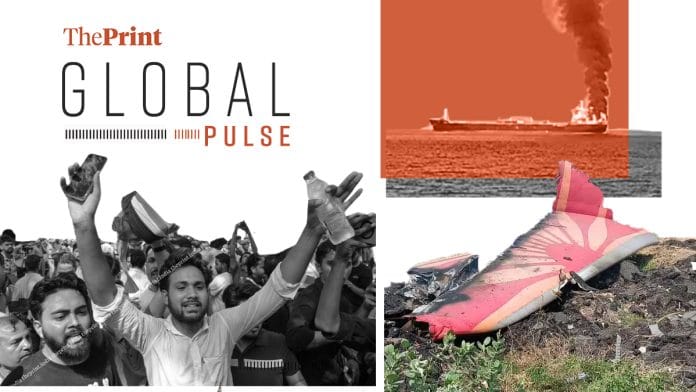


New Delhi: Friday, 12 June, marks one year since an Air India plane crashed in Ahmedabad killing 260 people. Azadeh Moshiri and Charlotte Scarr of the BBC talk to families who are still waiting for bodies of loved ones to perform the last rites. The report also provides an insight into how identification of the bodies has been an arduous task.
Miten Patel lost his parents, Ashok and Shobhana Patel, in the crash. It took more than a week for the Patels’ remains to be returned to the UK. But DNA tests showed Shobhana Patel’s remains were mixed with the remains of an unidentified man, the report says.
“The Patel family waited another month before they could cremate her remains, postponing Ashok’s last rites so they could be cremated together,” the report notes.
While palm prints and DNA of the unidentified man have been sent back from UK to India, he is yet to be identified.
“The challenge for emergency workers at the crash site was immense, with hundreds of casualties, and many bodies burned and torn apart. The wreckage was scattered across 37,000 sq m, the equivalent of five football pitches, as the plane collided with accommodation for medical students, and broke apart,” the report says.
BBC has tracked another such incident. “Amanda Donaghey returned to the UK believing she was carrying the remains of her son, 39-year-old Fiongal Greenlaw-Meek. She later discovered she had received the remains of a 70-year-old Indian woman, Vasuben Narendrasinh Raj.”
Meanwhile, The Economist asks, “Can India’s cockroach party become a political movement?”
The column highlights how people had expected that Abhijeet Dipke, the founder of the Cockroach Janta Party, would be arrested as soon as he landed in India and the protest banned. “Once Mr Dipke landed on 6 June, however, it became clear that the government had adroitly changed tack. The Delhi Police swiftly granted him permission to hold the rally,” says the column.
“The grievances that Mr Dipke has tapped into run deep and wide. Like many young people across India, the protesters were angry about a lack of jobs and an education system that can often seem designed to crush their aspirations. Many complained that those in power are unaccountable, and suppress dissent,” The Economist writes.
Dipke has promised protest marches across India. The second protest was held in Pune on 11 June. “He has plenty of discontent to draw on and a powerful symbol, which counts for something in Indian politics. But his movement is inchoate. It has no real organisation (the turnout in Delhi was surprisingly small), it lacks a coherent message, and it is not clear that Mr Dipke will have the skills to turn a burst of anger into a movement. Those in power seem to doubt that it will be any more than a minor pest. It is up to the cockroaches to prove them wrong,” the column says.
Dan Strumpf, Sudhi Ranjan Sen and Shruti Srivastava of the Bloomberg report that “Trump, Modi look to repair ties in the shadow of new US strikes”.
Prime Minister Narendra Modi and US President Donald Trump have been locked in a diplomatic back and forth. US forces this week attacked three Indian-crewed vessels in the Gulf of Oman region, killing at least three sailors and prompting protests from New Delhi, the report notes.
“Last month, Trump dispatched Secretary of State Marco Rubio for a multi-day visit to India, where he met multiple Indian officials and envoys from Japan and Australia as part of a security grouping known as the Quad.” This was the highest-profile visit by a US official in more than a year, the report says.
Soon after New Delhi’s announcement that it had summoned US Chargé d’Affaires Jason Meeks over the vessel strike late Wednesday, Trump posted on social media congratulating Modi on his 12-year tenure in office. Modi reciprocated with a warm thanks.
Experts are of the opinion that India will not make much of the US strikes and discount the attacks considering that the strikes took place during an active war.
The two leaders are expected to meet on the sidelines of the G7 summit in France next week, which would also be their first face-to-face meeting since a falling out last year following India’s military clash with Pakistan and Trump’s tariffs.
(Edited by Viny Mishra)
Also read: India’s AI report card: Global media lays out pitfalls of no sovereign model, but also some pros