



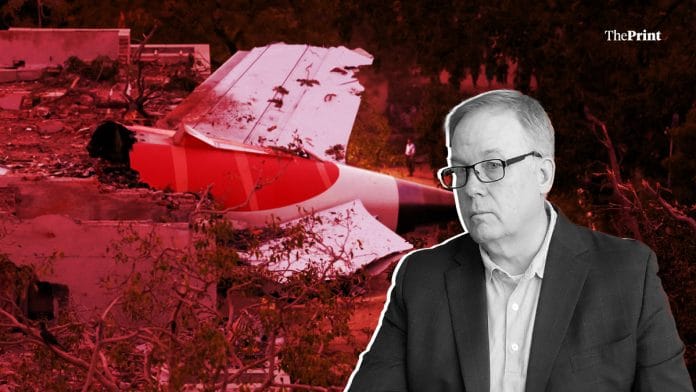

New Delhi: A year after the deadly Air India plane crash, the US-based attorney representing the families of victims has warned that a similar disaster cannot be ruled out unless investigators conclusively establish what caused the aircraft to go down.
The absence of definitive answers remains a concern not only for the families of those killed in the crash but also for the wider aviation industry across the world, he said.
“Unless the root cause is determined, this could happen again,” Mike Andrews told ThePrint. “If a disaster of this magnitude occurs and every effort is not taken to uncover the technical reason for it, then, of course, this could happen again.”
Several critical questions remain unanswered, he said, cautioning against settling on a single explanation before all the evidence has been examined.
Andrews also cautioned against blaming the pilots—Captain Sumeet Sabharwal and First Officer Clive Kunder—right away, pointing at the controversy post the release of the preliminary report when speculation around pilot error took centre stage despite the investigation still being underway.
The lawyer also raised concerns about attempts to secure broad legal waivers from victims’ families before the full circumstances of the crash are known.
Air India Flight AI171, a Boeing 787-8 Dreamliner bound for London, crashed seconds after take-off from Ahmedabad on 12 June 2025, killing 260 people, including 241 of the 242 passengers and crew on board and 19 on ground.
The Aircraft Accident Investigation Bureau (AAIB), which is investigating the crash, had come out with a preliminary report in July 2025.
The report found that both engine fuel-control switches moved to the “cutoff” position shortly after take-off, causing a loss of thrust, but investigators have not determined why this happened and have not assigned blame.
Though a final report is typically expected within a year of a crash, investigators have indicated that additional examinations are ongoing and no final-report date has been announced
Also Read: Air India, IndiGo scale down flight schedule for June, July as aviation sector losses mount
‘Warning signs’
According to Andrews, his team’s independent investigation has continued, involving a detailed review of technical documents, wiring diagrams, hydraulic schematics (simplified, standardized diagram of a fluid power system) and other aircraft systems for understanding the sequence of events that led to the accident.
Investigators working on behalf of victims, he said, have focused on several warning signs observed before and during take-off of AI171. These include technical faults reported before departure, the deployment of the aircraft’s emergency Ram Air Turbine (RAT), interruptions in fuel supply and possible problems affecting the hydraulic systems.
Rather than viewing these as isolated issues, Andrews said the warning signs may point towards a broader technical problem, with investigators continuing to focus on the aircraft’s electrical systems. “We continue to look at the electrical issues within the aircraft.”
One of the key areas under scrutiny is the RAT, an emergency device that automatically deploys when an aircraft suffers a major loss of power. Available evidence suggests the RAT may have deployed earlier than previously understood, according to the US lawyer.
“If the report’s timestamps are accurate, the RAT would have deployed much earlier than the official narrative suggests, consistent with video evidence showing it already deployed while the aircraft was still on the runway.”
His team, the lawyer said, has conducted simulator testing to better understand the aircraft’s performance during take-off and whether factors such as brake drag, reduced thrust or electrical anomalies may have contributed to the sequence of events.
Andrews said his team is examining whether known electrical vulnerabilities and system issues previously identified on the Boeing 787 could have any connection to the crash. Airworthiness directives, service bulletins and previous incidents involving the aircraft type are among the materials being reviewed, he added.
In January, the Foundation for Aviation Safety submitted to the US Senate that there were numerous issues reportedly with the Air India 787 plane, registered as VT-ANB, in its roughly 11 years of service.
While there is currently insufficient evidence to take legal action against Boeing, Andrews made clear that could change if investigators establish a link between the crash and a design or manufacturing defect. “If we prove it, we will sue them.”
The broader concern, Andrews argued, is whether the crash was caused by a fault unique to one aircraft or a problem that could potentially affect other aircraft of the same type.
“There are manufacturing defects and there are design defects,” he said. “Some issues are unique to a specific aircraft. Others can affect an entire fleet.”
If investigators identify a design-related issue, he warned, the implications could extend beyond a single aircraft and potentially affect Boeing 787s operating around the world.
There are 1,175-plus Boeing 787 Dreamliners being flown by customers spread across more than 85 countries, according to the American aviation giant in April last year.
Andrews stated that information-sharing between Indian and British investigators had been limited during the course of the investigation.
However, a spokesperson for the UK’s Air Accidents Investigation Branch told ThePrint that British experts do not have a direct role in another country’s probe and are only entitled to information released by the investigating authority.
The spokesperson added that the agency remains in contact with the AAIB and is ready to provide further assistance if required.
Beyond the technical investigation, Andrews spoke about the difficulties faced by families of those who died in the crash. “The crash was the end of life for the victims, but the beginning of suffering for their families.”
The US attorney further disputed suggestions that all compensation matters have been resolved, stating that some families still face uncertainty over claims and legal rights.
(Edited by Tony Rai)
Why is he opening his cards ?