



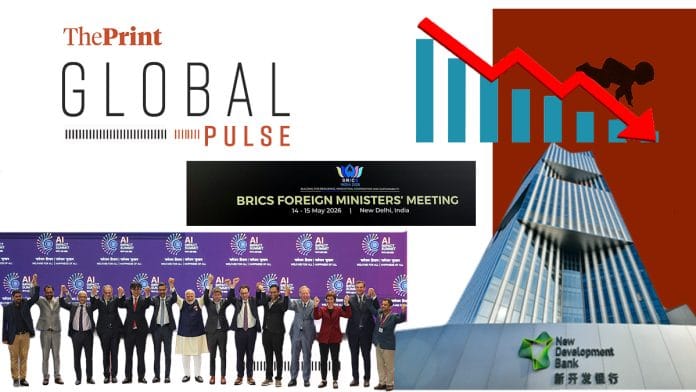

New Delhi: In February, India hosted the AI Impact Summit in New Delhi. While the summit was graced by leading AI giants, India’s own AI development, and whether it would be able to join the AI race, remains debatable.
Veena Venugopal of Financial Times writes about India’s standing in the AI race in a newsletter titled “Has India lost the AI race? Not entirely“.
“There has been much hand-wringing about India’s lack of an AI play. The latest casualty has been its standing in global stock market rankings. Fired by an AI-fuelled rally last week, Taiwan and South Korea overtook India in market capitalisation as foreign portfolio investors sold Indian equities to buy companies such as Samsung Electronics and TSMC,” Venugopal writes.
Technologically, the report says, India “appears” to have largely given up any ambition to build a sovereign AI model.
“The only promising option is Sarvam, which is building a foundational large language model for Indian languages.” Why? Because, as Venugopal notes, India’s industry visionaries did not see much value in entering the LLM (large language model) race. They are rather concerned with building AI apps.
Now, while there is value in building AI applications too, Venugopal says that an absence of a sovereign model leaves Indian companies and users dependent on external technology. “There are already concerns that paying to use this technology is a drain on foreign exchange and a growing cost item for Indian tech firms.”
In Financial Times, Martin Wolf warns about AI’s dangers. He writes “Why the world must agree to regulate AI”.
“Humans think, create and act. What will happen when (or if) machines do the thinking and even the creating and acting for us? Will humans still struggle to understand or will we become spoon-fed? In brief, will AI change not just what humans do, but who we are?” he asks.
He also addresses the company/AI dichotomy and what would happen if companies were to be run by AI. “Legally, companies are ‘persons’. But AI companies might make decisions with no people. How and to whom would an AI programme be responsible? Criminal chief executives can go to prison. What is the equivalent for AI?”
He also invokes Pope Leo’s recent encyclical, where the Pope called AI, ultimately, just a tool. “It is not a person. Does it suffer? Does it bleed? Can it bear moral responsibility? Can it be accountable in any meaningful way? No.”
Wolf concludes that we, as a civilisation, are trapped. “The technologists are catapulting us, at extraordinary speed, into a new world whose implications we neither understand nor control.”
Meanwhile, Vrinda Sahai writes in Carnegie India about “Managing Divergence: India’s BRICS Presidency in 2026”. She argues that India’s central challenge is not managing a single flashpoint but resolving the “underlying tension between expansion and institutional coherency” of BRICS.
And tension can be seen across three categories: intra-bloc trade, the institutional credibility of the NDB, and membership.
“Intra-BRICS trade remains structurally underdeveloped.” According to a United Nations Conference on Trade and Development (UNCTAD) report Sahai cites, although over two-thirds of the Global South’s GDP comes from BRICS members, only about 20 percent of South–South trade is intra-BRICS.
The grouping as no serious plan for de-dollarisation by establishing a new currency. However, intra-bloc trade in local currencies has surged. For instance, 99 percent of China-Russia trade is done in ruble and yuan.
“While the U.S. dollar remains deeply entrenched as the primary reserve currency (comprising 57 percent of global foreign exchange reserves, as of September 2025), BRICS nations aim to gradually build resilience through such alternate systems which they participate through bilateral arrangements, although any transition away from the dollar is likely to remain slow and incremental,” she writes.
The NDB, or the New Development Bank, was set up with the idea of establishing an alternate reserve for countries that are at a disadvantage in the World Bank and IMF systems. However, reality remains something else. “NDB remains undercapitalized with a modest $100 billion capital base and no indication of future investments. Expanding this will require greater membership support and enhanced faith in its creditworthiness.”
The last challenge that Sahai outlines is membership. The membership criteria of the bloc is undefined. The recent BRICS expansion has resulted in the “formation of a middle layer of strategic partners, where countries that are not full members are connected to the group through institutional or economic partnerships but their role within the bloc remains unclear.”
India has gone from having too many babies to too few babies. A column titled “India’s surprise baby bust is a warning to the world”, The Economist explains how India has slipped into a “baby bust” with fertility rates comparable to Scandinavian countries.
“India has a total fertility rate (TFR), a measure of children per woman, of 1.9 and falling. This is below the replacement rate, of 2.1 or so, needed for a stable long-term population. In several Indian states the TFR now matches the sputtering rates you find in rich European countries,” the column highlights.
Tamil Nadu and West Bengal both have fertility rates of 1.3, which is the same as Finland. And Maharashtra is at par with Norway with 1.4 fertility rate.
“India’s population will still continue to grow from its current tally of 1.45bn: it takes time for fewer births to translate into fewer people overall. But the number of births is already down by a fifth from its peak in 2001.” Some politicians are offering cash to encourage people to procreate.
“In India, fertility fell below the replacement rate at a much lower level of development than most countries: its GDP per person at purchasing power parity was less than half that of Malaysia, Mexico and Turkey at the same point.”
(Edited by Ajeet Tiwari)
Also Read: Global media writes on TMC revolt—how a tenacious opposition leader is losing grip of her party