





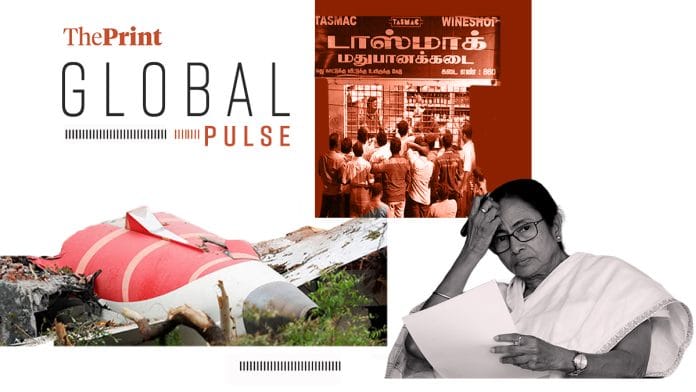


New Delhi: Rebellion is rising in Mamata Banerjee’s Trinamool Congress (TMC), and it has already come to New Delhi. At least 20 of TMC’s Lok Sabha 28 MPs have reportedly written to Speaker Om Birla about breaking away from the party and providing support to the National Democratic Alliance (NDA) bloc.
Soutik Biswas of the BBC reports on the predicament facing Mamata as rebel factions in the party sprout at both state and national level. “Barely a month after being voted out of office, the party is facing a rebellion by most of its legislators, a potential split among its MPs and growing doubts about the authority of its founder, Mamata Banerjee,” the report notes.
It highlights how Mamata is no ordinary regional leader. A “firebrand politician”, she did what many thought was impossible. In 2011, she booted the Communists out of West Bengal after 34 years of uninterrupted rule. Time magazine later named her among the world’s 100 most influential people, says the report.
To that end, the tensions simmering in her party have come as more surprising than the defeat itself. While the party still remains a substantial force in West Bengal and at the Centre, if the rebelling MPs formalise their breakaway to join the BJP, they would inflict significant damage. But for now, the party remains a formidable opposition face with 80 legislators in the state assembly and 28 members of parliament.
“Almost every day, TMC leaders are arrested on corruption charges and paraded, party offices are deserted, organisational networks are being dismantled and figures who once commanded fear and influence are being publicly attacked in their own strongholds,” Biswas writes.
Dwaipayan Bhattacharyya, a political scientist, told the BBC that TMC’s unravelling suggests something deeper—the party never developed an ideological structure that could hold the fort down when it lost power. He argued that the party rested on two pillars: Mamata’s brand value and governmental resources.
However, it would be premature to write TMC’s obituary, the report says. Bhattacharyya argues that any revival would need more than Mamata’s brand of charisma. “It will demand a willingness to renew the party and make difficult decisions about its leadership. So far, that has not been Banerjee’s strongest suit,” he told the BBC.
In other news, 12 June will mark the one-year anniversary of the Air India plane crash that killed 260 people in Ahmedabad last year. Zoya Mateen of the BBC visits the crash site to talk to the people who are living with the memory of the crash.
Of the 260 killed, 241 died on the plane and 19 were killed on the ground, in the hostel, where the plane crashed. Mateen visits families and staff who were inside the BJ Medical College campus that day. “Much of the attention over the past year has focused on the passengers aboard the London-bound flight and the unanswered questions surrounding its final moments,” the report says.
“In Ahmedabad, another question lingers: what happens to a place after a catastrophe becomes part of its daily life?” Mateen asks.
Unlike the plane, people residing in the medical college have to live with the ruins of the accident. For them, it’s a living memory that does not let families who lost their loved ones move on.
“A year on, the hostel struck by the plane still stands like an open wound. Its upper floors stand ripped open to the sky, concrete hangs in jagged slabs and a smoke-blackened staircase disappears into darkness. Soot streaks the walls, while suitcases and clothes remain buried beneath dust, rubble and twisted steel,” Mateen writes.
While officials have approved plans to demolish the damaged structure and build a new hostel. “Students pass the hostel on their way to lectures as aeroplanes rumble overhead every few minutes. For decades, the sound blended into the city’s background noise, as familiar and unremarkable as the traffic on the roads.”
The Economist writes how money troubles are driving Indian states to drink. The column highlights that prohibition is one of the directive principles in the Constitution. But these principles, as the column notes, can be likened to new year resolutions which are forgotten the next day.
“Pricey hotels get exemptions from dry-day rules in the interests of promoting tourism. Gujarat, a dry state since its creation, recently allowed booze to flow freely in GIFT City, a startup special economic zone it aspires to turn into a global financial centre,” the column says.
It adds, no one can replace the “warm fuzzy feeling of those delicious liquor taxes”. Liquor taxes became all the more important for the states due to the Goods and Services Tax (GST) reform in 2017. The single tax bracket left the states without power to levy taxes corresponding to their needs.
“What to do? As with many problems, the answer is found in drink. GST left two main areas for states to tax independently: energy and booze. Raising levies on fuel is politically difficult and feeds into the prices of everything. But just a fifth of Indian men admit to drinking at all and only 1% of women do,” the column argues.
However, the dilemma remains: How to generate more revenue without promoting drinking in a country that valued abstinence. A Karnataka-based report provides a solution: pricing liquor based on alcohol content instead of the brand and marketing. Insiders believe that this would lead to a surge in revenues, the column says.
“The reform is likely to be copied. In India’s federal system, successful policies spread quickly. That will be a relief for the country’s drinkers of beer, wine and premium spirits. More important, it will be a victory for common sense. And all it took to get here was a shot of concentrated financial pressure stirred into eight decades of sparkling hypocrisy. That is a sobering thought,” it adds.
(Edited by Tony Rai)