


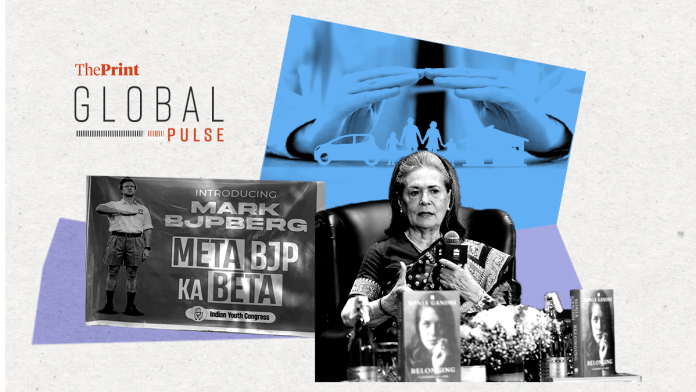
New Delhi: The questions surrounding India’s political future, economic ambitions and freedom of expression continue to draw attention from the international media. In its latest Asia column, The Economist takes a look at the Gandhi family’s political legacy, drawing on Sonia Gandhi’s memoir, ‘Belonging: A Journey of Love’.
Titled ‘The Gandhi dynasty suffers for India — And India suffers the Gandhi dynasty’, the article weighs in on Gandhi family’s claim to have protected India’s secular and democratic values. It opens with a pointed remark: “THANK GOODNESS for the Gandhi family. If it weren’t for them, India might have fallen into the grip of Hindu nationalists bent on destroying the country’s secular foundations and eradicating its diversity.”
The magazine revisits former prime minister Indira Gandhi’s decision to impose the Emergency in 1975, when she feared that her political opponents would “destroy the country” and that the Congress would “split and scatter”. The irony, the article notes, was that her attempt to protect the country involved suspending civil liberties, censoring the press and jailing opposition leaders.
It then turns to Rajiv Gandhi, who entered politics out of “the pull of duty towards his mother [and] his country”. But the magazine points to his government’s record, including the anti-Sikh pogrom following Indira’s assassination, for which it says “his affable manner did not absolve” him of “moral responsibility”.
Sonia Gandhi’s own account of entering politics is also examined. Despite describing the political world as one of “ambition and greed, hypocrisy and treachery”, she repeatedly presents her role in the Congress as a matter of duty. The magazine contrasts this with the corruption allegations that dogged the Manmohan Singh government, noting that “integrity was not a word often used for his government”.
The article ends with the next generation of the family: Rahul Gandhi as Leader of the Opposition and Priyanka Gandhi as a lawmaker, while Narendra Modi is in “his third term as prime minister. Thank goodness, he must think, for the Gandhis.”
In The World in Brief, The Economist highlights the contrast between the success of Sonia Gandhi’s memoir and the declining political fortunes of her party. The book, which chronicles the Nehru-Gandhi family, sold 200,000 copies in its first week, making it “India’s fastest-selling book, according to HarperCollins,”
But, as the magazine puts it, “Much less can be said of the dynasty’s political fortunes.” The Gandhi family, which governed India for decades, since 2014. The piece captures this contrast in its closing line: “Ms Gandhi’s past may be a bestseller but Congress’s political future remains in doubt.”
Also Read: Women in public life to Adani’s business empire— Global Media on India’s growth story
Financial Times writes India’s insurance brokers “are up in arms over a proposed cap on commissions, warning that it could hamper the growth of the country’s $126bn insurance sector,” even as the government looks to expand coverage and attract foreign investment.
The Insurance Regulatory and Development Authority of India (IRDAI) has proposed limiting commissions paid to brokers and agents to 2.5 percent for third-party motor insurance and up to 30 percent for term life policies. Currently, there are no such caps, and commissions can go as high as 81 percent for life insurance and 93 percent for health insurance.
The regulator wants to rein in these payouts to bring down costs for customers. But brokers argue that lower commissions could discourage agents from selling policies, particularly in areas where insurance penetration remains low.
“New business could dip during the transition,” Indian rating agency CareEdge said, warning that smaller insurers could face pressure to consolidate if the caps take effect in April.
The proposal comes as the government pursues its ‘Insurance for All by 2047’ target, under which it wants “every citizen” to have “adequate life, health and property insurance”. However, the regulator has pointed out that premium growth is not translating into a wider insured population. “This divergence indicates that premium growth is being driven more by higher-value sales to existing customers rather than by the expansion of the insured population,” it said.
Policybazaar chief executive Sarbvir Singh said lower commissions could hurt insurers as well as brokers: “If we don’t sell, then insurers will also have some impact.” Axis Max Life CFO Amrit Singh said the proposal had “pluses and minuses” and called for a “holistic” review.
The industry has also cautioned that regulatory uncertainty could deter investors. “If you are not becoming predictable, that will impact investment, and not just FDI,” an industry executive said, adding: “You cannot have this sword of changing regulations dangling.”
A Reuters report published by The Guardian looks at the growing confrontation between the Congress and Meta after Indian Youth Congress (IYC) members clashed with the police outside the company’s Hyderabad office over the removal of party leaders’ Instagram accounts. Two accounts were reinstated, but thousands belonging to journalists, creators and influencers critical of the government remain restricted.
Protests were also reported in Mumbai and in Gurugram as well. The demonstrations come amid a wider debate over online free speech and the “strict efforts of Narendra Modi’s government to remove social media content it objects to”. In February, the government reduced the deadline for platforms to remove unlawful content from 36 hours to three hours. Reporters Without Borders says the “removal of journalistic content from social media has been on the rise in India this year”.
Meta has disclosed that it restricted more than 5.4 million posts or accounts in India under local laws in the first half of 2026, compared with around 70,000 in the whole of 2025. The company said most restrictions were made because it was “obligated to proactively restrict content” under local law requirements.
(Edited by Tony Rai)
Also Read: Global media questions India’s investment appeal, climate record and Olympic aspiration