



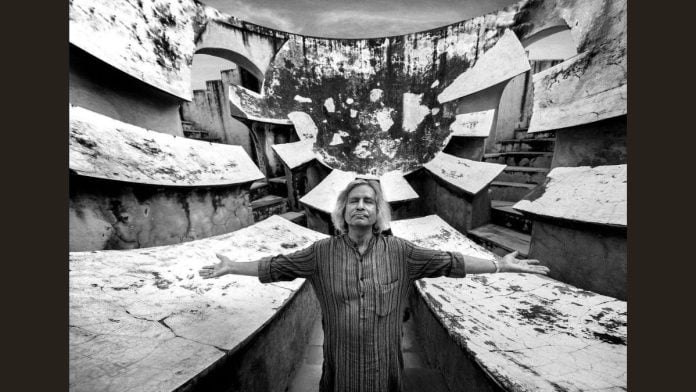
New Delhi: Jogen Chowdhury’s art captured the complexities of human life, from intimate relationships to the inequalities and power struggles that shape society. His figures, often distorted and marked by dense lines, reflected the realities of Bengal and India, speaking to experiences that crossed borders.
Chowdhury, one of India’s most influential modern artists, died in Kolkata on Sunday, aged 87, succumbing to blood cancer.
“He was remarkable as an artist of the human condition whose work reflected the reality of Bengal, but also India, and definitely of the world, all at the same time,” said Kishore Singh, writer and curator.
Born on 16 February 1939 in Daharpara, in Faridpur district of undivided Bengal, now in Bangladesh, Chowdhury grew up in a family where art was part of everyday life. His father, Pramathanath Chowdhury, was interested in art, while his mother, Indudevi, practised alpana, the Bengali tradition of decorative floor designs. After Partition, the family moved to Kolkata, an experience that shaped the world he grew up in and later drew on in his art.
Over a career spanning more than six decades, Chowdhury became known for figurative paintings and drawings that captured the complexity of human relationships and the society around him. His work earned him national recognition, including the Padma Bhushan in 1986.
Chowdhury’s work drew on Bengal’s visual traditions and the wider Indian imagination, including mythological and cultural references. The ability to move between the local and the universal made him a major voice in modern Indian art. His paintings and drawings were exhibited in India and internationally, including at the Havana Biennale and the Royal Academy in London.
“Jogen Chowdhury was an Indian original. His sinuous lines, sensuous forms and tactile textures gave the human figure a rare vulnerability and mystery, deeply rooted in the Indian imagination,” said Rohit Chawla, artist and photographer. “At his Emami Art retrospective in Kolkata, he shared the stories behind his celebrated works. His lines may have wandered, but they always knew where they were going. I shall miss the man behind the magic.”
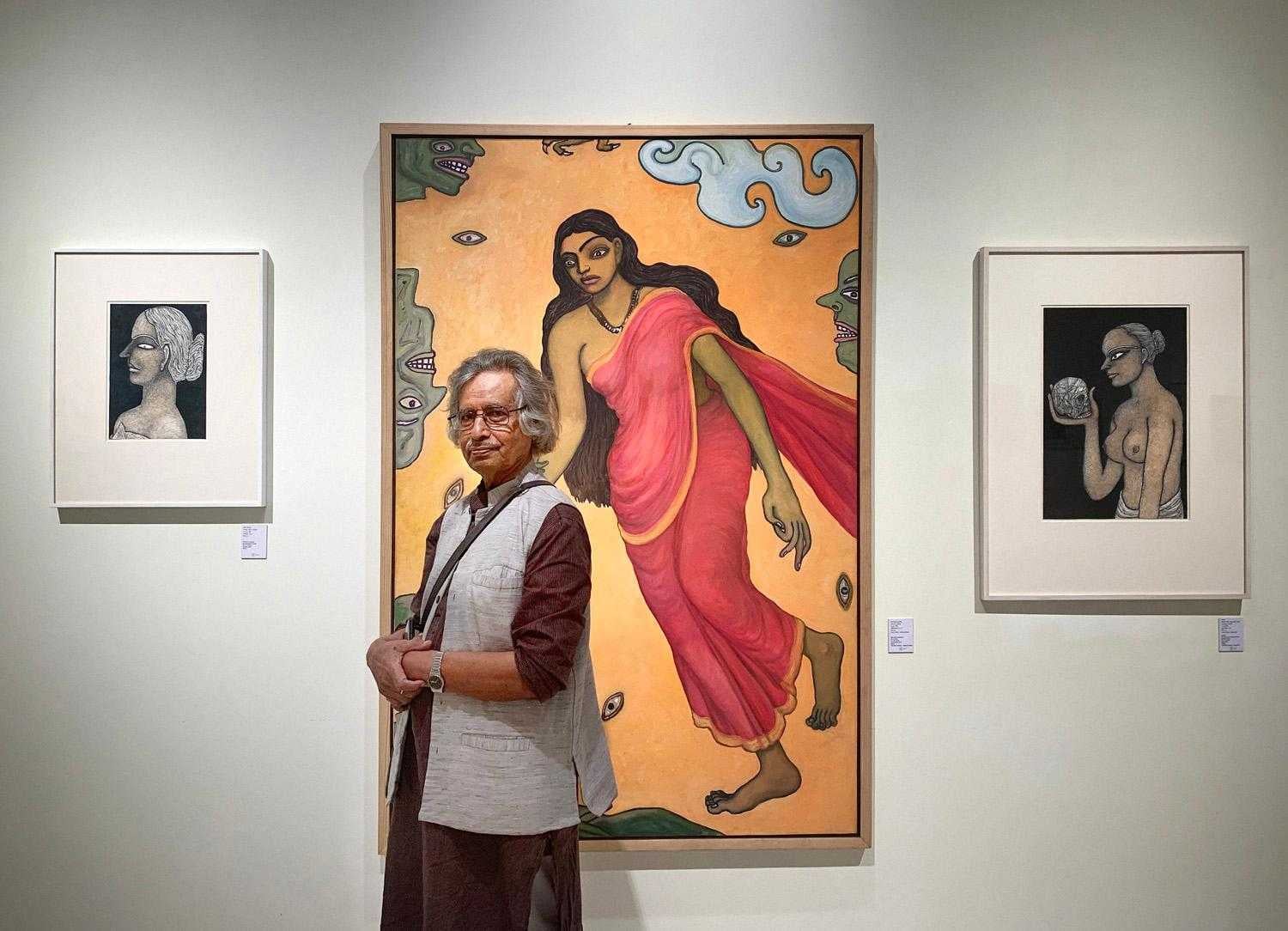
Artist who redefined Black
One of Chowdhury’s most striking works, Story of Woman (2013), explored the many dimensions of a woman’s relationship, from love and friendship to submission and aggression. It is a five-panel, 25-foot-long painting that examines how intimacy could give way to unequal power and sexual violence.
“I realise an important duty in the life of an artist is to spread social messages through aesthetics,” Chowdhury said of the work.
He studied at the Government College of Art and Craft in Calcutta, graduating in 1960. After working as an art teacher and textile designer, he received a French government scholarship to study at the École Nationale Supérieure des Beaux-Arts in Paris in 1965. The experience exposed him to different artistic traditions, but his own style remained connected to his cultural inheritance and observations of everyday life.
His art was distinguished by its treatment of the human figure. Rather than depicting bodies as idealised forms, Chowdhury exaggerated their proportions, crowded their surfaces with lines and used cross-hatching to give their bodies texture and depth. The figures could appear corpulent, awkward or vulnerable, their expressions caught somewhere between discomfort and contemplation.
For Kishore Singh, the use of black was what set Chowdhury apart.
“Jogen Chowdhury defined black in a way no other Indian artist painted using black. His strong outline in his figurative paintings was part of his inherited Bengal legacy, but more erudite, more universal, emphasising the transactional relationship between the protagonists he painted,” he said.
The relationship between figures was often also a relationship of power. Chowdhury’s subjects were not isolated bodies existing outside society. Their postures, expressions and physical presence suggested the tension between individuals and the inequalities of everyday life.
“His art represented the socio-political environment with corpulent figures that bore the stigma of violence and, often, the wiles and nature of authority borne by the exploiter and the exploited,” Singh said.
Chowdhury’s achievements lay in making these concerns visible without reducing his subjects to political symbols. His figures retained their individuality and ambiguity. They could be uncomfortable, sensual, absurd and unsettling, and sometimes all at once.
Also read: Feroze Gandhi called Indira a ‘fascist’—and called out Congress for ‘bullying’ people
Speaking truth to power
Chowdhury’s work also confronted political repression.
In Tiger in the Moonlight (1975-77), he depicted a prostrate woman being attacked by a tiger under a moonlit sky, using an unsettling scene to convey political violence and the abuse of power.
The painting was a response to the Emergency imposed by Prime Minister Indira Gandhi from 1975 to 1977. The work is now part of the collection of the National Gallery of Modern Art in New Delhi.
“I was a curator at the Rashtrapati Bhavan when the Emergency was declared, so I found myself in the middle of what was happening. Tiger in Moonlit Night showed a dead lady being attacked by a tiger in a moonlit sky. It depicted the fake emergency and was an interplay between the real and the unreal,” he said in an interview.
Chowdhury’s contribution extended into teaching, public institutions and the preservation of art. From 1972 to 1987, he served as curator of the art gallery at Rashtrapati Bhavan. He later taught painting at Kala Bhavana, Visva-Bharati University, in Santiniketan.
In 2014, he entered Parliament as a Trinamool Congress member of the Rajya Sabha, serving until 2020.
“I feel fortunate to have met him on several occasions, visited his studios and, once, even briefly abducted him to Jantar Mantar. His graphic, almost otherworldly geometry has fascinated me since my schoolboy days in 1982. Jogen gingerly navigated its extraordinary terrain, only to brandish his Rajya Sabha credentials when overzealous guards challenged our photographic adventure. Art, it seemed, had its parliamentary privileges,” said Rohit Chawla.
He also worked to preserve and make his art accessible to future generations. In 2019, he established Charubasona, a museum intended to house and display works from his lifetime of artistic practice.
(Edited by Ratan Priya)